We shall not be Zombies

With our multi-religious, multicultural, multilingual and diverse dietary preferences, it would not take much to start a sectarian firestorm if restrain is no longer applied. I feel that the phrase “tolerant of each other” is wrong. To survive as a nation, Malaysians collectively should be accepting each other as we are and get on with our lives.

[show_post_categories show=”category” hyperlink=”yes”]

[show_post_categories show=”tag” hyperlink=”yes”]

Commentary (Jan 28, 2017):
This article was written by me around August 2015 and published in Han Chiang News in September 2015 just before “Malaysia Day”. I feel that Malaysians who, unlike yours truly (and my contemporaries who studied in Northern Ireland during the period of 70s to 90s) who have seen at first hand how bigotry have brought man-made calamities to a nation, will not be sensitive to the perils of such political tragedy as in the “Troubles” of Northern Ireland. Malaysia of today is a lot more divided than the Malaysia of the 1970s that I had grown up in. Despite the fact that we are more educated, with almost everyone being literate, and better connected & better informed by modern communication tools, today we are more divided as a people of our most endowed homeland as ever. “Are we all going to be Zombies? ” That is a poser for my readers.


During my stint as the Principal / Vice-Chancellor designate of Han Chiang College / University College (2015 -2017) I mooted the idea of giving my students a chance to both organise and experience what I had when I was an undergraduate at Queen’s University of Belfast: a live concert with live bands and real singers. I must admit, I was pleasantly surprised by the kind of talents that we had among our students and even staff. I left the concert shortly after the DJ entered with his gig so that my students (and perhaps some of the staff on chaperon duties) could let their hair down and boogie the night away without the invisible “intimidation” by my presence.

A very meaningful song – Zombies

One song that was played that night really rekindled my memory of my second homeland, Belfast, Northern Ireland where I spent eight and a half years, most of which was during the so called “Troubles”. The Cranberries’  “Zombies” was a protest song about the “Troubles” of Northern Ireland which was released in 1994 but very well received in Malaysia up to early 1996. My then baby son somehow was fond of this song. The saying was, shortly after the release of this song, the Irish Republican Army (IRA) that had waged a war of terror in Northern Ireland to oust the British since 1968 (and then moved their activities “across the water” to England in the mid 1980s) declared that they would abandon their insurgency and would be switching their fight to the ballot box. It was not till 1998 that peace finally was declared in Northern Ireland. I had a chance to visit Belfast in 1999 and was amazed by the change (for the better) that I would not have imagined when I left my second homeland in 1991.

My first encounter of the “Troubles”

I arrived in Belfast in early October 1982, shortly after the end of the republican’s hunger strike crisis where ten convicted and jailed members of the republican movements went on hunger strike resulting in their death. Tension was high. People were suspicious of each other and some (including a good number of my classmates) were not exactly friendly to foreigners like me. Then on the first night that I moved into a shared house with 3 other Malaysian students, I heard something like a motorbike backfired at around 11 pm. It was, we found out the next day in fact a sectarian killing where a young man was shot dead for being from the “wrong” community just a street away from our house. I experienced at first hand the “Troubles”. Unfortunately I was to experience a great many more of these kind of incidences during my stay in Belfast. As a postgraduate student, naturally my peers and Malaysian buddies were mainly medical doctors. Their tales of injuries and bodily harm due to sectarian violence that they had to treat were even more gruesome to depict here.

A Catholic Buddhist or a Protestant Buddhist?

After a few weeks attending classes as a freshie (first year undergraduate), I managed to break the ice with most of my 27 other classmates. One of my classmates (who shall remain “nameless”) then casually asked me, “Chow, wat arre ye?” (Chow, what are you?)

By then I was beginning to understand the many different accents of the people of Northern Ireland and starting to adopt some of their accents and way of pronouncing English words so that I could be understood. My reply was, “Marn (man), what do ye (you) mean?”

My friend then said, “What’s your religion marn?” “I’m a sort of Buddhist,” I answered (I knew it would be pointless to explain that Chinese Malaysians have this other religion called Taoism that is mixed with Buddhism).

The next question from my friend was devastating. “Are ye a Catholic Buddhist or a Protestant Buddhist?

The sectarian divide in Northern Ireland was so intense that even university students would just classify themselves, inclusive the foreign students like me into either a Catholic or a Protestant.

zombies1-770x470
The “Troubles” in Northern Ireland had caused at least 3,600 deaths with 50,000 people maimed. After experiencing what incited hatred could do to communities in Northern Ireland, I cannot bare to imagine what could happen in my homeland if the bigots are allowed to roam freely!

My first taste of a car bomb

Jobs for graduates in Northern Ireland during the period of the “Troubles” were difficult to come by. Unemployment rate for the population was the highest in the UK. All because of the lack of confidence in the political situation there which deterred business investments. During the early eighties, car bombs were regularly planted at strategic commercial areas around Belfast. On the eve of my Master’s degree graduation in December 1987, I encountered my first car bomb: I was in a car with a friend (who was graduating at the same time with his Ph.D) and we were suddenly diverted by the Police to a side road. The bomb went off on the next street as we were turning! Fortunately for us, the great old Morris Minor that my friend, Dr. Sean D’Arcy had was very solid indeed & the bomb was not too near or powerful to cause us any injury.

Police stations and the security personnel were “legitimate” targets. To compound the matters there were the terror groups on the opposite side of the republicans (the so-called loyalists) waging a similar campaign of terror onto the republican communities. The “Troubles” had caused at least 3,600 deaths with 50,000 people maimed. Such was the scale of this political tragedy.

It’s in your head!

Today, 17 years after the ceasefire, the memory of the “Troubles” still haunt many who have lived through the period, including this writer. Perhaps some of the lyrics of “Zombies” sum up the collective feeling of the people of Northern Ireland well:

And the violence caused such silence

Who are we mistaken

But you see it’s not me

It’s not my family

In your head in your head

They are fighting

With their tanks and their bombs

And their bombs and their guns

In your head in your head they are crying

In your head

In your head

Zombie zombie zombie ei ei……………..

We are not zombies, we SHALL NOT be zombies!

One thing that puzzles me even today is, how come two communities in Northern Ireland which had lived for centuries together, speaking the same base language (English) with similar culture and food could be driven to exert such mistrusts that resulted in many horrible acts of violence against each other. But when these two communities could find a common ground, they could bring peace, prosperity to their common homeland in a short span of just a few years.

We shall not be zombies!

Meanwhile 10, 814 kilometers away in Malaysia, we are being manipulated by those who bank on creating the worst sectarian divide among our people with the power that be often sitting on the fence or turning a blind eye to these acts. After experiencing what incited hatred could do to communities in Northern Ireland, I cannot bare to imagine what could happen in my homeland.

With our multi-religious, multicultural, multilingual and diverse dietary preferences, it would not take much to start a sectarian firestorm if restrain is no longer applied. I feel that the often-overused phrase “tolerant of each other” is wrong. To survive as a nation, Malaysians collectively should be accepting each other as we are and get on with our lives.

If we let the minority with ulterior motives to impose bigotry on our society unhindered then we deserve to be heading towards the Malaysian version of the “Troubles”, which I shudder to think could be overcome in 30 years as it did in Northern Ireland!

Perhaps the keyword to deal with this threat is “Restrain”. We should restrain ourselves from being lured by these minority. We are not Zombies and we shall not be Zombies.

Rank universities by PTPTN default rate of their graduates

PTPTN should only give out loans to people who have the best chances of repaying and minimise its exposure to those with a high chance of default. Ranking of colleges by the rate of loan defaults by their graduates will allow PTPTN to be more equitable in distributing student loans.

Commentary:
I wrote this as one of my contributions to my former college’s blog. At that time, (September 01, 2016 to be precise) Hilary Clinton was set to pick up the US presidency. Now we know to take pollsters’ “conclusions” with a large table spoon of soy source! In view of the results of the poll in the US presidential election I had edited the last sentence of the last paragraph!

My argument is simple. If an institution keeps churning out graduates who are likely to default on their student loans, then the risk factor to the loan awarding body for this institution should be higher. Thus a ranking of colleges and universities with the highest rate of default among their graduates will force all colleges and universities to educate their students accordingly. PTPTN can also distribute its funding more fairly whereby colleges with good graduate repayment records (i.e. lower risk) will be given more allocation or even higher quantum of loans for its students. At present, the private sector students only get the maximum of 85% of the top loan for their respective fields of studies. This translate to no more than RM13,000 for most students following a diploma programme. With an average price tag of RM30,000 for a full diploma (for colleges not among the top players), the maximum PTPTN loan will cover no more than 43% of the tuition fees on average, putting students in private colleges and universities at a great disadvantage. By redistribution of money to the lower risk borrowers, PTPTN could “reward” the students of colleges with low rate of default by raising the ceiling of the maximum loan quantum for all fields of studies. The billion Ringgit question is, will there be the political will to do so?


An article in Education Drive entitled “Clinton hire signals more trouble for for-profits” caught my eye. In this analytical briefing, the author related that the hiring by Hillary Clinton of Rohit Chopra as a part of her presidential transition team would spell more troubles for the for-profit universities and colleges in the USA. The author opined that due to Chopra’s track record of exposing financial irregularities in two significant cases against for-profits (citing Corinthian Colleges & ITT Tech), any institution in the US  with high student loan default rates will be hit if Clinton clinches the presidency in November 2016.  Interestingly, Hillary Clinton’s husband, former President Bill Clinton served as the honorary chancellor of the for-profit Laureate Group’s Laureate International University, better known in Malaysia as the owner of Inti International University and Colleges from 2010 through to 2014. [At the time of writing, Hillary Clinton was set to win the presidency, but we all now know the outcome! But I think the Trump administration, putting the problems of Trump University aside, may also need to take some cues from this & go after the institutions with dubious student loan records.]

The bulk of the defaulters of student loans in the US are indeed coming from the for-profit universities and colleges. The aggressive and misleading recruitment methodology is the main cause coupled with the lower than average employability of graduates of some of these institutions in the US together created the student loan default crisis.

It was reported that till December 2015, Perbadanan Tabung Pendidikan Tinggi Negara (PTPTN) collected only RM7.9 billion from its borrowers which was much lower than the RM15 billion that it had targeted to remain financially healthy. Although PTPTN does not provide the demographic details of its 1.25 million loan defaulters, generally it is an accepted fact that the bulk of these people were students and graduates of public institutions of higher learning (IPTA) as opposed to private institutions of higher learning (IPTS). Although there has been good coverage of the consequences that blacklisted PTPTN loan defaulters  would face in the online press and personal finance sites such as  iMoney,  and even a popular motoring website, the message seems not to have percolated through.

Perhaps the power that be should seriously be considering arresting this problem “upstream”.  That is to make it harder for students from universities and colleges with high default rates to get loan or limit the number or quantum of loans for these institutions. A “league table” of the institutions with the highest PTPTN default rate (and number) should be published to make this policy more transparent. If this is implemented more funds will be channelled by PTPTN to institutions with better loan repayment records among its graduates and former students. This will have the direct effect of forcing all institutions to ensure that they produce employable graduates (who are also not underemployed).

The most heard of excuse from loan defaulters is the fact that they are unemployed or underemployed hence if PTPTN disburses its loan in accordance to the track record of the institutions (in terms of loan default rate), it will reduce the default rate and number accordingly. It is a no brainer really, you should only give out loans to people who have the best chances of repaying and minimise your risk by reducing the exposure to those with a high chance of default.

The billion ringgit question is, will the power that be and PTPTN collectively have the political will to publish this “league table”.

How to enjoy your Chinese New Year reunion dinner

Reunion dinner (or lunch in our case) is a time for family members (and clan) to gather, eat, celebrate and be merry together. What we end up eating should be put in a lesser significance than the togetherness of family members that the reunion meal brings.

Commentary: I wrote this article near the Chinese New Year of 2016 (published on Han Chiang News). It was the first year that we got to celebrate CNY after the mourning period for my late father was over. As the de facto “head” of the Chow clan, I had (after consulting with the “deputy head”, my younger brother) declared that we would not be eating reunion dinner in a restaurant. Instead, we would do a “combo- reunion-lunch” where simple dishes (those that were easily cooked) would be prepared, mainly for the ancestral prayers etc. while the main “dishes” would be the mandatory “yue sang” (tossing of salad with raw fish or “low sang”) which could be bought easily, friend chicken, roast pork, pizza or burgers etc. that we would buy. We would have plenty of time to eat and the “head” & “deputy head” would have lots of time to savour our amber nectar and red wine etc. etc. It worked out well in 2016 and we repeated this for CNY 2017!

Unfortunately for CNY 2018, due to the passing of my late father-in-law, we are not celebrating.

This writer would like to wish all readers of my blog a Happy Year of the Earth Dog for 2018.


Growing up in the 1960s and 70s in Ipoh I had the benefit of witnessing the evolving Chinese Malaysian custom of Reunion Dinner for several decades. Up till the passing of my paternal grandfather in 1976, reunion dinner for the Chow clan was an elaborate affair. As my maternal grandparents passed on very early (way before I was born), my paternal grandfather had been opening his home to my mother’s siblings for Chinese New Year and other main festivals for years. Reunion dinner during my childhood was a time when my late mother would be totally stressed out (she worked full time and had to be responsible for the reunion dinner as well!). Luckily for my mother, some of my aunts (from both sides of my family) would roll up their sleeves to offer their assistance. My mother and her “gang” of ladies had to cook for over 30 people and we even had a separate “children’s table” to accommodate everyone during the reunion dinner.

Aside from the main dishes which were used as offerings for prayer to the various Gods and of course the ancestors, there were many other dishes with particular auspicious sounding names in different Chinese dialects (my mother tongue is Cantonese, so the names cited henceforth are in that dialect) as ingredients such as oysters (fresh or preserved) – “Hou Si” (auspicious events); black fungus – “Fatt Choy” (making a fortune); sea cucumbers – “Hoi Sum” (happy) ; pig’s fore trotters – “Wang Choy Zhau Shao” (special fortune is on hand); etc.

As my mother grew more frail in the late 90s, my aunts took on more responsibilities for cooking the reunion dinner but the same “style” was preserved as my mother was still the buyer of food ingredients and the “kitchen director”. After my mother’s passing in 1998, we were faced with a big issue: both my brother’s wife and mine were not exactly great cooks and it was then that I decided in 2001 to eat out for reunion dinner where I would sponsor the dinner for the Chow clan.

Eating out for reunion dinner sounds a great solution for many to get around the “who to cook” (and who does the dishes) issue. But it does come with its own set of problems.

  • It costs a big bundle of money to have your reunion dinner at a restaurant. The cost can be easily 100% higher than if you and your family have a home-cooked reunion dinner.
  • You must book your table early. Popular restaurants tend to get booked up very fast and if you are slow in making your booking, you tend to get the “very early” (before 6pm) or “very late” (after 9pm) slots.
  • You do not get to order a la carte if you fancy a particular dish. It would be a choice from the “set-menu” with different combinations of dishes at differing prices.
  • It would be like eating in a “battle field” when it comes to having your actual reunion dinner.  You cannot hope to hold a decent conversation as the place will be packed and becomes very noisy.
  • You will need to eat your reunion dinner very fast, I mean really fast. Though it is often quoted that the restaurant will allocate 90 minutes for you to complete your meal, often you have got to wait for at least 45 minutes to an hour to get your food served, leaving you with precious little time to enjoy your food.
  • Be prepared for all (or at least 60%) of your dishes (usually 8 dishes) to come at once or at most at 2-3 minutes apart. Remember, after waiting for 45 minutes already, you have less than 45 minutes to eat! Be prepared for the next “shift” of eaters hovering near your seats while you are attempting to enjoy your meal.
  • Expect non-existence service from the restaurant staff (for your drinks and other needs) as the place will often be overbooked and understaffed. So you are best advised to self-serve your drinks etc.
  • It will be akin to eating in a packed commuter train such as the KTM Komuter at KL Sentral at 6pm on a weekday. Due to overbooking, restaurants tend to put in as many tables that they can get away with. If you have booked for a large table for 12, be prepared to be given one for 10 as chaos would be the order of the day. We once booked a large table for 15 persons but were given a table fit for 10 persons only. Recalling this, with a few “plus-plus sized” members, how we squeezed ourselves together on that occasion still remains a mystery to me.

A great deal of what I had described above would hold true and is “replayed” every Chinese New Year. There is only one word to describe the unethical business practices of some of these restaurateurs: Greed. However, it is a “seller’s market”. If you do not like the service and the conditions described above, there are many others who would gladly fork out the money to take over your place!  This is especially true for a city like Ipoh where thousands of Kuala Lumpur-based, Singapore-based or even overseas “Ipoh Mali” people (myself included) who would congregate at their home town for Chinese New Year. Thus with so much of yearly businesses coming to these restaurants, the merchants, especially those who are greedy, have no fear of mistreating, misleading and come to think of it, cheating these customers, many of whom would only be visiting their hometown on an annual basis.

So for Chinese New Year 2016 [and beyond], the Chow clan has decided that we would do something different. We will be having our reunion meal at our ancestral home in Ipoh where my younger brother and family are staying. We will have the necessary tossing of salad – “Loh Sang” (strive for prosperity) and the usual press duck, Chinese sausages, roast pork (for prayer to the Gods and to our ancestors). Instead of cooking the other dishes, we would have choices such as pizzas, fried chicken, McDonald’s burgers etc. for all the Chow clan. To facilitate our respective in-laws, we would be having a reunion “lunch” so that we could join our respective in-laws for dinner.

Reunion dinner (or lunch in our case) is a time for family members (and clan) to gather, eat, celebrate and be merry together. What we end up eating should be put in a lesser significance than the togetherness of family members that the reunion meal brings. It should be a time for family members (especially for those like my brother’s family and mine who live in different parts of the country) to meet, share a meal and to remember our departed clan members. It is also a time for us to enjoy each other’s company in a relaxing way (whether we need alcohol for this is immaterial, but for the Chow clan, it is mandatory!). All these could never be achieved if we spend the reunion dinner packed like sardines in an expensive restaurant which limits the amount of time we have to eat, to meet and to enjoy ourselves. It is about time Chinese Malaysians re-evaluate the meaning of reunion dinner and stop patronizing those greedy restaurants which force us to eat eight dishes in 10 minutes!

Vocational education: The stepchild of Malaysian education system?

If we are serious about uplifting the overall skill-sets of Malaysians, we cannot afford to go on treating the vocational education sector as the stepchild.

I contributed this article as the editor-in-chief of Han Chiang News, an online news portal set up to give budding journo a platform to practice what they have learned. This article was published on April 15, 2015, but my argument is still the same, TVET (technical, vocational education & training) is still a stepchild! More so in the eyes of the parents who are not well informed of its value and the complicated ways in which TVET is managed by too many government bodies and agencies making it difficult to integrate into the “traditional” academic route for tertiary studies for Malaysian youths. I had gained “Vocational Training Officer” credential in 2016 precisely because I see great future in the TVET sector especially in bridging links between TVET & academia.


The choke of my ceiling fluorescent light gave a “pop” sound and the lighting system failed. Not being that competent in handling electrical work, my wife and I decided that we would need the help of an electrician. If your air-conditioner starts to leak water, you would call the air-conditioning technician. If your car refuses to start, or if your car has a flat tyre would you know what to do?

There are countless aspects of our lives where we would require the skills and mastery of a vocational-trained person to deal with. Yet when it comes to vocational education, there seems to be a stigma in channelling our offspring into the vocational stream. Time and again it has been proven that vocational-trained young persons are more likely to get jobs than their counterparts graduating from colleges and universities with academic qualifications.

According to a recent Jobstreet survey (cited in the National Graduate Employment Blueprint), having “mismatch of skills” was the 4th most cited reason given by employers for not hiring a fresh graduate. Why vocational education and certification (aside from the IT & computer science fields and specialized academic diploma programmes in automotive sector) have not been widely incorporated into the curriculum of universities and colleges is the billion ringgit question! This could potentially solve the high proportion of unemployed graduates each year (over 53,000 out of 180,000 annual cohort of fresh tertiary graduates are unable to get employment). Perhaps  the lack of cross-understanding of the operational aspects of both the academic and vocational education pathways by the respective accreditation agencies is one of the key reasons for the Malaysian education system’s inability to cater to the needs of those coming from the vocational education sector and to embed vocational education into academic studies to enhance university graduates’ employability.

Thus the idea mooted by the Performance Management and Delivery Unit (PEMANDU) of the Prime Minister Department to amalgamate accreditation agencies such as the Malaysian Qualifications Agency and Skills Development Department (Jabatan Perkembangan Kemahiran – JPK) of the Ministry of Human Resources is brilliant. This may drive the creation of seamless learning and qualification pathways for those in the vocational sector to earn diplomas and degrees.

In addition, currently vocational education is provided by no less than 7 Federal ministries/agencies which makes effective coordination amongst these players highly challenging leading to duplication and wastage of resources. Amalgamating the operations of all the public sector training institutions currently under separate agencies into one body while leaving the respective functions such as funding and recruitment of learners to the individual agencies to fulfil their different obligations and objectives is therefore a no brainer.

Currently, some of the negative perceptions among parents and school leavers about vocational education are valid. Except for one case, all the trainees I have encountered so far had chosen the vocational studies route because of their lack of the required Sijil Pelajaran Malaysia grades to be on the academic track.

Thus although the Malaysian Qualifications Framework (MQF) provides for those coming from the vocational education route to cross-over to the academic pathway to earn degrees, in reality few if any of those holding Sijil Kemahiran Malaysia (SKM) vocational education qualifications ever made it to earn their diplomas or degrees from universities or colleges.

Personally I have come across a few SKM holders who technically were able to articulate into engineering diploma programmes in a college. However, their gap of knowledge in mathematics and physics (to a lesser extent, chemistry) was a huge hurdle for them. Thus to make a good pathway for SKM qualification holders into academic route, there must be a good bridging course to make up for the gap of knowledge. Presently, only the publicly funded polytechnics have the capacity and expertise to take SKM holders on to the academic route and places at these institutions are very limited.

[Commentary in 2017: In recent years, the Malaysian Qualifications Agency – MQA did put out a relaxation of admission criteria for SKM level 3 holders and allowing training institutions to provide bridging courses in English, mathematics and the sciences at SPM level to augment the knowledge gap which is commendable. However I feel that MQA should remove the need for SKM level 3 holders to have at least a “pass” grade in SPM and at least scoring a “Credit” grade in one SPM subject i.e. passing Bahasa Malaysia, and History. Instead, I would suggest that the MQA revise this by adding, ” candidates without a pass grade in SPM should show evident of their having taken and passed bridging courses in Bahasa Malaysia, history and one other subject relevant to their desired course of study at diploma level. This will allow for instance, students wishing to pursue at diploma level, mass communication but without a pass grade in SPM to have a chance to pursue the academic route if they take the relevant bridging courses while working on their SKM qualifications. We must not put up barrier but should adopt the “easy to get in but strict on passing out” principle to tackle this issue. Using traditional “academic” requirements will always leave those who have the aptitude to progress to academic route but without a pass grade in SPM stranded.]

In budget 2015, the Ministry of Education was allocated RM56.0 billion, but only RM1.2 billion (or 2.14%) of this was earmarked for vocational education. The higher education sector with about 1.2 million enrolees was allocated close to RM5.0 billion as National Higher Education Fund Corporation (Perbadanan Tabung Pendidikan Nasional – PTPTN) loans.  Yet with over 230,000 enrollees, the vocational sector only received RM200 million as study loans via the Skills Development Fund Corporation (Perbadanan Tabung Perkembangan Kemahiran – PTPK). PTPK’s budget has to cater to not only the study loan needs of school leavers but also those who are already working in industries thus making this resource grossly inadequate to deal with the demand of all who are interested to take on vocational training.

With about 5 times less in funding (RM870 per enrolee in vocational sector compared to RM4,167 for enrolees in the higher education sector), it is not surprising that the vocational education sector are not able to cope with the demand of industries. I think if we are serious about uplifting the overall skill-sets of Malaysians, we cannot afford to go on treating the vocational education sector as the stepchild. The power that be, needs to put its money where its mouth is!

Registry of Ph.Ds – how it could be best administered

The establishment of the Registry of Ph.D Holders will have one very clear “side-effect”. It will go a long way in separating the wheat from the chaff but since not all accredited overseas institutions award Ph.Ds, the list of institutions in the Registry may not fully represent all accredited overseas institutions but it does provide at least the first list of institutions where their Ph.D awards are recognised in Malaysia.

Commentary: (April 11, 2017):
On Apirl 03, 2017,  Deputy Minister of Higher Education, Datuk Dr. Mary Yap Kain Ching reported that her ministry will roll out a registry of Ph.Ds soon. But this will be confined to Ph.D holders from local institutions. This is a step in the right direction indeed. However one major problem area, those using fake Ph.Ds from foreign institutions or from degree mills are not covered. Based on my own gut feeling, the bulk of the pretenders are in the latter crowd. So this Ph.D registry may only catch the tip of the ice-berg.

I would like, if one of my readers forward my suggestions below to the power that be to tackle the issue still hiding below the ice-berg!

One comment in the above news report that caught my eyes was what Datuk Dr. Mary Yap said, “We all know those who said they finished their PhD within 10 months are fake PhD holders,”

In fact, the good Datuk took 5 years to complete her Ph.D and my learned beautiful and multi-talented friend (from our Doctorate Support Group in Facebook), Dr. Soo Wincci (#drsoowincci) took 6 years to complete hers proved that there is no short cut!


There has been a lot of news for the past few weeks on the need to set up a registry of Ph.D holders in Malaysia. These calls have been brought about by the increasingly serious issue of bogus Ph.Ds and people claiming to have honorary doctorates etc. which was proven to be bogus. I have also made references to this matter in an earlier post and there is a commentary on this issue recently.

In October 2016, the National Council of Professors (NCP) in Malaysia called for the setting up of this registry and hinted that they be given this task by the power that be. However, since not all Ph.D holders are members of this council, and by that, not many Ph.D holders actually are professors (and not all professors in Malaysian universities hold Ph.D or professional doctorates), this body may not be the best representation of the nation’s academic-intellectual power. The NCP further suggested that some charges be levied for the administration of this registry which implies that there may be some monetary gain by the said organisation should they be granted this task.

It was reported that the Ministry of Higher Education (MoHE) would be working on setting up a Registry of Ph.Ds for Malaysia where all Ph.D holders from local universities (both public and private) would automatically be added to this Registry. It was mentioned that Malaysian Ph. D holders with their doctoral degrees awarded overseas will have to seek verification of their doctorate degrees. So far I have not been able to find the mechanism for such a verification process. Needless to say, this verification process will have to be effective, efficient, fair and transparent. There is also (as mentioned earlier) the need to sort out a cost effective way of administering this Registry.

I think perhaps the following suggestions might be considered by the power that be before deciding on how this Registry is to be administered.

  1. Ownership:
    The MoHE should be the custodian of this Registry which should be “owned” by the Malaysian Government. This will ensure that no parties can gain any financial advantage for owning the data the Registry so contained or make monetary gains for the administration of the Registry. The MoHE’s Registrar General and his/her staff is the right team to handle this since they have ample experience handling the registration of around 500 active private colleges and universities where many of the Ph.D holders are already in the MoHE’s databases. This will make cross checking of data and verifications work more effectively accomplished.
  2. Criteria of admission:
    There must be a clear, but simple to use set of criteria for admission to the Registry. The admission of a Ph. D holder should be done once all the criteria have been met. There should not be any hint of any “approval” step or steps in the process. Anyone with a bone fide Ph.D (that is verifiable) shall be admitted to the Registry. No one should be denied a place in the Registry because of his/her colour, creed, ethnicity, religion or political affiliation. Getting on the Registry should be considered the same as getting on to the electoral roll –  it is a right and not a privilege. Thus the cost of registration should be made as low as possible where I would suggest that the MoHE be granted a yearly budget by the Treasury for the administration of the Registry. We need to stress the fact that not all Ph.Ds are earning big bucks. There are the freshly minted ones who may not have a job or the senior ones who have already retired. Thus the cost to register in this Registry shall not be made a deterrent to those who may not be so financially endowed. RM10 – RM50 should be the the range for the registration fees for  the administration of this Registry.
  3. Transparency & Peers Review:
    The entire process of registration should be fully transparent to give the Ph.D holders and the other stakeholders confidence in the entire system. Perhaps the transparency can be extended to the data held such that each registrant will be having a “page” where her/his expertise, papers published etc. (but not personal details) will be listed. This will serve one further purpose: anyone who have slipped through the filtering process may be “caught” at this stage as the page will be open to anyone on the internet. Peers review is a very powerful tool for the Registry administrator to use. The power that be should take a leave from the career/job/hiring social medium platform, Linkedin where few of the members have (or dared) to put in false credentials as these could be easily “discovered”. Perhaps for more senior Ph.D holders, the need to verify their credentials may not be that stringent as many would have Linkedin profiles where their respective “contacts” would have studied and scrutinized their credentials before accepting them as “contacts”.My Linkedin profile is more credible not because of my own data but the “contacts” that I have who are more established scientists, entrepreneurs etc. than yours truly had verified my credentials and are willing “to be seen” as a part of my network. This philosophy is actually the key success factor of Linkedin. “I am credible because my many contacts have verified my credentials directly by linking with me”. It is not the same as Facebook! Thus the Registry may have features that mirror that of Linkedin to allow senior, established Ph.D holders to help in the verification process in the “Linkedin” way. In fact, I would risk saying that the MoHE should discuss with Linkedin to find a way to maximize the “social verification” features of this platform and the MoHE may be well advised to considering “putting” the Registry on this platform.
  4. Leverage on Foreign Universities:
    All bone fide institutions of higher learning worldwide will want their academic awards be recognized. This should therefore be the key to getting foreign institutions to contribute to the work needed to administer the Registry. However there are key questions that the power that be needs to have answer to, namely:
  • Is there a way to make sure that overseas universities submit themselves to be included in the Registry?
  • Can we make it simple and accept all universities that are accredited in their home countries?
  • Can we make use of the diplomatic missions in Malaysia to be responsible for keeping this list updated for their respective countries?
  • What about those countries without representation in Malaysia? Can we use some international association like The Association of Commonwealth Universities … even the listing for Malaysia is not complete with only 21 institutions (with many Malaysian public universities not listed the organization)…

MoHE can also leverage on the foreign universities to shoulder a big part of the burden in verifying their own graduates’ credentials. It is after all, to the very institution’s advantage to make sure that their graduates are fully recognized. Thus the MoHE could in fact make a “standard” arrangement with the education authorities of each of these nations so that the list of new Ph.D holders (with verifiable details provided) each year (and that of previous years) could be supplied to the MoHE by each interested institution. My son’s alma mater, the University of Nebraska-Lincoln, USA even has a website that provides verified details of its graduates principally for the benefits of prospective employers. Thus giving them confidence of the data held at the website and a way to cross check the resume of UNL’s graduates readily. Perhaps MoHE can tap into this sort of databases to make the verification process a lot faster and effective.

The establishment of the Registry of Ph.D Holders will have one very clear “side-effect”. It will go a long way in separating the wheat from the chaff but since not all accredited overseas institutions award Ph.Ds, the list of institutions in the Registry may not fully represent all accredited overseas institutions but it does provide at least the first list of institutions where their Ph.D awards are recognized in Malaysia. What the Registry also need is a “compliant” segment where if anyone’s credential is challenged, there is a fast-track way for the complaint to be studied and verified. There must also be a heavy penalty for the supply of false information by the registrants. Thus I suggested that the Registrar General’s office shall be the best authority to deal with this as there are already some provisions in ACT 555 and related acts of parliament that have penalty clauses which can be used.

When the Registry is ready, I shall be one of the first to want my name to be on it!

Whose choice is it anyway?

I still get calls or Whatsapp messages a few times a year from friends asking for advice on how they can choose tertiary studies for their offspring. My favourite response, “It’s their future, let your kids chase their dreams. By all means, influence their choices but let’s not force them to live YOUR dreams!”

This article was first published in 2015 as a part of my contribution as a working committee member of Penang Chinese Chamber of Commerce’s Newsletter Publication Committee. As I am not sure of the reach of the newsletter, I am publishing this article on my blog to benefit more of my readers.

I still get calls or Whatsapp messages a few times a year from friends and acquaintances asking for advice on how they can impose their choice of tertiary studies on their offspring or which field of studies is “hot”. My favourite response, “It’s their future, let your kids chase their dreams. By all means, influence their choices but let’s not force them to live YOUR dreams!”

I published a related article on this area in late December 2014 citing an article I wrote for the now defunct The Heat (but the online version is still alive).

A survey carried out and published by Penang Han Chiang College on over 300 college-going-age students in early 2015  confirmed two important trends in Malaysia. When it comes to the choice of study and choice of college for high school students: (a) Parents are often the decision makers; (b) Students want to decide for themselves. One will wonder why these two trends are at a tangent to each other.

Parents in Asia, including those in Malaysia are very concerned with their offspring’s education. While Malaysian parents usually make pretty straightforward choices concerning primary and high school education, the same cannot be said about the tertiary education level. High school graduates and more importantly their parents are faced with more and more tertiary education choices and an information explosion that compounded the issue. While the bulk of the high school graduates want to decide on their choice of study and college, many, because of deep-rooted Asian upbringing differ to their parents’ wishes.

“I want him/her to study medicine/law/engineering etc.” is a common phrase one will hear from fellow parents with teenage children. In many cases parents think that they know best without learning about their child’s aptitude for the field of study and the child’s preference for a particular college. They also have the wrong impression that one must take up a career in the field of one’s undergraduate studies. This article gives four real life examples (though only the real name of this author is given!) of university graduates not taking up a career in their fields of study and making a success (or in this author’s case, a good career)  in what they do.

My Story

I studied agriculture at Queen’s University of Belfast, Northern Ireland and moved on to read Biotechnology for my Master’s degree culminating with a PhD in plant tissue culture. As yet, I have never farmed after my undergraduate studies. I have also not worked as a plant tissue culture scientist for close to 20 years after my stints at the National University of Singapore and later in a commercial plant tissue culture laboratory.

Instead, since 1996, I have been serving in the education and training industry at diverse capacities, allowing me to learn enough to be hired as the CEO and Principal of a private not-for-profit college (in 2015), working to upgrade it to be a university college. However, my three university degrees are not “wasted” as they allow me to pick up more knowledge and skills and prepare me to take on many difficult tasks. When I first started to work as a lecturer in Klang, Selangor, I had to call upon what I learned in “Farm Management, Planning, and Control” to provide tutorials to a group of engineering students on a twinning degree programme with the University of Adelaide, Australia in  a subject on project management. The “Business Policy” subject  I learned during my Master’s degree became very handy when I served as the Director of Special Projects for a publicly-listed education group where I often had to churn out full business proposals complete with financial details to bid for funding or “sell” to prospective business partners. The six months of 12-hour day writing my Ph.D. thesis forced me to pick up writing skills which allowed me to serve as a columnist and feature writer for the weekly publications, Focus Malaysia and The Heat recently. I think ‘education not wasted’ is a good way to describe my experiences in utilising what I learned at college!

ML’s Story

While at university, ML and I became very good friends. In fact, I stayed at ML’s house for almost two years when I was completing my Ph.D. studies. ML was trained as a surgeon and in 1988, he bought his first second-hand personal computer and asked me to teach him how to use it (I, being a scientist was always curious and was already a self-taught advanced user by then). ML also used to take things apart, fixed them and put these back together to work better. ML and I once spent a few days working in the pit of the garage of Belfast’s Malaysian Centre where he and I took apart the engine of his car, sent it for repair and put it back together (with me providing just the muscle as I was not into cars). Towards the end of 1990, ML got a job in Singapore, working for an international computer hardware & software company as its medical system specialist.  He came from nothing to an expert in a medical computing system in less than 18 months! He went on to form his own IT system company a few years later, but sold it when it was at its peak, finding his first pot of gold. Despite the bursting of the “dot-com” bubble in the early 1990s, ML founded the first share discussion platform in Singapore and built it to be the talk of the town, eventually selling it to a large publication house in Singapore. This medical doctor friend of mine retired at the age of 48. He had not practiced as a medical doctor for about 20 years, yet I think, like me, he made use of all the knowledge and skills he had picked up at medical school and from his many hobbies and applied these to his best advantage.
[Sadly, my good friend of 34 years, ML passed on on Feb 12, 2016, RIP.]

SB’s Story

I first met SB when she was a Jabatan Perkhidmatan Awam (JPA – Malaysia’s Public Service Department) scholar who was sent to my university. SB was very popular, smart, and networked readily with her peers. She earned her degree in Electrical and Electronic Engineering with ease. Our paths crossed again in the early 1990s when I was working in Singapore and she was then working as an electrical and electronic engineer. We met up again in the late 1990s in the Klang Valley when I learned that SB was doing well as an investment adviser handling her clients’ mutual fund portfolio. Naturally, I became SB’s client and I must say, I have not been disappointed with her professionalism and sound advice. Today, SB is very established in her business which brings her tremendous financial freedom. I think if she had stayed as an engineer she would not have attained her wealth so quickly. SB made use of her knowledge as an engineer to quickly became adept at financial investments to provide good advice to her clients. I was once told by a financial analyst that the best people to pick up financial analytical skills are those with engineering degrees as they know how to apply their mathematics knowledge easily. I think SB provides the classic example for this!

MP’s Story

MP was heavily pregnant when I first met her while I was working as the head of a department at a private college in 2001. She was very friendly and humble. I allowed her the 5-minute sale pitch that I would entertain sales people whose disposition earns my attention. She was at the right place at the right time as I was looking for some medical insurance for myself and my family. I soon learned that MP graduated from a local public university as an electrical engineer. Like SB, she did not pursue a career in engineering. MP gives great professional service and was willing to service my life insurance policies bought from another company. She also looked after my family’s general insurance needs. Naturally, not only my family but my sister-in-law also became her client. When my sister-in-law needed to file for her medical insurance claims, MP was fast and efficient in her service resulting in a quick settlement of the claims. One day, during one of MP’s routine visits to my home, I asked her why she did not pursue a career in engineering. I was not surprised by her answer: she wanted flexibility and a way to build up a business. Like SB, the technical training as an engineer made it relatively easy for MP to pick up the new skills and knowledge needed to be an effective professional investment advisor in the insurance sector.

You are what you make out of your knowledge

‘You are what you make out of your knowledge’ is perhaps the most appropriate way to describe why in the four real life examples above the people concerned did not follow the paths of their undergraduate studies when it comes to a career. So if you are the parent of teenagers, you should perhaps sit back and hear out what tertiary study plans that your offspring have. Your job is not to dictate which field of study your child should take. People of Generation Y are a lot more independent-minded and they have access to multiple channels to information relating to tertiary study options. As parents, you must try to draw out from your teenage offspring his/her real interests. You can influence them by providing sound advice while at the same time take their views into consideration. Parents should not impose their view forcefully upon their offspring. I have personally witnessed a few examples while I was at university of friends struggling to cope with their studies due to the lack of aptitude and interest. Give your child the benefit of thinking about his/her future “under their own steam” i.e. without you putting words in their mouths.

In my own experience, my son was able to decide on his choice of studies pretty fast when he was studying for his Sijil Pelajaran Malaysia (SPM is a public examination taken by high school students in Malaysia before graduation) and is now on the verge of completing his studies in Finance at the University of Nebraska-Lincoln, USA. My 16-year-old daughter’s tertiary education desire (now completing her SPM examination) was a bit more challenging for us to discover. But through many sessions of discussions and our sharing of our views and knowledge about different professions, my wife and I finally found out what she wanted to study recently. She was taking selfies as a child with my camera (and later my mobile phone) long before the word “selfie” was invented. Naturally, she hopes to pursue her studies along the videography and allied field!

Whichever the study options my children choose for their tertiary education, I am not sure these would be their career paths in the future. What I know for sure is, if they have inherited the combined wisdom of my wife and I, they would be using the knowledge and skills that they have gained at college to strive out a career for themselves in whichever fields that they so desire. Our job as parents is simple, to provide our children with our RINGGIT and support them with our SPIRITS.

All your customers are entitled to quality customer service

All your customers, regardless of their spending budget, expect and deserve good quality and prompt customer service, if you fail to provide this, they can always vote with their feet.

I was a guest of Professor Lin Hsiou-Wei, Dean of Management College, Tunghai University in Taichung, Taiwan in late July 2016. It was my first trip to Taiwan. Upon arrival at Taoyuan International Airport in Taipei, after immigration and custom clearance, I was looking to buy a local SIM card so that I could stay in contact with the office (and my family) back home as well as with my host. A counter was spotted and I proceeded towards it. I saw five very elegant looking young ladies (PYT – pretty young things as coined by the late Michael Jackson)  sitting at the counter. What happened next went on to show why Taiwan is such a great holiday destination.

As I arrived at the counter all five PYTs jumped up from their stools, greeted me with smiles and went on to sell me the most suitable SIM card package for my short trip. While one PYT handled my money, one was explaining to me the features of the SIM package, what I could do etc., the third PYT was busy working on putting the SIM card in my smartphone which had 2 slots for SIM cards. The whole episode took no more than 3 minutes, I was then able to send an “arrived safely” message to my family back in Malaysia. My first impression of Taiwan was several hundred percent boosted by this small encounter (PYTs aside!)!

Just a few weeks before, my former colleague Peter Tang brought his guest, Mr. Li Qunshan of Hunan University, China to visit me at Han Chiang College. Mr. Li needed to fly from Penang to Johor Baru (JB) at the conclusion of his visit to Penang. We booked him on a Malindo Air evening flight which required him to transit in Kuala Lumpur International Airport (KLIA). Mr. Li who could only speak Mandarin (and a bit of Russian as he is from the border region between China and Russia) made a frantic call to me at around 5:30 pm. He said that he was not allowed to board (15 minutes before his scheduled flight) and the people there could not tell him what was happening. I ended up asking him to pass his mobile phone to the airline staff at the boarding gate and spoke to the Malaysian Airline System’s (MAS) staff in Malay to discover that Mr. Li’s Malindo Air flight was delayed and the boarding gate for his flight was re-assigned. When I asked the MAS staff which was the new boarding gate, the answer was, “Saya tak tau, kamu suruh dia tanya orang Malindo sendiri” (I don’t know, you tell him to ask the Malindo Air people). By then, Mr. Li, who was to attend a key event in Johor Baru was panicking. I tried my best to convey the MAS staff’s message but Mr. Li kept asking, “Where should I go to board my flight?” I was not in the position to answer him as I was 500 km away in Penang. My attempt to get him to find the flights information LED screen was futile as Mr. Li reminded me that he could not read English. At the last resort, I suggested that Mr. Li look for a Chinese-looking staff or even young Chinese Malaysian looking person who might speak Mandarin for help. 15 minutes later, I called Mr. Li and both of us were relieved that he finally found the new boarding gate and his flight was delayed by 90 minutes so he did not miss it. Mr. Li told me that he asked a Cathay Pacific staff for help and luckily for us, he was willing to take the trouble to find for Mr. Li the re-assigned boarding gate.

I feel that the quality of service of Malaysian airlines (both Malindo and MAS) left much to be desired. Malindo Air, knowing that there was a transit passenger in a delayed connecting flight where the assigned boarding gate was changed in the last minute should have stationed someone at the arrival/boarding gate of the Penang – KLIA flight to take care of Mr. Li. But that did not happen. The MAS staff was even less customer friendly. It did not take much effort to look up the new boarding gate for the Malindo Air’s KLIA –  JB flight as this sort of information would be easily obtainable from their computer terminals. They could have also alerted Malindo Air staff of Mr. Li’s predicament. But the MAS staff had chosen to ignore the problem. At the very least, knowing Mr. Li being a China National, the MAS staff could have just ask any of the passengers who could speak Mandarin (I am sure with 97% Chinese Malaysians having studied in Chinese primary schools, SJK(C), it would not be an issue) and helped Mr. Li accordingly.

Can Malaysia hope to attain her tourism target each year with this low quality of customer service at our international airports? I seriously doubt it!

On the international front, I think customer service quality is the determinant factor for the success of an international business at any market overseas if prompt service can be provided locally. In my “early” days of social media marketing of 2013, Facebook local office in the region did not provide technical or customer support. Often if you had issues, it would mean that you were on your own. There was once that we had a credit card issue (where a payment was refused by our bank and the advertising account was barred), it took us more than two weeks to get FB to resolve the issue. Luckily for us, we had a backup credit card, but even then it took about 48 hours for the switch of the credit card to take effect. It meant  that we were really not able to have our advertisements reaching our target audience for 48 hours! Then recently  Facebook which opened its regional office in Singapore back in 2010 decided that customer service provided at the local level was important and one of their staff indeed made contact with us to provide both training and technical advisory to allow us to make full use of FB’s advertising power and get us more bangs for our advertising ringgit. My digital marketing team (there were only the three of us, yours truly included) were very happy and learned a number of tweaks and tricks to stretch our advertising budget and to have more effective social media marketing campaigns.

We also have an advertising account with LinkedIn at my college. However, LinkedIn did not provide us with a full administrator access to our advertising account and as such simple procedures such as the change of authorized users would have to be requested by us and carried out by LinkedIn. LinkedIn also has an office in Singapore which, like FB, is serving the region. When recently I needed to nominate another senior staff to be given access to our advertising account  I first sent a LinkedIn internal message to the service personnel assigned to our account. It took him a few hours to respond to say that it would be done. 24 hours later, the request was still not acted upon. A second message to this guy was replied a few hours later to say that for technical stuff, it might be best for me to contact the person directly…but neither the technical support person’s name nor his/her contact details were given! I waited for another few hours, to no avail. I then proceeded to do some research and found out who was the person actually acting as our “account manager”. But there was no way I could contact this lady directly. I had to send an internal message to ask to be connected with her first. After a day she accepted my request to connect and only then was I able to alert her of my problem. It took another few hours for her to get back to me to say that the request was acted upon. All in all, it took LinkedIn more than 96 hours to act on a simple “please take out User A and replace with User B” request.

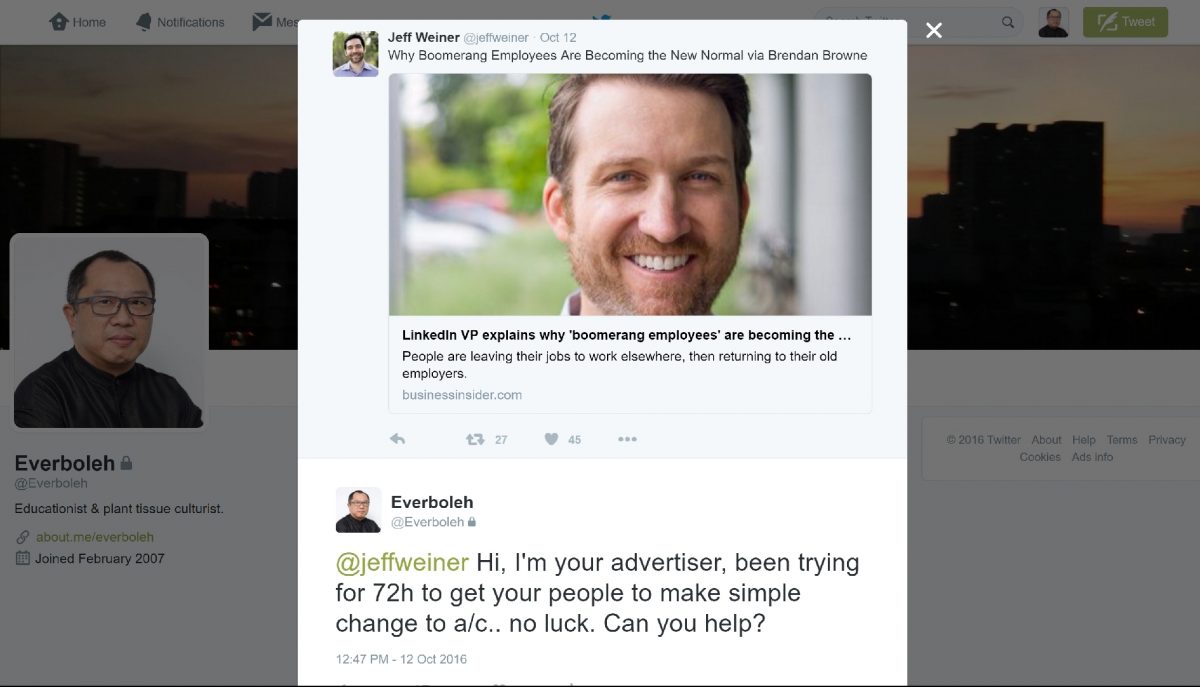
In desperation, before I was able to find and connect with my “account manager”, I even tweeted a message to LinkedIn CEO, Jeff Weiner but of course, I did not get any response. I am just a small fry of a customer in little ole Malaysia! The Pareto Principle (80/20 rule) applies, I guess and I belong to the “80” crowd!

Even clients with small budget deserve to have the basic service quality from Linkedin. I am not sure if LinkedIn realizes that some of those in the “80” crowd, if they are treated well, could well turn into your “star” customers of the future!

I wonder if it is because of the fact LinkedIn now is owned by Microsoft that it has a different customer service philosophy or if it was because of the relatively small (by their standard) advertising account we have which put us in the back of any customer service queue? Now would you wonder why advertisers are not flocking to LinkedIn?

I monitor my college’s social media pages closely and I have been known to show my displeasure to my staff if there was a delay in answering any Facebook messages left on our FB Page, respond to messages left on our “live chat” app by enquirers during our “office off” hours etc.. With the internet being used as the first line of enquiry today, providing your potential customers (and existing customers) with prompt and quality service is the key to success. This holds true regardless of which industry you are in but it is more crucial for service industries like higher education. If prompt responses are not forthcoming, the potential students (and parents) today can just move on to the next college for answers and may enroll with your competitor instead. Thus high-quality service is even more important in the private higher education sector in Malaysia which is facing tremendous turmoils with cut-throat competition amid a dwindling local student market where more and more alternatives are available both locally and overseas. I think colleges that provide the best quality and prompt service will be the ones that will ride through this storm.

I opine that the key to Taiwan’s tourism industry raking in good sales could well be the tourist-friendly nature of the Taiwanese people. Throughout the short four days visit I had in Taiwan in late July 2016, I was amazed by the care and quality of customer service that was provided by everyone in the service industry from the friendly hotel staff, the waitress at the local cafe to the express bus service counter guy, everyone was making me feel very welcome and everyone took pride in their jobs and exhibited great work ethics.  If Malaysians could emulate even 20% of the Taiwanese attitude towards visitors, we will be very much closer to being a developed nation and could rake in more tourism earning! The “not my problem” attitude shown by MAS staff towards my visitor, Mr. Li will not be productive towards Malaysia’s aim of 2 million tourists from China for 2016.

All your customers, regardless of their spending budget, expect and deserve good quality and prompt customer service, if you fail to provide this, they can always vote with their feet.

Pursuing just a single PhD is tough enough!

The achievements of former beauty queen, singer, actress, producer, successful business woman, Soo Wincci have now debunked the negative notion about beautiful women. Dr. Soo is the first Malaysian beauty queen (dare I say, Malaysian actress/singer too!) who has earned her Doctor of Philosophy in business administration from the Open University Malaysia. Even someone as capable as Soo Wincci took 6 years of part-time studies to complete her doctorate studies. “Earn” is the key word here as those of us who have been through the PhD journey will tell you that you have to have what it takes to earn your PhDs!

Dr. Soo Wincci, the first Malaysian beauty queen, singer, actress to earn her PhD (This image was taken from Dr. Soo Wincci’s Facebook page)

December 17 this year marks the 26th year of my being conferred a Doctorate degree by my alma mater, the Queen’s University of Belfast, Northern Ireland. Everyone who has completed his/her PhD journey will have a story to tell. Each and every one of us who, I have often jokingly call ourselves, “the permanently head damaged”, has a unique PhD journey.

My full-time PhD journey took me just about three years during which I worked long hours in the laboratory or in the greenhouse. My PhD journey was shorter than many because my Master’s degree required me to embark on a one year research project where I had horned in many of the basic skills required of a PhD students and my scholarship would only support me for 36 months! My PhD journey is a “typical” of all who are lucky to have secured scholarships / sponsorships to make the journey as full-time researchers. The first six months of my PhD journey was one for soul-searching. I read copiously, made plenty of notes (it was in the late 1980s… we had no internet and the PC was a luxury that all research students and staff had to share) and tried my best to figure out what I should be doing for my PhD. In my case, I was helped greatly by some of my former lecturers and I was lucky to have my main objective very clearly: to find a way to clone Narcissus (daffodils) bulbs using plant tissue culture technology. A travelling scholarship from the British Royal Society which partially financed a one-week study visit allowed me to learn from experts in bulb science in the Netherlands. Dr. Piet van der Linde (of the Flower Bulb Research Institute at Lisse) selflessly taught me the key laboratory technique to obtain healthy and microbial-contaminants-free cultures. I thought then my work could be easily mapped out.

How wrong I was! For over 18 months after the visit (i.e 2 years into my PhD studies), I was not progressing well and I could not make the cloning process produce sufficient number of cultures. Even if I could do the magic in cloning masses of shoots, the end products required were bulbs. I was in great distress to say the least and at times my PhD degree seemed like a pipedream. Then, I happened to “mistreat” some of my cultures on a gloomy wintry Friday night in late 1989 mainly due to frustration. I did not know then that this “mistreatment” (I was brutal in the way I chopped the culture down) was the first turning point of my PhD journey. I had another turning point shortly after which allowed me to “make” bulbs out of shoots. The end of the tunnel was insight by early 1990 and I completed my work (actually was “barred” from the laboratory by my supervisors so that I could concentrate on writing my thesis) within 6 months and was awarded my PhD in December 1990.

The “brand new” Dr. Chow Yong Neng on December 17, 1990 with his late mother, Mdam Wan Sim Then and late father Mr. Chow Kong Yong by his sides, taken on the lawn behind the Lanyon Building, Queen’s University of Belfast.
The “brand new” Dr. Chow Yong Neng on December 17, 1990 with his late mother, Mdm Wan Sim Then and late father Mr. Chow Kong Yong by his sides, taken on the lawn behind the Lanyon Building, Queen’s University of Belfast.

I happen to belong to  a closed Facebook group, “Doctorate Support Group” which I think Dr. Soo is also a member. This is a mutual support group of those pursuing doctoral studies as well as some “oldies” like yours truly whose main aims for being in the Group are to (a) give moral support to fellow PhD aspirants (b) to receive and provide information on research, jobs, learning etc. All those who belong to this Group, especially those who have completed their PhD journeys have at least 3 things in common:
(a) being through “hell” is inadequate to describe the kind of hardships that all have been through;  (b) everyone has been through a period of soul searching, self-doubt and in severe cases, depression during the course of this PhD journey; and (c) everyone has to sacrifice some sort of family or personal life in order to pursue her/his PhD dream.

Having a PhD does not show that you are smarter than those without these 3 little letters behind your name. Instead it shows that the PhD holder has the kind of tenacity, the ability to apply knowledge and skills to work on a complicated problem, and to communicate her/his new found knowledge in an effective manner. Each and every one of us who has been awarded a PhD has one thing in common regardless of our fields of studies, be it social sciences, engineering, computer science, physical, chemical or biological sciences, we all have created a new piece of knowledge for the betterment of mankind. It is this new piece of knowledge that ultimately earned us our PhDs! By “permanently head damaged” it means that all who been through the tough process of working on their PhDs would have successfully endured the challenges, which at times created great nightmares, anxieties, sense of helplessness, dejection etc. which may affect the PhD students’ psychological well-being to the extent that some “damage” could result. I can assure my readers that (and I hope that other PhDs agree with me) all these “damages” are worth every single effort that we had to put in and all these “damages” are transient in nature!

I have met my fair share of “pretenders” –  those who hold dubious or fake PhDs. In most cases, those of us who have actually earned our PhDs like Dr. Soo just did would have little difficulties in figuring out the “dubiousness” of these so-called PhDs by asking 3 – 4 simple questions relating to these people’s PhD journeys. You cannot earn your PhD because of your “life experiences”, this is especially so if one is very young. There is no shortcut.

In 2003, when I first met Professor William Purcell (then of University of Newcastle, Australia and now the Deputy Vice Chancellor of University Technology Sydney) and mentioned to him about an individual who was an active Chinese educationist having laid claim to not one but three doctoral degrees. To this, Professor Bill Purcell’s response was a classic, “What’s wrong with the first one?”

I can understand someone with lots of determination, time and resources, after earning a PhD in one field (say engineering, or biological science) could then went on to study up to doctoral level in another different field such as management. These sort of people are very rare indeed as we can see from Dr. Soo’s example, it would take someone with a job and not working on the doctoral studies full time, around 6 years to complete their doctoral studies. Incidentally there is at the time of writing of this article (Nov 02, 2016) a Hong Kong TVB drama series where a very attractive actress was playing a boffin with not one, two but eight PhDs… we all know that in reality this is not possible!

Honorary doctorate degrees are another kettle of fish. These are awards often given out to people in recognition of their having made great contributions to society, to the community or to the awarding university. People holding honorary doctorates are, by tradition not supposed to call themselves “Doctor” but rather they should put their titles in parenthesis i.e. (Dr). It is very rare for an “average” person to be honoured with even one honorary doctorate as one might imagine the magnitude of contributions to society etc. that this person must have made to warrant the said honorary doctorate. Thus I read with great amusement (the story was picked up by the mainstream and online press) about a sort of “marketing whiz kid” cum motivational speaker who claimed to have not one but three honorary doctorates. These claims were resoundingly refuted by the institutions in which this gentleman claimed to have given him such awards. The tell-tale sign of this person’s dubiousness was the fact that he insisted on addressing himself as “Dr” XXX! No honorary doctorate degree holder worth her/his salt will want to show his/her ignorance by calling himself/herself “Dr So & so”!

To those who are working tirelessly on their PhD studies, do take Dr. Soo as a role model and do get yourselves into the closed “Doctorate Support Group” where people like me (the oldies) and some “youngster” (I dare say Dr. Soo and a whole cohort of recent fellow “permanently head damaged” people ) will be there to cheer you on. To those who aspire to come on board, do not wait. You do not need to be a genius to pursue your PhD studies, but what you do need to have is a strong will to succeed. Pursuing your PhD studies is a tough job but as the saying goes, “when the going gets tough, the tough gets going”!

If I score 10 ‘A’s does any one owe me a scholarship?

A student from a remote village in Sabah who did not have the means to attend private tuition classes for key subjects may scores “only” 5 “A+”s compared to a student from Subang Jaya who attended private tuition classes for these subjects who scored 8 “A+”s. As an educationist, I will put my money on the Sabahan student being academically a better student compared to the student from Subang Jaya. Further, because the Sabahan student could thrive without the benefits of tuition classes, I will opine that the chances of this student faltering at university-level studies will be much lower than his/her Subang Jaya counterpart. However by evaluating students based initially on just the number of “A”s scored the odd is stacked heavily against the Sabahan student.

This article is rather long and in its original form was published in two parts in Han Chiang News. It was written in response to the recent news in Malaysia of government bursaries/scholarships students who were promised full funding for overseas universities being told that the coffer does not have enough money and so the power that be had to renege on its promise. I have decided to republish the unedited version here in its entirety. 

In recent weeks the press has highlighted the case of many public service department (JPA) scholars having their collective dreams of a fully paid for undergraduate studies overseas being dashed. The lack of fund was the main cause of the drastic decision by the JPA to reverse course for these students who did spectacularly well in their Sijil Pelajaran Malaysia (SPM – Malaysian Certificate of Education) in recent years. However all were given full financial support for pursuing their studies in local public and private universities.

This case begs the question, “Does society owe a student who has scored straight “A”s in SPM an oversea scholarship?”

While it is disappointing to see talented students who obtain top scores fail to continue their tertiary studies overseas, one must view this situation in a holistic manner. SPM is not an easy public examination for one to score straight “A”s. However those who scored straight “A”s in SPM are not necessary the same people who eventually shine well at university studies. There are many cases of SPM holders with more than 10”A”s who struggled and even tumbled at their undergraduate years.

All of us who have been to college know that there is a big gap between SPM and STPM/”A” levels or equivalent pre-university qualifications. The gap from pre-university to tertiary level is even bigger. Although in general those who did well at SPM would be able to cope with pre-university studies, there are many examples of students with very good SPM and pre-university results faltering at university studies. Thus for a country to commit so much resources to send its citizen to study overseas at this early stage is somewhat of a gamble. The safer bet is in fact what the JPA has done: let these students with great SPM results and pre-university qualifications study for their undergraduate degrees in local public or private universities. If these students turn out not to be what the Chinese described as “Xiao Shi Liao Liao, Da Wei Bi Jia ” (小时了了, ,大未必佳 - being bright at an early age does not necessarily bring success upon growing up), the country can then commit great resouces to send them overseas perhaps on a 2 + 2 model, saving great resources at the same time allowing the selectors to fine tune their selection. Many established private institutions of higher learning have attained great expertise, reputation and network of good overseas institutions to take on this responsibility. For those students who have proven “track records” the country can then commit greater resources to send them for their Master’s or even PhD studies overseas.

Judging someone’s ability to learn well and flourish at university based solely on his/her SPM results is not a very fair method. A student from a remote village in Sabah who did not have the means to attend private tuition classes for key subjects (like Malay, English, Mathematics, Physics, Accounts or Additional Mathematics)  may scores “only” 5 “A+”s compared to a student from Subang Jaya who attended private tuition classes for these subjects who scored 8 “A+”s. As an educationist, I will put my money on the Sabahan student being academically a better student compared to the student from Subang Jaya. Further, because the Sabahan student could thrive without the benefits of tuition classes, I will opine that the chances of this student faltering at university-level studies will be much lower than his/her Subang Jaya counterpart. However by evaluating students based initially on just the number of “A”s scored the odd is stacked heavily against the Sabahan student.

I studied for my G.C.E “A” levels at a state-run technical college in England in early 1980s. The college’s “A” level students were mainly those who had taken the examination before but were repeating for one reason or another. Nearly all of them wanted just to pass. Because of clashing of timetable, in the first year of my “A” level studies I could only take the Applied Mathematics half of the “Pure and Applied  Mathematics” as a part-time-revision-class which had 50% of the hours of the full-time class, covering only 60% of the syllabus. Yet, I was able to score a Grade A for this subject after studying only for 1 academic year. In my case, my “struggle” was recognized by the university selectors and I received two offers to read dentistry in 1982. The lower offer was just any two subjects at grade E or better! Unfortunately, due to my family’s lack of fund, I had to decline both offers despite meeting the minimal requirement easily with one further Grade “A” and two Grad “B”s. Compared to a boarding school student with dedicated school masters and a greater teaching system who scored 4 Grade “A”s at A Levels, I think my achievement under a much less favourable condition would be more reflective of my ability to learn and survive at university level and beyond. Who should you think is deserving of a scholarship to study at university?

To those students who are expecting (or have scored) straight “A”s at SPM and are now at a crossroad as far as tertiary studies is concern, I urge you to take note of the following points:

  1. No one owes you a scholarship just because you scored well. There are a lot of other influencing factors that the selectors of scholarship fund need to consider. You have no right to demand for a scholarship no matter how well you think you have done in your SPM. As a holder of 2 postgraduate scholarships, I can tell you that getting a scholarship is a privilege indeed and not a right!
  2. Because of (1), you must show courtesy under all circumstances. The matured response reported of the recent JPA “Bursary” students’ case in appealing for help rather than “exerting their rights” is the correct approach. You will not get far if you adopt a confrontational approach and project the image of the world owing you something just because you have the talent to score “A+”s!
  3. Have a Plan B, C or even D.
    • Local private colleges provide lots of scholarship opportunities. Most will regularly contribute to the Nanyang Siang Pau’s and Sin Chew Daily’s respective scholarship scheme. However based on this author’s observation, in many years, most of these scholarship awards were not able to find rightful recipients due mainly to the lack of qualified applicants. This shows that there are lots and lots of scholarships out there! Go and grab these!
    • Be flexible in your aspiration. Have an open mind in choosing for at least one other alternative field of studies. Remember Sun Tze’s “Art of War”,  “Zhi Ji Zhi Bi, Bai Zhan Bu Dai” (知己知彼,百战不殆: know yourself and know your enemy, and you will never be defeated in a 100 battles). Often you are your worst enemy in this context! Be realistic. Know your own strengths, weaknesses and interests, match these as far as possible with the different tertiary fields of studies. This will help you to formulate your Plan B, C and even D.  Make use of the knowledge of your school counsellors, talk to your seniors who are already at universities/colleges, attend as many education fairs as possible. Whatever you do, be honest with yourself.
    • Do your research on what scholarships are available early, preferable BEFORE taking your SPM. This will allow you to evaluate which fields of studies or which institutions are your top choices. You can also test out your own ability, aptitude and interest in each of the shortlisted fields. Do not wait till after your SPM results are announced to do this “homework”.
  4. Have an open mind. Not getting a scholarship for overseas studies is not the “be all and end all” episode of your life journey. Remember the saying, “When a door shuts in your face, one will open up somewhere else for you.” In my case, not getting to study dentistry was a blessing in disguise. I found out why I did badly on 3 dimensional vector in Additional Mathematics and why I could not for the life of me figure out the technical drawing of my roommate only when I was already at university reading general agriculture. I have a form of learning disability in spatial recognition. I would have made a very lousy dentist, assuming I could pass in the first place! The “door” which opened for me was indeed my undergraduate studies in general agriculture, through it, I managed to secure two different scholarships for my Master’s and PhD studies! See a counsellor if you are really depressed but get this bout over as soon as possible. Remember the Chinese saying, “ Everybody has something that they were born to be good at (天生我才必有用 ).  Your job is to find that “thing” that you are good at and pursue your tertiary studies in that “thing”. Having good SPM grades definitely will put you head and shoulder above most candidates.

The most memorable line from the highly successful local movie, “Olabola” was uttered by an actress in Cantonese: “Even though I scored As in every subject in Form 5, I am still stuck here as a rubber tapper…..” That was in the 1970s. In today’s environment with close to 500 private institutions of higher learning chasing after students, the protagonist would have secured a scholarship somewhere and PTPTN loan would have covered most of her tuition fees. However, if you are one of those SPM holders with less than 9As and wonder if there is any chance of getting some financial assistance, you will be glad to know that there are still opportunities available to you.

Editor’s Note: Most private colleges have many academic-merits-based and need-based scholarships and bursaries specially designed to help students contemplating tertiary studies due to financial constraints. You don’t need to scored As in every subject in Form 5 to receive a bursary!