Remembering Dr. Michael Leong Hong Kah

[show_post_categories show=”tag” hyperlink=”yes”]
Chinese New Year is a time for reunion, not only for family members but old pals and schoolmates as well. This year’s reunion dinner for my school mates (especially for those who are based in the Klang Valley) happened on Friday, Feb 12, 2016. As I knew my guys would be consuming lots of alcoholic beverages for this function, and traffic in Bukit Bintang area (where our dinner would be held) would be a nightmare, I took the RapidKL 770 bus instead and planned to change at KL Sentral for the monorail.

Then the first “lightning” struck: one of the members of my Queen’s University Alumni Association Malaysia buddies, Andy Gan posted this on our Whatsapp group – “Our dear friend Michael Leong Hong Kah passed away this morning.” I spent the rest of the bus journey checking the various social media and chatting with Andy to verify this shocking news. Not wanting to accept this as Michael Leong just exchanged email with me in late November 2015 and he told me he was recovering well, I contacted our mutual friends, Dr. KK Wong and Seetho Tan who are based in Singapore (where Michael had been living since the early 1990s). I first heard of Michael’s fight with colon cancer when I read his blog in April 2015. In late November 2015, through an exchange of emails Michael told me, “I am still recovering from colon cancer. “ My worst fear was confirmed later that night when Dr. KK Wong called to confirm that Michael had left us. I have lost my best buddy of over 30 years. The second “lightning” struck!

Michael and I were real buddies. We helped each other with our respective weddings. I gave the “best man” speech in his wedding dinner and he was taking lots of photographs for mine…etc. and the list goes on.

Michael (front row, second from the right) was one of my photographers during my wedding dinner in 1991.

Michael and I came from the same hometown, Ipoh, but despite our being of similar age, our path never crossed until we both were in the UK. Our first meeting was around Christmas 1979 in London. But we were just acquaintances back then. Michael’s elder brother, Dr. Tony Leong was studying medicine at Newcastle University, England and I along with my three other friends (all former SMJK Sam Tet Ipoh boys) were students at South Shields Marine and Technical College, 10 miles away. Tony was asked by one of our seniors at school who knows Tony well to keep an eye on us as we were just 17 years old and living on our own for the first time in our lives.

In 1982, armed with my GCE “A” levels result slips I went to Belfast after meeting a fellow Malaysian, Clarence Ko in Dublin where I was accepted to read agriculture at University College Dublin (UCD). Clarence persuaded me to give the Queen’s University of Belfast (QUB) a try as it would mean saving of one year compared to UCD. Apart from Clarence, I only had two acquaintances in Belfast, Michael Leong and Khoo Thiam Chye. October 1982 was the start of my 30 odd years friendship with Michael Leong.

Michael took me to QUB’s admission office and then to different faculties to help me finally get a seat to read general agriculture.  As I had to “waste” one year studying in Remove Class on account of my having studied in a Chinese primary school, Michael who was 1 year older than me was in fact 2 years my senior at QUB.  As both of us were busy with our studies I only bumped into Michael once or twice during 1982/83 academic year. In 1983 I defeated Michael when both of us stood for the presidency of the Malaysian Students’ Society of Northern Ireland (MSSNI). I think it was not that I was a stronger candidate, but the fact that the “medic gang” (the medical students formed the largest contingent of Malaysians at QUB in the 1980s) was competing with the non-medic gang (mainly engineering students) and I being the “neutral” person somehow was the compromised candidate. Michael did get himself elected as the Vice President of MSSNI. I appreciated the great contributions from Michael especially when our Treasurer, Cheong Kok Wai had to relinquish the position suddenly. We had lots of fun together including successfully smuggling a fellow Malaysian (a young lady) back to Stranmillis College late one night after curfew! As we both embarked on our respective final year of degree studies (Michael’s medical degree took 5 years and mine took 3 years), we seldom get together in 1984/85 academic year. However I recall helping Michael take out the engine of his old Peugeot 305, sent it for repair and put it back together and did the test run. We also helped a fellow student, Mr. Lai to change his car’s clutch. All was done in the garage pit of Belfast’s Malaysian Centre.

564362_10150827606336799_1643002800_n
Michael Leong & I shared the joy of graduating on the same day with our respective bachelor degrees in 1985.

We also shared the joy of graduating with our bachelor degrees on the same day and at the same venue, the Whitla Hall of QUB in July 1985.

During my Master’s and PhD studies from 1985 to 1990, most of my peers had already graduated and left for home, save for the medical doctors working in Northern Ireland. Michael was always game to host a dinner once a month for our group of “oldies” and I was the only “non-medics” among them. In late 1988 Michael bought a house in Belfast and persuaded me to move from my digs (home for me for three years) to keep him company. Seeing that I was working well with my first “personal computer” , a now vintage Sinclair

Sinclair’s Z88 was a revolutionary computer at its time but still lacked the power of the IBM PC.

Z88, to write my PhD thesis, Michael went on to buy a second hand Z88 and proceeded to play with it. After 2 weeks, ever the entrepreneur, Michael learned that the Z88 was too limited in its functions, he promptly sold off his Z88 and bought a second hand IBM clone PC. He knew that I was already very familiar with the PCs having used these in my research work and naturally asked me to train him on how to use his new toy. It did not take Michael long to learn enough to do work on his PC. Soon Michael got a job working in a dermatologist’s practice in London and he relocated there. By late 1990s Michael got a job with a US multinational hardware company and relocated again, this time to Singapore as its medical systems specialist.

When I received the offer of a postdoctoral research position at the National University of Singapore in January 1991, I contacted Michael to seek his advice on accommodation etc. Michael found me a room and went on lending me two thousands Singapore dollars for me to get settled in. It took me more than six months to repay Michael.

After my stint in Singapore in 1996, my wife and I moved back to Malaysia. We kept in good contact with Michael and Irene by phone. For a couple of years, my wife, May also served as

Dr. Micheal Leong and Dr. Chow YN meeting in Kuala Lumpur in 2012.

a director of Michael’s Malaysian company. The Leong and Chow families had our meetings occasionally when Michael brought his family to Kuala Lumpur for holidays. The last time our families met was in 2012. The social media era of the past 10 to 12 years meant that I got to chat with Michael occasionally, usually via Facebook and sometimes via Gmail. The last time I met Michael and family was on June 02, 2014. May and I needed to be in Singapore to sort out some financial matters. Michael drove his family all the way to Changi Airport just

Dr. Michael Leong insisted on driving his family to Changi Airport to have dinner with the author and his wife in June 2014.

to have dinner with us. It could be that Michael remembered me as the guy who was a student surviving on subsistence level stipend, he would always buy the meal. I now regret never to have the chance to repay the compliment.

Michael was a quiet person despite the infectious laughs and that gentle smile of his. Perhaps only Irene knows his inner self best. In April 2015, not knowing the full extent of Michael illness I tried to help QUB’s Head of Alumni Relations, Ian Moore to seek a short meeting with him but Michael politely declined, “My life is for my family and for close friends only. Thanks.” That was his answer. By retiring at the age of 48 as a financially independent person Michael put his family first spending the last 8 years fully and filled with quality time with his wife, daughter Annabelle and son Aaron. I think not many of us could have had this joy of Michael’s.

On the morning of Feb 12, 2016 I lost a great buddy. The readers of pertama.com lost the “oldman”, Michael’s moniker. The community of investors in Singapore have lost a great role model. Most of all, his family lost a caring father and a very devoted husband.

Michael, may you rest in peace.

Author’s note: I feel that telling the story of Michael and his interaction with me is the best way I can preserve the memory of my late buddy. Michael Leong was a serial entrepreneur who was trained as a medical doctor. He had not practiced medicine since living in Singapore in 1990. My life has been made much fuller by having been Michael’s buddy.

My time at Queen’s University of Belfast

I was contacted by Dr. Gerry Power, an old friend and the man responsible for keeping tab on alumni relations at Queen’s University, my alma mater to contribute to “My Time at Queen’s” in 2015. MT@Qub is in fact a series of visits down memory lane by former students, ‘old and young’. Here I detailed a new chapter of my life’s journey as a university student, one which took me close to 9 years to complete! I am one of the few living individuals who have earned not one but three degrees from Queen’s and this is my story.

[show_post_categories show=”category” hyperlink=”yes”] :
[show_post_categories show=”tag” hyperlink=”yes”]

I was contacted by Dr. Gerry Power, an old friend and the man responsible for keeping tab on alumni relations at Queen’s University, my alma mater to contribute to “My Time at Queen’s” a few months back. MT@Qub is in fact a series of visits down memory lane by former students, ‘old and young’.

It took me a few hours to write and edit the original version which is quite long and detailed. An abridged version was published in The Graduate (page 37) in Oct 2015.

Here is the original contribution.


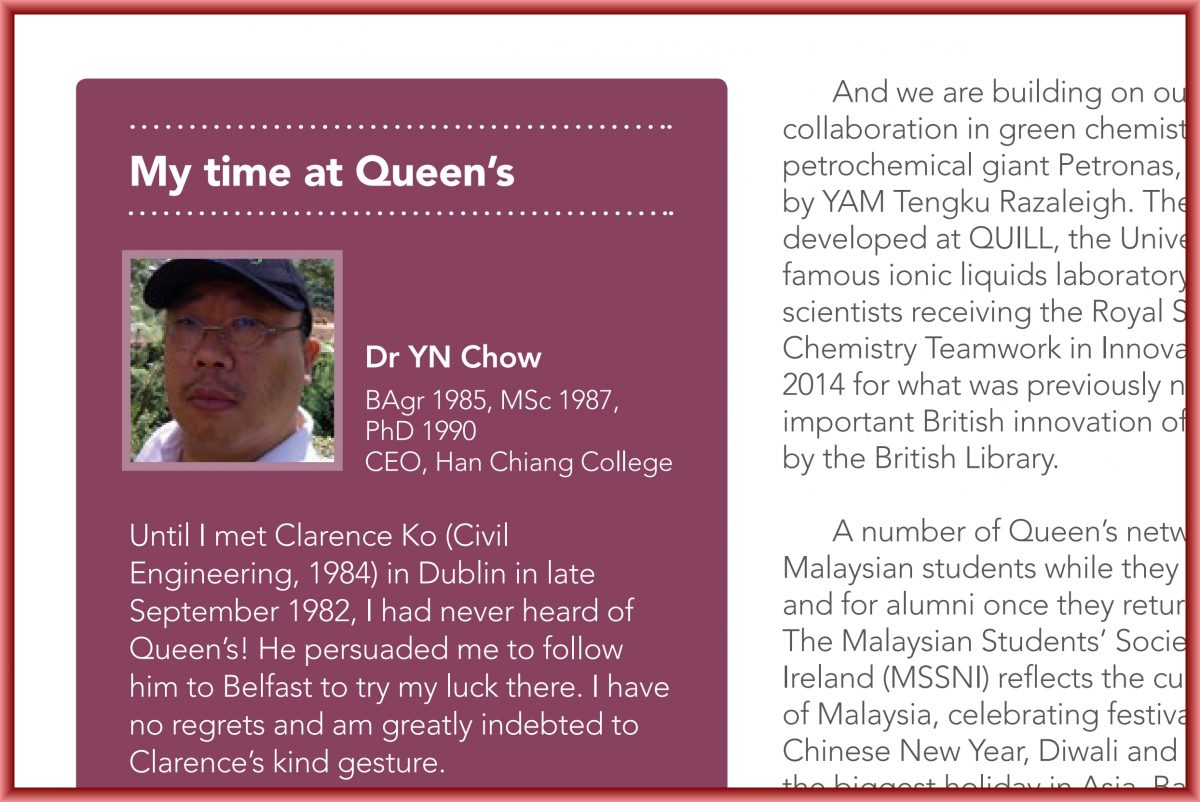
Until I met Clarence Ko (Civil Engineering, Class of 1984) in that fateful day in Dublin around late September 1982, I had not heard of Queen’s University of Belfast (QUB). In fact it was a coincidence that I ended up at Queen’s as I could not afford the high tuition fees of the universities in England and resorted to Plan B: study in University College Dublin. Clarence persuaded me to follow him on a visit to Belfast to try my luck at QUB. I have no regrets and am greatly indebted to Clarence’s kind gesture. As an “Accidental Queen’s Man”, I often wonder why I stayed as a student of QUB for almost 3 times longer than most people and perhaps ending up being one of the few living individuals who have earned three degrees from Queen’s.  I graduated with a Bachelor of Agriculture degree from Queen’s in 1985, followed by a M.Sc in Biotechnology in 1987 and finally a PhD in plant tissue culture in 1990.

Life as an undergraduate in agriculture was tough for me as I had never been near a cow or a sheep until I read agriculture at QUB. My classmates were mainly from farming background and they had an upper hand when it came to understanding what our lecturers were teaching us. I had to content with the many different accents of my classmates but the generosity of some of them helped me cope and I blended in. There were only 3 foreign students (all were Malaysians) in the Faculty of Agriculture and Food Science during my time. Lim Wui Phen (B. Agr, Class of 1984) was my senior and free tutor. I also inherited a lot of books and notes from Lim. Having to be on field trips almost every week visiting different farms gave me a better insight to life in rural Northern Ireland than most Malaysian students would have and these were the occasions that I got to learn at first hand what was covered in class.

In 1983 I was elected as the President of Malaysian Students’ Society of Northern Ireland (MSSNI) more as a compromise candidate (there were two groups  of Malaysians which could not agree on most things and as the ‘outsider’ not allied to either, I won!). I learned about the meaning of democracy truly when we were courted by candidates vying our votes for the post of QUB Student Union President. The low turnout at the Student Union AGM meant that Malaysian students, even if we had only 10 persons attending would be the kingmakers!

As a student who did not come from a farm, I needed to gain some farming experience in order to graduate. I spent the summer of 1984 working at the experimental farm of Agriculture Research Institute of Northern Ireland, Hillsborough. I was the general farm hand and it was the first time I played the role of a sheep dog! Marshalling sheep, as I found out was a very skillful and physically demanding activity, especially for the “sheep dog”. It was during this time that I took the first driving lesson: on a farm tractor!

Organising the annual Merdeka Ball for MSSNI in 1984 took a toll on my studies. I received a sharp warning from my director of studies that if I did not work hard for the final year, I would have problems graduating. That made me worked on a tight regime of studies during my final year. But despite this, all of us living in the self-catered house (I forgot the name, it was the biggest house with the rugby team captain as the sub-warden) took time off studying for our  final examinations in late April to watch Dennis Taylor defeat Steve Davis at World Snooker championship in 1985.

My postgraduate years at Queen’s were very “quiet” as the laboratory work was a lot more taxing than the undergraduate years. Yet I still found time to attend most of the MSSNI’s functions and as one of the “oldest” Malaysians, I was appointed the Chairman for MSSNI’s AGM twice. I came closest to the “troubles” on the eve of my Master’s graduation. After collecting my graduation gown, I took a lift back to the laboratory at Newforge Lane from Sean D’Arcy (PhD, 1987). We were on Sean’s Morris Minor driving on Malone Road when we were diverted by the police. As we were turning onto a side road, a car bomb went off in the next street. Neither Sean and I nor his beloved Morris Minor suffered any damages, but it was shocking nevertheless to be so close to a car bomb!

I think because of my years being a student at Queen’s (and my faculty), the selection committee awarded me the McGeough Bond Studentship / Harold Barbour Scholarship in 1987 for my doctoral studies thinking that I was a “local” student. In the end, my overseas student tuition fees almost bankrupted the trust funds! I had a “guardian angel”, Ms Audrey Griffiths who was the Faculty’s Secretary coming to my rescue when the Dean had an idea of cutting my stipend to pay for the additional tuition fees!

I found a great casual job during the final part of my doctoral studies: I was manning the security desk of one of Queen’s examination halls and earned a good sum during the 1990 May – June examination session. On top of that, I wrote about 70% of the first draft of my PhD thesis while sitting at the security desk helping to invigilate examinations! I could not afford a laptop computer then but bought a Sinclair Z88 computer instead. The now spoilt Z88 is still lying somewhere in my house.

Z88 – an idea of PDA/tablet computer that was 25 years ahead of its time!

[FILM] The Man from U.N.C.L.E. + A little of Fantastic Four

This film review and critique is the first by Leland Chow which is reposted here. Leland is a junior reading Finance, minor in communication & economics at the University of Nebraska-Lincoln.

Since this is technically my first review, I would like to explain some of the features I would use in my blog. The title, as you could see has hard brackets ([ and ]) first. This denotes the category I will be writing about. This is followed by the title of the post, which is usually the title of the film, music, or something that I want to write about specifically. Sometimes, a plus (+) sign is used to denote that I will also be writing about another film, music or other things. In this post, I will be writing about a film that is released on 14 August 2015, The Man from U.N.C.L.E., but in the theater near where I live, most, if not some, films are released a night earlier. Therefore, I have actually watched this on 13 August.

Without giving too much details (for now), The Man from U.N.C.L.E., or in short UNCLE, showcases an American spy and a Russian spy being forced to work together during the Cold War to, in general, save the world. This film is based on the 1964 television series of the same name that featured David McCallum as the Russian spy, Illya Kuryakin, and Robert Vaughn as Napoleon Solo. People might recognize McCallum’s name because he currently portrays as Ducky Mallard, one of the major characters in NCIS, and Professor Paradox in the Ben 10 series.
This film adaptation stars Henry Cavill (Superman, Man of Steel) as Napoleon Solo, and Armie Hammer (the title character in The Lone Ranger) as Illya Kuryakin. The female lead is Alicia Vikander (Vera Brittain, Testament of Youth), who portrays as Gabriella “Gaby” Teller. In the film, Cavill’s Napoleon Solo is charming, handsome, and quite a womanizer, dressed up very neatly (and probably very expensive as well), and speaks in a calm manner. Hammer’s Illya Kuryakin can be considered to be Cavill’s polar opposite. Kuryakin is quiet, dressed up more casually, and speaks in a less calm manner, sensing that he has slight temper issues.

Cavill’s portrayal of Solo was simply breathtaking and funny, and it was very enjoyable watching him being Napoleon Solo because he can crack a joke while speaking in a calm manner. Hammer’s portrayal of Kuryakin also did not disappoint because his Russian accent was quite convincing, and his background with a troubled family did aid in explaining his temper issues.
However, the film is not without its flaws. The plot was enough to explain the reason of the creation of UNCLE, but not enough to explain the backstory of both Solo and Kuryakin. I was left dumbfounded on what exactly did Illya Kuryakin’s father do to be a shame of Russia. Conversely, Solo’s backstory was well-explained, but it had not a lot of information of how exactly did Solo get caught stealing expensive artifacts. Besides, the plot itself, although sufficient to explain the creation of the agency, was not entirely interesting because it followed the standard spy film: Damsel in distress, saving the damsel, receiving mission, meeting the antagonists, spy in trouble, spy receives help from another character, spy manages to save the world. As you might be able to see, the flowchart is the standard flowchart used in spy films, and UNCLE used a similar formula.

In general, I, as a typical moviegoer, enjoyed this film for its funniness and sexiness (Cavill and Vikander). UNCLE, however, cannot be compared to Mission Impossible: Rogue Nation, because both of them had different settings, though they are both spy films.
Rating: 4/5
(Why did I give such a high rating? As much as I found flaws to the film, I thoroughly enjoyed the film and would be willing to watch it again.)

Fantastic Four
I did not watch Fantastic Four, not only because of its very low rating on Rotten Tomatoes (8%), but also because I felt that they did not have to remake the film. However, my largest issue was the casting of Miles Teller as Mr. Fantastic or Reed Richards, because I did think that Miles Teller was not the most suitable actor to portray as Reed Richards, as the Reed Richards I have read about was more matured. Miles Teller did not have the mature vibe, but he had a face that I could see that can portray an evil character. Unfortunately, Reed Richards did not have an evil-looking face.
Rating: 0/5
P. S. This is my first full-scale review on a film. I have never written reviews for films for this length. Hence, I do apologize if it is not up to the standards of a typical film critic.

Beware of pitfalls and surprises when hunting for an apartment in Penang

This is the unedited edition of my article first published in Han Chiang News yesterday (May 20, 2015).

properties-hunting

After “migrating” back from Singapore in the late 1990s, my family and I have been living in the Klang Valley. In early January 2015, I came to Penang with my wife to hunt for a suitable accommodation when I decided to take my present appointment. As both of us are not familiar with the local housing scene and more importantly, the most suitable location to take up residence, I had an idea of temporarily living in a budget hotel close enough to my workplace while I have a chance to get familiarize with the various options available. We quickly abandoned this idea after driving around Penang with the aid of Google Maps. Parking would be the most important feature lacking in most of these establishments and the surrounding would be the next.

After almost 5 hours of driving around looking for a suitable place for me to stay, we finally narrowed down our choices (via an online portal, ibilik.com) to a condominium (TSP) close to the “emerging hot” area of Persiaran Karpal Singh which looked very presentable online as well as in real life. As I was not sure of my preferences, having only stayed in the hotels along the tourist-belt of Penang from Gurney Drive to Batu Ferringhi, it would have been risky to commit to a yearly rental contract. Thus we decided that I should take up a room in this “up-market-ish” condominium with a flexible rental contract instead.  Suffice to say, the rental was not cheap, but it did come with a covered car park space.

Housemates from Hell

After staying in TSP for just one week, I realized that my housemates, a couple, occupying a small room (which was carved out of the living room by the landlord) treated the entire condo unit as theirs. The refrigerator, the hall, the front landing, the kitchen, the bathroom and even the balcony were conquered as their “own domains”. Newbies like me had to make do with whatever space that I could “muscle” in. No one bothereds to lock the front grill gate, we were protected from thieves just by a simple padlock. Cleanliness was never in the vocabulary of this couple and the kitchen sink was used often as the basin for brushing teeth and clearing of one’s throat. The common areas were never cleaned. Needless to say the common bathroom/toilet was a mess at any day which I had to clean regularly as I could not stand the grime and other bodily waste scattered all over the surfaces. After 2 months, when I got to know the local geography especially in relation to my work place better, I had had enough and decided that I should “upgrade” to my own condominium. I also consulted with my Penangite colleagues to hone in on the best available options for me.

Misleading to cheat

Having lived in the Klang Valley since the late 1990’s and having let out our own apartment, I was taken aback when I found out that in Penang both the landlord and the tenant are expected to pay the estate agent or agents (as sometimes one would be representing the landlord while the other brings in the tenant). In the Klang Valley, only the landlord are supposed to foot this bill.

I was looking for a unit that was unfurnished which would have allowed me to (1) pay a lower rental, and (2) to acquire furniture and electrical goods to my liking. I thought I had a unit when the estate agents brought me to an empty-unfurnished unit. I asked several times for confirmation about the rental and more importantly the car park space that would come with the unit. The agents confirmed all these each time. Off I went to pay one month’s deposit to secure the unit as unfurnished units in this particular location were hard to come by. While I waited for the landlord to get the rental agreement prepared, I went on to buy a refrigerator, a washing machine, an air conditioner and even a firm mattress. Then came the fateful day agreed by both parties to sign the rental agreement and to hand over the relevant keys. After both the landlord (a landlady in this case) and I had signed the rental agreement I asked to be shown the location of my car park space, I was given the first rude shock. The landlady insisted that the unit did not include a carpark space (even though it is a well known fact that each condo unit in this estate would come with one) and my agents disputed this. However the landlady stood firm and after half an hour of negotiation, I sensed from the eyes of the landlady that there was something that she wanted to attain other than renting out this unit. My suspicion and second shock came when she refused to return my one month’s rental deposit. This lady was out to cheat unsuspecting people of their rental deposit by reneging on there being a car park space (which she misrepresented to the estate agents as being a part of the “deal”). She knew that her victim, a.k.a. yours truly would not have taken the condo unit if the car park space was excluded. She would then be able to pocket the one month’s rental deposit as technically I would forfeit the said rental deposit for not going through with the deal!

I have lost not only the RM850 as deposit due to this scam, I had to deal with the fact that I had electrical goods and furniture already bought and paid for. “Luckily” for me, one of my colleagues has just taken possession of a new condo unit and he would “take over” all my electrical goods, but I had to give him a discount of 15%, losing about another RM400 in the process!

Off I continued with my condo hunt and nursing a RM1,250 financial wound. Luckily for me, the estate agent acting for the landlady, Ms DT was very ethical. DT took responsibility for both of us falling for the trap of this landlady (apparently it is not a standard practice to have the landlord signed on a piece of paper to confirm what are the features and facilities he/she is offering in the property for rent). She waived her fees in searching for a new condo unit for me. Thus this helped to cut my losses significantly but I am still RM400 down for having to dispose of my electrical goods at a steep discount, goods that I had never taken delivery of, I must add!

My advice to all who wants to hunt for a condo, especially in Penang: get to see everything that the landlord or agent claim the property has and make sure this tally with the list of facilities and furniture etc. in the rental deposit form before you hand over your money, or else you may, like me stand to be cheated!

One should try to get an estate agent whom someone who lives locally can recommend. I will surely recommend DT to you!

Incidentally, just 3 days after being scammed, I received a call from another estate agent whom I had contacted earlier. This lady informed me that an unfurnished condo unit at the location I wanted was available. The description of this particular unit (the block and floor it was located) matched the one I was scammed! Thus condo unit hunters in  Penang beware, the predator is now searching for the next victim (or has she been successful in securing more victims after me?)!

I think the authorities in Penang as well as the Penang property agent industry should come out with a clear guideline and best practices to protect innocent tenants like me from be scammed. Having a “standard” declaration of facilities, furnishing and features in the rental booking form would be a good starter.

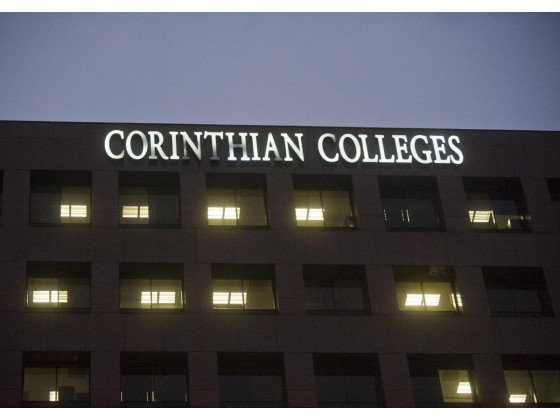
Will Corinthian Colleges’s kind of education meltdown happen in Malaysia?

nnu2yb-corinthian
Photograph source: http://images.onset.freedom.com/ocregister/nnu2yb-corinthian.jpg

The final nails are being hammered into the coffin of Corinthian Colleges, once one of the largest for-profit education groups in the USA. The impact of this private higher education meltdown is far and wide. Many of its remaining 16,000 students are left out in the cold, most are shouldering huge personal / education debts with bleak future. Many of Corinthian’s problems that led to its downfall are related to inappropriate management of state-funded education loans to students and over promise of job prospects and pay levels. Can we find similarities in cases of education institutions’ collapse in Malaysia?

If PTPTN can finally get it’s act together (it looks as if it has began the clean-up which it should have been doing in terms of defaulting borrowers management long time ago), will we witness similar higher education meltdowns in Malaysia too?

There are just too many colleges (private, community, public etc.) chasing a Malaysian youth population that is not growing in tandem with their collective capacities. The growth in international students population can help to redress this only a little. Not all the smaller players have what it takes to attract foreign students!

Should PTPTN now also start honing on errand colleges and universities which have been over promising its students with job prospects? Let’s be fair on this, PTPTN should include every institution, both private and public where the most loan defaulters have come from. It also owes the citizens of Malaysia an explanation on why it had decided in November 2014 to whack 15% from the private college students’ PTPTN loan amount while taking only 5% from those in the public institutions of higher learning. This reduction has already showing its impact on the enrollment figures of many private institutions relying heavily on PTPTN loan to fund their students (does this ring a bell?….think Corinthian!).

Consolidation of the higher education industry of Malaysia was called for by some politicians recently. But these people may not have a full understanding on how the higher education industry works and they have no idea of the complexities that the act of consolidation (along the idea of banks mergers) would entail. Colleges and universities are not like banks, the “products” are all very different, the pricing systems and delivery schedules are all unique to individual institutions. It would be easier to let “sick” colleges die than to “cross infect” the healthier ones! No sane edupreneur will be willing to buy into someone else’s huge debt!

With more stringent entry requirements for private colleges and universities set to come into effect in 2016, and the possibilities of PTPTN getting tougher on institutions which produced the largest number of bad debtors, there is a huge storm that the higher education industry as a whole and the private sector in particular are riding into. The “Corinthian Meltdown” may yet to be witnessed in Malaysia!

I for one will not be buying any education stocks for now!

(Declaration: I do not hold any direct shares in any of the 4 public listed education groups in Bursa Malaysia!)

Life’s lessons learned from Harry Potter

What life’s lessons can you get from Harry Potter books? Read what a young fan, Potterhead got to say about this.

[show_post_categories show=”category” hyperlink=”yes”]

[show_post_categories show=”tag” hyperlink=”yes”]

Commentary about this article (revised –  Apr 19, 2018)

The author, Leland Chow was a junior reading Finance, minor in communication studies and economics at the University of Nebraska-Lincoln when he wrote this piece. This article originated as an assignment for one of the author’s classes and is presented here for our readers’ enjoyment.

In late 2012 Leland Chow took the Malaysian Sijil Pelajaran Malaysia (SPM) which is a national high school diploma equivalent examination that most Malaysian school leavers will take. My wife and I were very worried for Leland. Instead of burying himself with SPM study guides, textbooks etc., he was reading Harry Potter books during most of this month-long examination. We joked that if Harry Potter books are included in his examination, he would score grade A+ hands down. Leland simply smiled and told us that it (reading J.K, Rowling’s books) was his way of relaxing. He claimed that reading Harry Potter calmed his nerves as well. Well, Leland might have a point there. He did extremely well in his SPM to win a full scholarship at SEGi University. But after reading what he wrote, I think Leland gets more than just a calming of his nerves! I also learned two things from this piece, (i) Leland was a victim of bullying at high school (& wish I knew earlier to help him to tackle this),  and (ii) the meaning of a new term, “Potterheads”! ————–> Chow Yong Neng, PhD.

~~~~~~~~~~~~~~~~~~~~~~~~~~~~~~~~~~~~~~~~~~~~~~~~~~~~~~~~~~~~~~~~

This was the third and final essay of my English: Rhetoric as Inquiry. My instructor, Ms. Maria Nazos has asked me to write an essay regarding a person or a group of people who I admire. Instead of choosing a real-life person or a group of real-life people, I decided to choose my favorite characters from my favorite childhood series, Harry Potter, Ron Weasley and Hermione Granger from the Harry Potter series. I utilized textual evidences from the book to support the characteristics of the three unlikely best friends. —————–> Leland Chow

Introduction

He was an orphan as his parents were brutally murdered by a horrendous man. He lived with his maternal aunt and uncle since he was born. His aunt and uncle treated him as if he was their servant. He did not feel loved, happy, cared for. His cousin also did not help to the fact that he was literally neglected and bullied by his aunt and uncle, as his cousin was spoiled by his aunt and uncle, giving his cousin new gifts and toys, while he could only get hand-me-down, second-handed gifts and toys. His room was worse, as he literally lived in a small storage closet, barely enough to fit his small body. His life was basically miserable for the past 11 years, until a letter was written to him, telling him that he was accepted into a prestigious school, a magical school, Hogwarts School of Witchcraft and Wizardry.

It was not until 2005 when I started noticing the world of Harry Potter. People usually read the books before watching the film. I, on the other hand, took notice of the first film, Harry Potter and the Sorcerer’s Stone. I really liked how magical it was, and immediately bought the second film, Harry Potter and the Chamber of Secrets and watched it. I felt that Harry Potter was in a way, sad, but very inspiring to me. Then, I persuaded my parents to buy the three books that came after the first two films. I loved reading books as well, and hence I read the three books quite quickly. Suddenly, I realized that I was actually really enjoying all of the Harry Potter books and films, I was a Potterhead.

Background

Harry Potter was created by a British author named J. K. Rowling, in a delayed train from Manchester to London in 1990. She used that name as she had no middle name, borrowing Kathleen as K. from her grandmother, and this made J. K. Rowling’s initial identity to be more anonymous. She wrote the first few ideas of Harry Potter on a napkin, and in later times, used a typewriter to type the first book, Harry Potter and the Philosopher’s Stone. When she was writing, she usually wrote in cafes in Edinburgh, and her then baby daughter would be around with her (Farr). I found it to be quite ironic that J. K. Rowling got her ideas of Harry Potter in a train, as in her books, a platform in King’s Cross Station, Platform Nine and Three Quarters, is used as the platform for the official school train, Hogwarts Express, which is used to transport students to Hogwarts (Rowling, “Sorcerer’s Stone”, 87). This coincided her writing with her true experience in the train. Her way of writing this type of transportation used in all books of Harry Potter resembled a relation between the land of magic and the land without magic. It served as a bridge between the wizards and witches, and the normal non-magical people, the Muggles (Rowling, “Sorcerer’s Stone”, 53). A bridge whereby there were quite a few similarities between the magical world and the non-magical world, which was quite fascinating because to me, I would not have expected wizards and witches to use just the same mode of transportation: a train. Even though it may be a magical train, but still, it was the same type of transport, using a similar type of train tracks.

The younger me at that time read books pretty quickly, so in a month or two, I have already finished reading the three books, ranging from a thin Prisoner of Azkaban, to a very thick Order of the Phoenix. But, unlike now, where I take my time to read and understand carefully about the books, I was just reading and not understanding the plot of the books. Somewhat, this old habit of mine reflected on my personality that I did not understand deeply enough about the true nature of things. I was technically bullied at that age, but I did not know that I was bullied, nor did I know why I was being picked on. I was just too immature at that time to understand things from a different perspective.

Harry’s Love

Love was one of the themes in the Harry Potter book series, and it was evident in Harry himself. Unlike his nemesis, Voldemort, Harry Potter had been loved by his parents. He was born into a dangerous world, and was bullied by his aunt and uncle, but when he was in school, he was loved by his friends, Ron Weasley and Hermione Granger, Ron’s parents, the headmaster, Professor Albus Dumbledore, and even the deputy headmistress at that time, Professor Minerva McGonagall. Molly Weasley, Ron’s mother, in fact claimed that Harry can be her son, and even gave Harry her brother’s watch as Harry’s 17th birthday present (Rowling, “Order of Phoenix”, 90; “Deathly Hallows”, 114). Harry’s love for his friends was also evident when he saved them in the Chamber of Secrets, where he successfully slayed the Basilisk, a dangerous monster, faced many Dementors, which were soulless creatures, and as mentioned in the previous paragraphs, sacrificed himself for the safety of his friends (Rowling, “Order of Phoenix, 527; “Deathly Hallows”, 703).

If he did not love any of the people mentioned, I believe that he would not have sacrificed himself because the existence of love in him was one of the key reasons he did not join the evil side. The darkness that was present in the society was growing more than ever, but his love for everyone and vice versa kept him grounded. Voldemort utilized his followers as if they were his tools, and when his followers were useless or dead, he did not shed a single drop of tear, nor did he show any signs of remorse (Rowling, “Deathly Hallows”, 656). Harry, on the other hand, showed his emotions clearly. He was sad and cried for the death of his loved ones, even in the case of a death of a non-human creature, Dobby the elf! He manually dug a grave and engraved “Here lies Dobby, a free elf” on top of the gravestone (Rowling, “Deathly Hallows”, 478-481). Would Harry be less emotional, and worse, less likeable, if he cannot feel love? In my opinion, definitely! This is what sets Harry and Voldemort apart, as Harry understood the ability to love someone, while Voldemort, unfortunately, could not feel love, and did not love anyone, as he was born under a concoction of a love potion made by his mother for his father (“J. K. Rowling Web Chat”).

Hermione’s Logical Intelligence

Of course, the adventures of Harry Potter would not be as great if Harry was not accompanied by his friends, Ron Weasley and Hermione Granger. Hermione Granger possessed a trait that many people would seem to admire and hate, all at the same time: logical intelligence. It was because of her logical intelligence that she solved the Potion Riddle to help Harry to defeat the professor who had Voldemort stuck at the back of his head (Rowling, “Sorcerer’s Stone”, 286). However, it was also because of that intelligence that Harry and Ron were not fond at her at first. She was described as a know-it-all, having read and studied every book in detail even before the semester has started (Rowling, “Sorcerer’s Stone”, 105). Her intelligence came from the fact that she was outspoken, and because of her outspokenness, the two boys did not like her (Jusino). She proved herself worthy though, and through her kindness towards everyone, she has won many people’s hearts, including Harry’s and Ron’s, and they eventually became good friends. To me, she has also won my heart, as she resembles me in some ways. I am considered an outspoken person. Because of this though, many people think that I am intelligent, especially when it comes to getting good grades in my exams. Unlike Hermione, however, I am the one who works hard, pay my fullest attention in classes, and try my best to get the grades I want. Unfortunately, when it comes to house chores and other life skills, I am the worst person to ask. I cannot cook, I cannot assemble a shelf properly, and I definitely cannot fix a car. Hence, Hermione possesses a trait that is somewhat relatable to me and I admire her because of this.

Soon, as I grew older, I started rereading the Harry Potter books. I now had four books, including Half-Blood Prince. I slowly began to understand more about the struggles Harry, Ron and Hermione faced in the books. I understood the pain the trio faced, especially Harry, after rereading those books. I have slowly started to change my habit of reading, preferring to read slowly and understand more about the plot development. At the same time, I started to realize that I was not very happy in life. I realized that I was being bullied, and I did not dare to tell my parents about it. I just kept everything to myself, like what Harry did by hiding his pain from Ron and Hermione.

Ron’s Humor and Maturity

Ron Weasley, Harry’s male best friend, on the other hand, was not as smart as Hermione, nor as skilled as Harry, but he had a trait that the both of them lack: His sense of humor. He was a character that provided some comic relief in the books, making sure that the books were not dark and sad at all times. At the beginning where Hermione was not on Ron’s good shoes, he kept on mocking her, saying that she was scary. When Harry and he were stuck in a plant and Hermione was freaking out, he questioned by shouting at her if she was a witch. He also joked that Harry had to get his Inner Eye tested during a class when Harry tried to read the tea leaves from Ron’s cup but failed miserably. When the fake Professor Moody Transfigured Malfoy into a ferret, Ron told Hermione to not say a word, as he was trying to remember that scene forever (Rowling, “Sorcerer’s Stone”, 172, 278; “Prisoner of Azkaban, 105; “Goblet of Fire”, 207). In the first two cases, although he was mean to Hermione, he was funny and in a way, was a joker to the other two of his friends. Rowling has said that the reason why Ron had a good sense of humor was because he was immature as well (Ferreol). He, however, became more mature where he came back to Harry and Hermione after leaving them. At the end, when he married Hermione and had kids, he said to his children that he’s extremely famous, prompting them to laugh, showing that he still had his sense of humor (Rowling, “Deathly Hallows”, 380, 759). In my opinion, Ron was one of those people that no one could hate, as he was hilarious in many situations. Rowling wrote such a contrasting character to accompany Harry and Hermione, but because of what she wrote, Ron was easily likeable by Harry Potter fans, or commonly known as Potterheads. He was the type of guy that every guy would want to be when dating with a girl, as he knew what to say to make the girls laugh.

When the last book, Harry Potter and the Deathly Hallows was released, I was delighted and requested my parents to buy the book for me. As it was quite expensive, they were initially reluctant to buy the book for me. After several plead from me though, they decided to buy for me as they knew I liked books. A few years after owning the last book, after many times of rereading, I finally realized that I had changed after reading Harry Potter, somewhat quite a lot. I learned to look things at a different perspective. When I realized I was being bullied at first, I kept on wondering why I was picked to be the victim, why other people would not be the victims. Then, I realized that maybe it was because of some misunderstanding with them, or they had a huge issue on me that even I did not realize.

The Trio’s Bravery

Harry, Ron, and Hermione, however, possessed one of the few traits that no one else in this real world could compare: Their immense bravery. Lord Voldemort tried to kill Harry many times after he killed Harry’s parents, including the night where his parents died, the time where he was fighting for his life in the Triwizard Tournament, and the time when he was a legal magical adult, facing Voldemort, and came to accept his apparent death (Rowling, “Sorcerer’s Stone”, 12; “Goblet of Fire”, 663; “Deathly Hallows”, 703). He was not alone, as Ron and Hermione bravely stood beside him in nearly all occasions, trying to help him to defeat Voldemort once and for all. They were not cowards, and they did not bother running away. Even until the end, the trio did not surrender, even though Harry sacrificed himself to his death. In fact, Harry knew that he had to do so because that was the only way to defeat Voldemort. He knew that a part of Voldemort’s soul was attached to him, and as long as he lives, Voldemort cannot be defeated. Ron and Hermione did not know about that, but when they found out about it, they were sad and continued fighting against Voldemort and his followers (Rowling, “Deathly Hallows”, 686, 731).  Harry chose to die, and not live, as if he chose to live, everything that has done for by his parents and everyone else he loved will be betrayed (Deyoung).

The trio’s bravery was the main reason why Potterheads, including me, admire him. In my opinion, bravery was something lost in the whole of Harry Potter book series. There were too many characters who were afraid of losing something, including losing Harry’s life. These characters then decided to stay silent and be passive in the general public, unlike Harry, Ron and Hermione. They were one of the only few who decided to take action against Voldemort. They were the one of the few who sought light against all the darkness. They were the ones who stood up against all evil, never giving up, and bravely assumed their roles that they must defeat Lord Voldemort in order to successfully vanquish the evil, and restoring peace in the world.

2012 was the year when the final film adaptation of Harry Potter was released. It was a bittersweet moment for my life as I realized that this was THE final film of Harry Potter. No more Harry, no more Ron, no more Hermione. Deathly Hallows Part 2 was very heartfelt as I finally got to see the truth, as read in the book. My life took a turn for the better after reading and watching the last book and film adaptation, respectively. I finally understood that people were still immature at that time when I was bullied, as when I was finally leaving high school, I was not bullied, but on the contrary, I had friends who I can count on. I finally got to experience true friendship from these great friends.

Conclusion

It was and still is surprising that a pure-blood, a half-blood and a Muggle-born could be good friends together. Harry, Ron and Hermione, from the Harry Potter series, have inspired many people to be brave, to be themselves, to fight against evil. I dare to admit and say that I am one of those people. I applaud Rowling for writing such a great series of books, timeless stories, and most of all, creating a magical world that many Muggles like me try to realize in the real world. I hope that everyone who reads Harry Potter could take something home after reading the series, because I have.


Works Cited

Deyoung, Rebecca Konyndyk. “Love Bears All Things: Thomas Aquinas, Harry Potter & The Virtue of Courage.” Virtual Library of Christian Philosophy. Calvin College. 12 Sept. Web. 16 Nov. 2014.

Farr, Emma-Victoria. “JK Rowling: 10 Facts about the Writer.” The Telegraph. Telegraph Media Group, 27 Sept. 2012. Web. 16 Nov. 2014.

Ferreol, Yvette. “Rowling Reveals `Marriage’ to Harry Potter at Reading (Correct).” Bloomberg.com. Bloomberg, 22 Oct. 2007. Web. 30 Nov. 2014.

“J.K. Rowling Web Chat Transcript”. Bloomsbury. The-Leaky-Cauldron.org. 30 July 2007. Web. 11 Nov. 2014. Transcript.

Jusino, Teresa. “Hermione Granger: Minority Geek Girl”. Potterpalooza on TOR.com. TOR.com, 14 July. 2011. Web. 13 Nov. 2014.

Rowling, J. K.  Harry Potter and the Deathly Hallows. New York, NY: Arthur A. Levine, 2007. Print.

—. Harry Potter and the Goblet of Fire. New York: Arthur A. Levine, 2000. Print.

—. Harry Potter and the Order of the Phoenix. New York: Arthur A. Levine, 2003. Print.

—. Harry Potter and the Prisoner of Azkaban. New York: Arthur A. Levine, 1999. Print.

—. Harry Potter and the Sorcerer’s Stone. New York: Arthur. A. Levine, 1998. Print.

________________________________

Below is the grading & comments from the author’s instructor at the University of Nebraska-Lincoln

Grade: ___A_____Comments: Leland, well done! Your revisions all went in the right direction. It is great to see (after the Doyle essay) how truly athletic you are as a writer, slipping from one challenging essayistic form to the next. You have been a delight to have in my class. Please keep in touch if you need anything.

[Feature picture of this post was derived from: http://blogs-images.forbes.com/markhughes/files/2014/10/Harry-Potter-1940×1212.jpg]
Who’s going to do their work if I send them to training?

If you want your business to have a chance to soar with the eagles & not run with the turkeys, you need to appreciate & develop the staff that you have.

[show_post_categories show=”category” hyperlink=”yes”]

[show_post_categories show=”tag” hyperlink=”yes”]

I attended a graduation ceremony about two years ago in Subang Jaya by the Trinity College London in which 150 musicians graduated with their Associate, Licentiate or Fellowship awards. Parents, spouses and even children of graduates came from all over Malaysia to celebrate their love ones’ achievements. It dawn on me that despite our relatively small population, Malaysia really has a lot of musical talents. In the same year’s Global Chinese Music Award, Malaysian artists took home 20% of the 35 opened awards. However, almost all of these artists had to leave Malaysia to seek and find their fame & fortune, in Taiwan and China. In the inaugural issue of the now defunct print weekly, The Heat, it was revealed that former Miss Malaysia, Soo Wincci had to spend RM1.0 million to launch her musical career. To nurture talents is indeed a very expensive undertaking and there seems to be no allocation by the state to nurture these talents. But judging from the musical talents I witnessed in the Trinity College London event, Malaysian parents are willing to spend heavily on their children’s music education even if the government is not prepared to do so. However, funding of music education is just one of the many aspects of developing musical talents in the country. When the “ecosystem” for an industry is not able to sustain its healthy growth, talents will need to move overseas. We may lose these talents altogether.

In the workplace, aside from the civil service, government-linked companies and multinationals, many private companies still treat the training and development of their staff as something that the government “forces” upon them. The implementation of the Human Resource Development Fund (HRDF) put paid to some of these lack of training commitments as contributing companies have to pay 1% of their payroll as HRDF contribution and they get back training grants in return. But there is still a lack of training culture in private companies, especially among the Small and Medium Enterprises (SME). SMEs form the bulk of the companies that do not fall into the the HRDF contribution requirements.

When I was operating a federal government funded institution that provides technical and vocational training in 2011, my centre was awarded RM100,000 by the SME Corporation Malaysia (SME Corp) to spend on subsidizing 50% of the training fees of approved short technical and vocational courses for SMEs. The qualifying criteria were very simple: the trainees need to be Malaysians, the companies have to be majority Malaysian owned or in sole-proprietorships or partnerships. I was told by my staff that every year we would have trouble spending the full allocation. I decided to do something different. I packaged soft-skills courses (which were not covered by the grant) into the offering so that the trainees would get 2 courses for 50% of the fee for each SME Corp sponsored course they take (2 for half the price of one course). I was prepared to lower the margin for my centre to benefit these SMEs. Despite the incentives, I was having great trouble spending the RM100,000 grant!

It seemed that in that part of Malaysia, the culture of appreciating and nurturing our talent pool did not exist.  I was wondering why many bosses only paid lip service to my effort. In the end my centre only managed to spend less than half of our allocated grant. Later, after I have made some enquiries and spoken to some of the SMEs and clients, I discovered that there were two reasons for my failure to entice SMEs taking up my offer. Firstly, most do not subscribe to the idea of training their staff. I was getting this question thrown to my face many times,”If I send my guy to your training course, who is going to do his job?” Secondly, many of the SMEs were nearly fully relying on foreign workers with only token Malaysians working in the administrative, marketing and supervisory functions. Foreigners are not eligible for the training grant. Many of these SMEs seemed to be contented with being the fabricators or contract manufacturers, at the bottom of the value-chain. They stand to lose out to other companies, especially those from cheaper cost regions when there is any changes in the business environment. They will always be squeezed by the big customers or main contractors because of their lack of technical ability or design capability.

Some years ago, I read a very interesting article in one of the Chinese dailies. It was describing the 4 types of people that employees can be classified into. “Wealth generating people” (WGP) (“Ren Cai“  - 人财) are talents that you have who will help you to create all the wealth of your company. “People being there” (PBT) (”Ren Zai” – 人在) are those employees who will clock in to work each day waiting to clock out and have the “minimalist” approach to doing work. “Woody people” (WP) (“Ren Cai” –  人 材) are those described as deadwood. “Talented people” (TP) (”Ren  Cai” – 人才) are staff who have all the potential and talent waiting to be developed. Of course you will want to be rid of the WP and PBT as fast as possible. You will need to be very alert when communicating with the WGP. These guys know what they have and can do and they will bring their talents elsewhere as soon as they detect any major issues with you or your company. Your success rely more on the TP. But if you do not take the trouble to develop them, either they will look for better opportunities or they will, when they become more experienced, turn themselves into WGP for other companies.

Although all entrepreneurs aspire to soar with the eagles, but many, like those I had encountered in my vocation and skills development centre, are content to run with the turkeys. But I sincerely hope that they know, only with a bit of commitment in cultivating the “Talented people” among their staff, even though they might not be soaring with the eagles, at least they can be the “roadrunners” to always race ahead of the turkeys and escape from the coyote….Beep! Beep!

##################################

I wrote the draft of this article on November 01, 2013. At that time I had been roped in to contribute articles to help in getting the then brand new English business weekly, Focus Malaysia off the ground. As happened to many new publications, getting credible writers was the main headache for the editors. Hence I became the “accidental” writer to fill in the gap till the publication could engage sufficient full-time and part-time writers. This piece was prepared for my column, “Learning Circle” in which I had been publishing my column under my moniker of “Plantcloner” but it did not get the see the light of day in 2013 as my column was pulled in favour of a “star” columnist. For my stint as a columnist for Focus Malaysia, I did not receive a single cent or any incentive for my effort.

Since then this draft has received several revisions when I was writing for The Heat (the print version) and later Focusweek, but somehow I did not manage to shorten it from the 1,000 words (as specified for Focus Malaysia) to about 800 words for the latter two.

If you are a business owner or managing a business for an employer, may all the staff that you have turn out to be either Talented People or Wealth Generating People!

(The image used was derived from: http://schenec.com/business/wp-content/uploads/2013/07/Corporate-Training.jpg

How do you debunk myths about Chinese primary schools in Malaysia?

It is not easy to fight lies told about the vernacular schools of Malaysia. A recent availability of a string of revealing facts help to debunk these myths. Read more & comment!

I have always wanted to write something to debunk the myths propagated by people with ulterior motives about Malaysia’s Chinese primary schools (to a lesser extent, Malaysia’s Tamil primary schools as well). I have tried without success in getting data from the Ministry of  Education’s website. Without these data, we cannot do much to nullify these myths.

It took the availability of key statistics by the Chinese press in Malaysia to give me the facts and figures I needed in early November 2014 to write this article.

It is extremely difficult to demystify the lies and untruths told over and over again by successive has-been and dead-wood politicians, but I try my best and hopefully provide at least some good points for supporters of the vernacular school system to keep the struggle going and gain the upper hand. A lie told many times unchallenged will eventually be misconstrued as the truth. There are many, many lies told about Malaysia’s vernacular schools and a great deal more will be concocted by politicians with limited mental capability. It is the duty of all who are concern with the rights of Chinese and Indian Malaysians to learn their mother tongues to fight these lies and liars.

Subsequent to the publication of this article on November 14, 2014 in Focusweek, there have been some startling facts further revealed by a Sabahan UMNO (United Malay National Organisation) member, the dominant partner of the coalition that rules Malaysia since independence in 1957 (from the British). Datuk Taufiq Abu Bakar Titingan revealed on November 29, 2014 that, out of 35,162 students studying in Chinese vernacular schools in Sabah last year (2013), 15,120 were bumiputra (and hence not Chinese Malaysians).  In fact in his constituency, 85% of the bumiputra students study in Chinese primary schools! Datuk Taufiq told the annual assembly of UMNO that, “….so there is no need to close down these schools“.  I would have liked very much to see the political rotten eggs on the faces of those who have been calling for the closure of vernacular schools in that grand meeting in the end of November 2014.

Despite the reiteration of the position of the Malaysian government that the vernacular schools are part and parcel of the national education system and their existence guaranteed under the Federal Constitution of Malaysia by the Prime Minister, the vernacular schools, especially Chinese primary schools are still the favourite punching bags of those with ulterior motives. The Mahathir administration was brilliant in coming out with the Wawasan School concept to provide a solution to tackle this problem. I personally was involved in helping to ensure that the first Chinese primary school established by the Malaysian government (in 2002) in 45 years of administration, SJK(C) Tun Tan Cheng Lock was nothing but a true Chinese vernacular school, except it is housed with and shares​ facilities with one Tamil vernacular school and one national primary school in the same school complex. Although there were many detractors (especially the “right-wingers” of the Chinese school movements) to the Wawasan School Concept, SJK(C) TTCL is today one of the most difficult to get your children registered!

Perhaps the Najib administration should relook at the Wawasan School Concept and relaunch it whenever there is an opportunity to do so?

DEBUNKING MYTHS ABOUT CHINESE SCHOOLS

By Dr Chow Yong Neng

1/1/2015 9:00:00 AM

SJKCs and SJKTs are no different from Sekolah Kebangsaan (SK), the national schools, because all these schools follow the same administrative systems as prescribed by the Ministry of Education


For many has-been politicians and those who are vying for attention, attacking the existence of Chinese primary schools, the Sekolah Jenis Kebangsaan (Cina) (SJKC), seems to be a sure way to get attention.

And why not? Those who run Chinese primary schools are government servants; they are not likely to fight back. Their ultra-rightism may bring these mediocre politicians some press attention and hence signify their political relevance to their target audience. Thus, whenever there is a need to divert the people’s attention, the SJKCs have been the politicians’ bogeyman.

Let us get some facts straight. SJKCs and SJKTs (Tamil primary schools) are, for all intents and purposes, no different from Sekolah Kebangsaan (SK), the national schools, because all these schools follow the same administrative systems as prescribed by the Ministry of Education (MoE).

The schools follow the same curriculum with the exception that the vernacular schools have greater emphasis on the use of the respective mother tongues in the delivery of the lessons and have an additional subject, that is Chinese or Tamil language.

There are 1,294 SJKCs, 523 SJKTs and 5,863 SKs, with student enrolments of 560,788, 89,007 and 2,029,658 respectively. SJKCs and SJKTs account for 20.78% and 3.30% of the entire primary school student population respectively. Collectively, they are educating close to a quarter of Malaysian primary students.

Outside of Greater China (China, Hong Kong, Taiwan and Macau), Malaysia is the only country where the government funds and operates Chinese primary schools

Successive prime ministers have made it clear that vernacular schools are part and parcel of our education system and the Federal Constitution guarantees their continued existence.

There are over 60,000 pupils in Chinese primary schools who are not Chinese Malaysians. This group of mainly bumiputera pupils constitutes about 10.7% of SJKCs’ student population. Has it occurred to these opportunistic politicians to wonder why the parents of these 60,000-plus students send their children to SJKCs rather than SKs?

Some politicians say that SJKCs only have Chinese Malaysians as teachers but they do not back this claim with facts. While I do not have access to proper data, my observation of my children’s school reveals that during my daughter’s time (she completed Year Six in 2011) there were two Malay teachers, one of whom I have known personally since she started in the early days of the school’s establishment. When I was a pupil of a SJKC, I was taught Bahasa Malaysia mainly by Malay teachers. So the statement that SJKCs have only Chinese Malaysians as teachers is untrue, concocted by politicians without substance to gain political advantage.

The recent leak of Ujian Pencapaian Sekolah Rendah (UPSR) examination papers supports my point. All UPSR classes of 2014 had to resit the Science, English and Mathematics papers. The only reason why candidates from SKs, SJKCs and SJKTs have to resit these same papers was because they studied the same curriculum in the same medium of instruction.

This pokes a big hole in the credibility of those who charge that vernacular schools are not part of the Malaysian education system. The philosophy of teaching at SJKCs that dates back over 80 years is the only difference. This philosophy is passed on by senior teachers and headmasters to younger teachers. I believe this philosophy alone accounts for the higher scholastic achievements of SJKC students, something which ill-informed politicians have chosen to dispute.

Outside of Greater China (China, Hong Kong, Taiwan and Macau), Malaysia is the only country where the government funds and operates Chinese primary schools. Malaysians are reputed to have the best command of Mandarin outside Greater China. The standard of Chinese at SJKCs easily outclasses that of our southern neighbour, Singapore.

But with the incessant attacks on Chinese schools and deliberate hurdles placed by some officials at the MoE (the case of not sending Chinese language teachers trained for secondary schools is one example), this advantage is eroding. Already many secondary schools pupils have been either actively discouraged or coerced into dropping Chinese at the Sijil Pelajaran Malaysia (SPM) level. This comes at a time when other countries are encouraging the learning of Chinese.

Incidentally, my friend’s son who is studying at a high school in Australia is required to take Chinese as a subject due to his ethnicity. With so many China nationals having settled in Australia, there is no shortage of good Chinese teachers to guide students in Australia. Perhaps Australians outclassing Malaysian in their command of Chinese within the next 20 years may be a reality that we will face.

 [the feature picture for this post was source from The Heat Online]

Let your children chase their own dreams!

I mooted the idea of writing a commentary about Malaysian parents, especially Chinese Malaysians wanting to dictate the fields of studies for their offspring way back in January 2014. This was because I regularly get requests from acquaintances, friends, and families to provide “free advising” to their college-going children.

As a freelancer (on and off since 2011), the idea of providing a fee-based advisory service on higher education opportunities and options was a very attractive one. I even managed to get myself appointed as a recruitment adviser by a few overseas institutions. But to base my bread and butter on this kind of work is not exactly child play. It is a pay-on-success-only kind of arrangement. You will get nothing for the time, effort, parking charges, restaurant tabs etc. that you have spent on a student unless the parents concerned sign up their offspring. I had wasted many hours and lots of expenses giving this sort of free advising.

Then I decided to levy a small charge of RM100.00 (about US$28.60 in Dec 2014) for providing unbiased advising. After all, people have no issue paying for professional advisory from their lawyers, accountants, etc. why not education advisers?

Did I earn any income for the advising I have been providing to my “clients”? You may incline to ask. The answer is absolutely NIL!

Either all the people who have engaged my time, knowledge and services are cheapskates or they just did not know that as a freelancer I need to generate some income for my time. So I hope this article will help in a way to sow the seeds for my friends, relatives, and acquaintances to pay my bills! People should be aware that unbiased advice comes with a price tag and mine is a modest RM100.00 only! Doesn’t your kid’s future worth this small sum?

So have I stopped all these pro bono work? Not exactly.  I just become more incline now to refer requests for free education advising to the many education establishments directly and have become very “economical” with my advising unless the request comes from a close friend or relative.

Whatever the message this article below conveys, I would like all parents to do what I have done. Guide your children in their choice of studies which may or may not lead to a career in the same field, but let them chase their own dreams. Whatever their choices, your job as parents is to support them both in spirit and in Ringgit (or US$). Let the kids realize their own dreams. They need not take up the profession of their choice of studies. If they find out that they have to change direction, don’t get mad. It is part and parcel of learning to find a suitable path.

Just look at me. An agriculture graduate who was trained to be a farm manager or farm adviser. The fact is, after graduating with an Honours degree in General Agriculture from the Queen’s University of Belfast in 1985, I have never worked in the field of agriculture. In fact, for 18 years now, I have not worked in the field of expertise I gained from my postgraduate studies, plant tissue culture! Instead, I become an education management specialist.

Luckily for me, the field of plant tissue culture progresses at a snail pace and an armchair “old dog” lab scientist like me can still find my expertise being valued and fortunately, I can still keep pace with developments. But “old dogs” still need to learn new tricks, that is where Massive Open Online Courses come in handy, but that is another story! The broad-based agriculture degree prepared me well to lead the life of an academic when in the heyday of private college growth in the late 1990s and early 2000s this broad knowledge helped me to be a much better educator. The farm management, especially farm marketing and accounting courses that I studied helped to horn in my entrepreneurial skills. The list of applications for knowledge I had picked up during my university days is very long indeed. There again, I spent almost 3 times longer than the average British-educated person in university!

It may be great to know that (and I am very proud to be associated with this man) one of my buddies, Dr. Michael Leong who was trained as a surgeon became a serial entrepreneurs (who retired a very wealthy man before he was 48 years old) is one of those people who did not follow the typical career path of a medical doctor! I don’t get to meet with Micheal who is based in Singapore often enough, but every time we meet he would insist on buying the drinks and food and I usually could not argue well with a self-made multimillionaire on that!


DO PARENTS KNOW BEST?

By Dr Chow Yong Neng
12/27/2014 5:00:00 PM
Young students must be given the freedom to realise their own dreams

Being an 18-year veteran of the education and training industry has its perks. Every year, especially after the Sijil Pelajaran Malaysia (SPM) examination (a public examination for all Malaysian high school graduates), I get invitations to lunch or dinner from friends and relatives to provide advice to their offspring on the next step after high school.

I would be expected to give my unbiased and learned views. My round of questions would usually not solicit much of a reply from the young student involved. Dad or mum knows best is the theme. Mostly, the kid realistically has no say in his choice of studies.

Many parents, even those who have had the benefit of university education, do not understand the real reason for their children having a university education. The notion, especially among Malaysian parents, is that students must choose and seek their career in their respective fields of undergraduate studies. That is why parents are so concerned and usually take over the decision-making in the fields of studies that their children should undertake.

A former colleague, Dr. CGB, who was a practicing engineer and lecturer in structural engineering, once commented: “Most fresh graduate engineers are half-baked; we need to put them through at least three years of rigorous industrial exposure before they are ready.”

I think Dr. CGB’s view can be applied to almost all fresh graduates. University education is a means to provide students with the opportunity to learn new knowledge, skills and social networking. A person holding an undergraduate degree demonstrates to the world that he has the ability to think, analyse and assimilate factual knowledge to solve problems better than those without such an advantage.

That’s why I had adopted a liberal view in helping my own children choose what they want to do. I exposed them to what different career choices entail and explained what they need to do to be in various different professions.

My son, having learned these quickly, discarded the idea of being a medical doctor right from the age of 15 and decided by the time he was in Form 4 that he would like to study mathematics, finance or actuarial science. He settled on the finance option when he embarked on his tertiary education.

Exposing your children to different professions at an early age lets them gain the knowledge that they need to make the right decision on a course of study when the time comes.

As parents, it is our duty to guide our children on their choices of study. The key phrase here is “their choices”. We should be flexible and should refrain from deciding on the choice of study for them. Young students must be given the freedom to realise their own dreams. They should not be expected to accomplish and live the dreams of their fathers or mothers. Parents force their children to take a study choice that they do not have an aptitude for, there may be damaging consequences.

While you are explaining and exposing different professions and career choices to them, never attempt to look down on non-traditional choices of study. Not everyone is interested to be an engineer, doctor, accountant, lawyer or banker. Many people who did not choose to be in any of these professions in their university studies ended up doing just as well or better.

In 1982, I had chosen general agriculture as my choice of study. My parents, who were paying for my education, supported my choice without hesitation. I met many fellow Malaysian students at the Queen’s University of Belfast who were reading medicine, engineering or accounting. Some of them thought I chose to read agriculture because (a) I must have had poor grades for my GCE ‘A’ levels, (b) I must have some predilection for the smell of cow dung or (c) both.

They were gobsmacked when they learned that with two A’s and two B’s, I was offered to read medicine, engineering or accounting but I had chosen agriculture instead. I like biology and the most practical form of biology was agriculture.

Interestingly, you would think that an education consultant would be able to earn a living from satisfying regular requests for unbiased advice. In reality, no one seems to be willing to pay my consultancy fees of RM100 per hour. My friends and relatives either do not think that my advice is worth RM100 or they think I am too wealthy and therefore will not need this small fee.

[This article was originally published on November 1st, 2014 edition of Focusweek  & is re-published in The Heat Online on December 27, 2014]

The “cheap” in cheap hosting can be costly!

Don’t buy any web hosting or domain name registration till you have read this! You’ve been advised!

I have been playing around with pre-loaded scripts for various applications from my web hosting services for the last 3 years. One of the applications I use a lot is which is powering this blog is in fact WordPress. I also installed the e-learning platform, Moodle for me to put some of the courses I created or obtained from open source sites.

In fact, I was attracted to having my website and applications hosted by the promotion of Mochahosting which gave me 3 years of hosting for US$88.20 (RM299.88). The speed, performance and support provided by Mochahosting however leave much to be desired. Since I was paying something like US$2.45 (RM8.33) per month (and the price was guaranteed for the lifetime of my account), and I was just using it for playing around with the various applications that it has bundled, I was not too bothered by Mochahosting’s shortcomings. I have just renewed the subscription to Mochahosting for another 3 years, setting me back by US$88.20.

There are however many hosting service providers out there which are supposedly better in performance, speed and support. Many do give a very good deal that is similar to Mochahosting. I was attracted to one of these providers, Godaddy about 1 year ago. I was given a free domain name registration (for 1 year) with the hosting cost of US$72.06 (RM237.78). Imagine my shock when the next bill came a few weeks back, to carry on for another year, my hosting cost would be RM359.88 and add to it a domain name registration at full price of US$15.29 (RM51.99), the whole package would cost me US$121.14 (RM411.87)! This is 173.32% of my initial package! This makes the cranky Mochahosting look decidedly low cost in comparison, if I can tolerate living with its quirky service level. To make things worst, WordPress was the only active application I ran using the expensive Godaddy web hosting service.

My aim all along is to have my blog, “As I was Learning” easily found and always available to my followers. That rules out Mochahosting and I am not willing to be “suckered” by Godaddy’s comparatively high cost for my simple WordPress powered blog. I began searching and reading about alternatives and I found one, sort of.

It turns out that WordPress, via WordPress.com (as opposed to WordPress.org) provides a blog hosting service. It will, if you want to use your own domain name registered elsewhere (i.e. not via WordPress.com) allow you the option to map this domain to its free hosting for US$13.00 (RM44.20) a year. However, since I have not invested too much resources in promoting my blog’s domain name, this could be a bit expensive too as I would need to spend at least another US$15.29 (RM51.99) to renew registration of this domain name with Godaddy, making a yearly cost of around US$28.29 (RM96.19).

When I looked further into the various deals provided by WordPress.com, one was very attractive indeed. For US$18.00 (RM61.20) per year, I would be given a year of domain name registration plus the free hosting of WordPress.com. This is the very deal that this blog is sitting on. It did mean I had to abandon the initial domain name of my blog and use a new domain name, theplantcloner.com .

Those people who, like me have got used to having our own WordPress powered blog hosted ourselves would need to adjust a little bit when we switch over to the free hosting of WordPress.com. You will lose the use of all those wonderful WordPress plugin that make the platform a very customizable blog platform. You also no longer be able to use Google Analytics to do the deep probe into the performance of your blog. But WordPress.com’s in-built statistical analytical tool does give a broad analytics of your visitors, but it is far too crude for my liking. Limited customization is possible depending on which free theme that you have chosen. Then again there are paid themes that grant you more customization and features but these come with price tags that can range from US$18 – $150 (RM61.20 – RM510) making it probably worth your while hosting the WordPress blog elsewhere. But if you are like me, have a modest features demand, the US$18.00 (RM61.20) cost per year for having one’s own domain plus hosting is hard to beat.

Transitioning from an externally hosted WordPress blog to one that is hosted by WordPress.com is very simple. It is just a matter of backing up your content from the old site and reloading the content into WordPress.com hosting.

So the next time you are tempted by a “cheap” promotion on web hosting or domain name registration, you should look into the fine print to see how much the service provider will charge you from the time your contract is up (usually one year later). “Cheap” could turn out to be “expensive”! Remember, there is no free lunch in this world!

[polldaddy poll=8463559]