It is not a contest when everyone wins an award

CYN-USM-medals


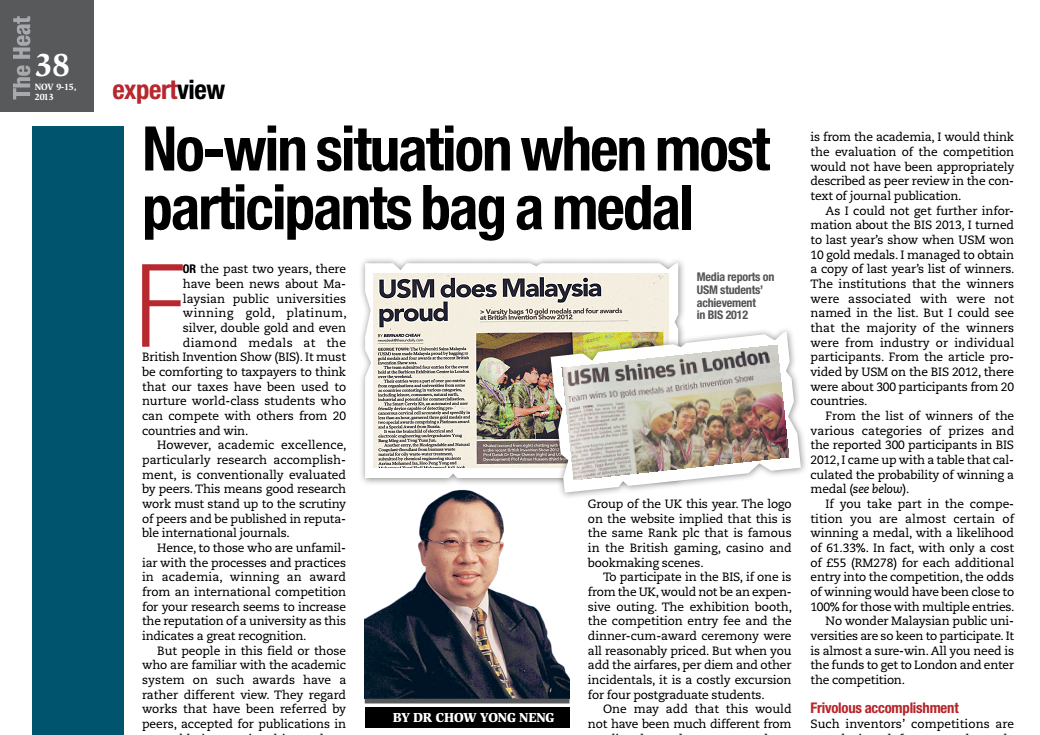
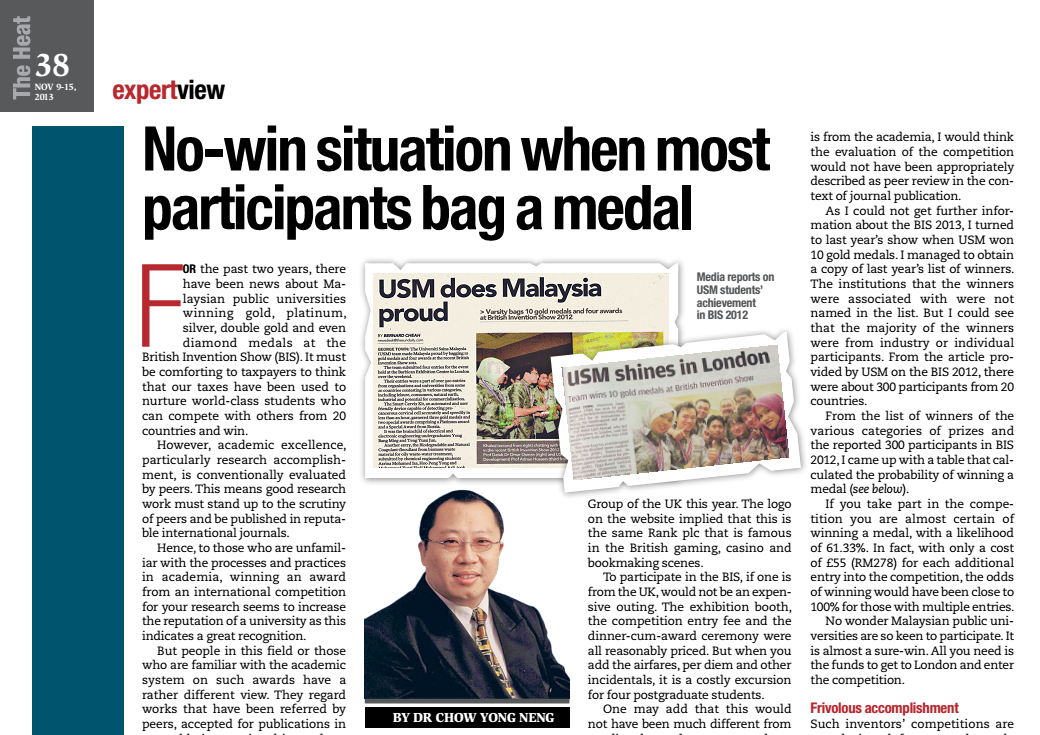
One of us has written a piece for The Heat (Friday, 08 Nov 2013) on the self-congratulatory acts by local public universities which cannot produce good research to “score” points. They sent students and staff to attend inventors show where more than 60% of entries win a prize (and team will have more than one entry…making it a sure win).

Read more: http://www.theheat.my/Article.aspx?ArticleId=1675

Spend on agriculture research, not another university

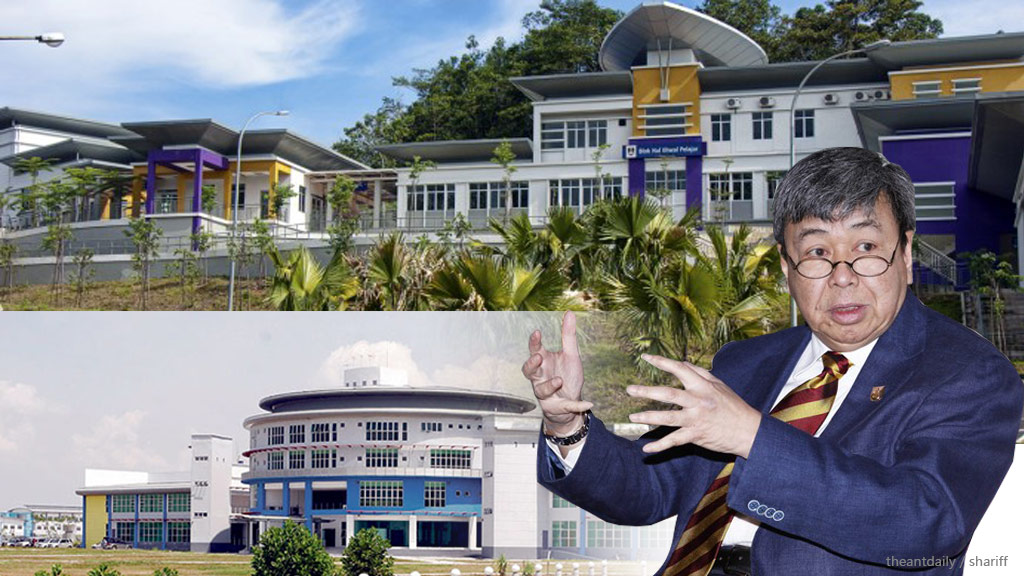
One of us wrote this piece on theantdaily in response to the rejection by The Sultan of Selangor to the plan to open an agriculture university.
Last updated on 05/11/2013 – 08:09

Posted on 03/11/2013 – 15:36

Chow Yong Neng

COMMENT: The Sultan of Selangor Sultan Sharafuddin Idris Shah has said that there is no necessity to set up a new agriculture university in Malaysia. His opinion and wisdom should be most valued by everyone.

Malaysia, with a small population of 28 million, on a per capita basis has one of the largest numbers of institutions of higher learning. From the Department of Higher Education of the Ministry of Education’s directory of private colleges and universities, we can see that there are no fewer than 485 establishments in Malaysia, with 67 having the status of university, university college or branch campus of a foreign university. In the public sector, there are 20 public universities, 32 polytechnics and 86 community colleges. With these many institutions – with many in the public sector having adequate research infrastructure and many private institutions having excess capacity – it just does not make any economic sense to set up yet another public university catering to agriculture and agro-based industry.

To put the cost into perspective, the Universiti Industri Selangor (Unisel) was established at a cost of between RM285 million and RM1.5 billion, depending on whose figure you take. Unisel will be in the size range and land allocation that an agriculture university should have. Even the lower figure of RM285 million is still a lot of money. This sum of RM285 million can fund at least the tuition fees of 5,000 undergraduate students for the entire duration of their degree studies at private institutions.

As rightly pointed out by the Sultan, Universiti Putra Malaysia, or more appropriately, its previous name, Universiti Pertanian Malaysia (UPM), has good infrastructure already in place to teach and do research on agriculture. In fact, it would be most cost-effective to channel resources to re-emphasise the teaching, learning and research work of UPM. However, relying on just one institution for a strategically important sector as agriculture is risky. Thus, the resources and funding that have been earmarked for the setting up of a new agriculture university can be used to establish or strengthen agriculture faculties in regional universities in Sabah, Sarawak and Pahang.

As an agriculture graduate, I can attest to the vast resources required in having a full-fledged agriculture faculty. You will need ample supply of land for experimental agriculture in crop husbandry, animal husbandry and, of course, plantation management. Land, animals, crops and machinery are very costly to acquire and maintain. The expertise required, as agriculture is a very broad field, is again very extensive. You will need experts from all the branches of agricultural sciences (soil science, botany, animal health, entomology, to name a few), plantation management, agro-biotechnology, agricultural business and so on. Thus it may be good to set up centres of expertise in different universities to spread the load. Plantation management is in fact the most important. A lot of research and development work is being done by the Malaysian Agriculture Research Institute (Mardi) and research institutes of the Malaysian Palm Oil Board (MPOB), which collectively have a broad range of expertise required. I think the strengths of Mardi and MPOB can be tapped to extend the teaching and research of the agriculture faculties of universities. I was in fact taught mostly by scientists and researchers from an institution akin to Mardi where I learned my rope in agriculture in Northern Ireland decades ago. So this can be done easily.

I would suggest that we do not stop at the public institutions. Large plantation companies like United Plantation, Felda, Sime Darby and IOI have all been doing lots of research and have collectively amassed a great deal of expertise in their respective research laboratories; most are not only research-based but of production scales as well. The government should not reinvent the wheel; it should tap into the expertise and research (as well as teaching) superiority of these companies to ensure that Malaysian agriculture graduates are skilled in plantation science and management as well. Plantation science and management is one of the very few areas that Malaysia can claim world-class expertise. Spending on enhancing and developing our expertise further is a no-brainer.

The government should also allocate some of the resources saved from the infrastructure cost of the planned agriculture university to encourage private colleges and universities in Malaysia to teach and conduct research on some areas of agriculture, agro-based industry and plantation management. Nottingham University Malaysia (NUM) has already set up a research centre named Crop for the Future Research Centre to look into underutilised and neglected crops. Funding should be provided to private institutions of higher learning with university status like NUM, Taylor’s, SEGi, HELP, Unisel and so on to establish and operate research centres specialising in different areas of agriculture and plantation science and  management to broaden the scope of expertise within our nation.

Another area that is closely related to agriculture but has been neglected completely is in the taxonomic studies of plants and animals. With expertise in these two fields, Malaysia has the chance of finding the next oil palm or rubber as a plantation crop or new species of animal  for farming or other economic exploitation.

The only issue left is whether the power-that-be will listen to common sense and realign the path to achieving its objective of harnessing and nurturing agriculture and plantation science and management expertise for the country in a more cost-effective and broad-based manner.

Dr Chow Yong Neng studied and earned a Bachelor of Agriculture degree from the Queen’s University of Belfast, Northern Ireland and holds two postgraduate qualifications, a Master of Science and a PhD from the University.

Do you need RM270 mil to train 7,500 teachers?

[show_post_categories show=”category” hyperlink=”yes”]

[show_post_categories show=”tag” hyperlink=”yes”]

Dr. Chow Yong Neng contributed this piece in 2013 to the now defunct theantdaily.com.

######################################

This piece was written by one of us commenting on the spending of RM270 millions to mentor 7,500 English teachers.

Last updated on 28/10/2013 – 15:51

Posted on 27/10/2013 – 20:00

Chow Yong Neng

COMMENT: The controversy surrounding the Education Ministry’s RM270 million spending on 360 expatriate “native speakers” as mentors for 7,500 Malaysian teachers over three years (from 2011 to 2013) has created a lot of debates. I think we need to break down the figures for a better understanding of the issue.

Firstly, let us break down the RM270 million. To train 7,500 teachers with a budget of RM270 million, each teacher was allocated RM36,000 over three years. In other words, the project allocates RM12,000 per participant per year. This is rather a high figure for mentoring, since most college-level full-time course fees range from about RM8,000 to RM18,000 at private colleges. Full- day corporate training programmes (for eight hours per session) cost around RM1,000 per person. Assuming that training or mentoring was done monthly for the entire 36-month duration, then the training fees would have been around RM1,000 per person per month. This is about twice the rate charged by typical corporate training programmes. Expensive, true, but not really excessive as some high-level executive programmes are priced much higher for half-day programmes.

Thus if we view this RM270 million project as a high-end executive programme, the cost is within that range to train 7,500 teachers. But one should ask this question: were these teachers considered as having the calibre of senior executives? Often for the kind of price, executive training programmes would have been conducted at hotels. Were hotels used as the venue for this teacher mentoring programme? In other words, what kind of training facilities were given to the teachers for these mentoring sessions?

Now we look at the supply side: 360 “native speakers” from overseas to act as mentors. If the entire budget was put to the cost of salaries, then each mentor would cost RM750,000 or RM250,000 per year. However, I think this figure should include not just their salaries, but also the curriculum, venues and cost of travelling and so on. The figure of RM20,000 per month is a salary commanded by people serving as deputy vice-chancellors at private universities. Thus it would be of interest to know the exact “pedigree” of these expatriate mentors.

The salaries for UK lecturers in the higher education sector currently range from £33,000 to £43,000 per year (about RM168,630 to RM219,730). Hence, if we assume that all the mentors were senior academics, then the figure of RM250,000 per person per year was not that far off. However, one should ask the question: why do we need so many mentors, especially if they are giving only one half-day session of mentoring per month? The mentor:mentee ratio was 1:21 (7,500 mentees to 360 mentors). For private colleges and universities, the prescribed lecturer:student ratio for non-technical full-time courses in Malaysia is 1:25. The corporate training sector also has a practice of trainer:trainee ratio of 1:25.

Thus if these expatriate mentors were actually working full-time, giving just one mentoring session a day, five days a week, to cover 7,500 participants (and at a mentor:mentee ration of 1:21), there would be only a need for 72 expatriate mentors. Thus about 20% of the 360 expatriate mentors would have been sufficient for the project.

Let’s be generous, to cover the entire nation especially the rural regions of Sabah and Sarawak, we could add in another 10% of the number of full-time expatriate mentors, and the total number required for the project would still be 110. Thus there is credence to Bukit Bendera MP Zairil Khir Johari’s conclusion that these expatriate mentors were in fact on three-year paid holidays. Someone was really having a good time and profiting at Malaysian taxpayers’ expense.

We next look at the question: what if the RM270 million project was given to Malaysian institutions of higher learning to manage, would it be cheaper? There are many colleges and universities in the country that could do this job well. Government-linked investment company, Ekuinas (Ekuiti Nasional Bhd), actually owns many colleges. It bought over 90% of Cosmopoint Group for RM246 million in April 2012. Cosmopoint can accommodate 11,000 students and has 13 centres nationwide. One wonders why the project was not given to GLC-owned colleges like Cosmopoint or 11 state-funded skills development centres of the Federation of Malaysian Skills Development Centre or even specialist English teaching private college groups such as ELS Language Centres and Erican Education Group to handle. After all, these specialist English language centres have years of experience not only in teaching but in hiring and maximising the talent of “native speakers”. They also have the facilities in multiple locations to enhance the learning of the participants.

Even if we still hire the 110 expatriate mentors to drive the programme at a cost of RM82.5 million for the three years of the project (at RM250,000 per person per year), there would still be a lot of the budget left to ensure that the mentoring skills were picked up by Malaysian institutions (assuming that our lot did not have what it takes in the first place, which I would dispute). At most, I think the operation of the project would have cost another RM82.5 million, thus around RM165 million would have been sufficient to train 7,500 teachers over three years. Thus RM100 million or more could have been saved.

One last point: had the Education Ministry ever thought of making use of the experience, expertise and teaching skills of those retired English teachers in their 60s and 70s? A great many of us in our 40s and 50s were taught by these teachers and many of us had been well taught. This group of retirees must have had what it took to teach their students well. Many would have no problem serving as mentors, one session or two a week to train the current generation of English teachers. I dare say the cost would have been much lower too. It is about time that the ministry learned how to evaluate and value the large talent pool that it has at its disposal.

My personal experience, having been taught by “native speakers” while studying in the UK, is that unless these “native speakers” also have learned a second language at a high level, they often do not have the empathy for people learning English as a foreign language. They are not the most suitable people to teach English to “non-native learners”! I wonder how many of those 360 “native speakers” had one or more language credentials besides English.

Dr Chow Yong Neng has served the education and training industry for over 17 years in diverse capacities.

Original story: http://www.theantdaily.com/news/2013/10/27/do-you-need-rm270-mil-train-7500-teachers

Dubious qualifications and fool’s gold

What’s the difference between real gold and fool’s gold? Dubious qualifications is just like fool’s gold with the holders being the fools!

[show_post_categories show=”category” hyperlink=”yes”]

[show_post_categories show=”tag” hyperlink=”yes”]

The original post was published in The Ant Daily which is now closed: http://www.theantdaily.com/news/2013/10/10/dubious-qualifications-and-fools-gold . In view of the recent news reports in the Chinese press about traditional medicine practitioners being conned up to RM50,000 for dubious Ph.Ds, I think it may be good to remind people about what I talked about in this article. … (commentary: Feb 23, 2017)

In response to a federal minister trying to defend his dubious qualifications, one of us wrote this piece for theantdaily.com.

Last updated on 10/10/2013 – 12:34

Posted on 10/10/2013 – 12:31

Chow Yong Neng

COMMENT: The recent debate in Parliament on the issue of cabinet ministers having dubious degrees and the inapt defence provided to sweep this under the carpet provided lots of amusement for the masses. In this week’s The Heat, the story of dubious qualifications has been well covered. However, at issue is a few facts that could perhaps put paid to the defence provided by those who have purchased such qualifications.

Fake or genuine

I agree fully with the Minister of Human Resources Datuk Richard Riot Jaem’s contention that the qualifications he had presented were not fake. Indeed these are 100% genuine, with one big caveat; the qualifications were issued by degree mills. There is no academic standing whatsoever in these pieces of paper that the good Datuk holds. Let us call these papers by their proper collective name: dubious qualifications.

Recognised and accredited

A check with Jabatan Perkhidmatan Awam’s (JPA) website revealed that neither Preston University (USA) nor Chartered Institute of Business Administration (Ireland) was listed. Similarly, Preston University was not listed in the website of USA’s Council for Higher Education Accreditation (CHEA). Thus the minister’s dubious qualifications are not only unrecognised but also unaccredited. CHEA also provided links to several US state governments’ websites which specifically warned that anyone using dubious qualifications will be deemed to have committed a felony.

Funny as it may seem, I personally have seen a JPA letter of recognition issued for another famous degree mill, Irish International University, on the latter’s website (which has since disappeared from cyberspace). Thus JPA’s letter of recognition is not a good yardstick in telling if a qualification is of the dubious kind. One should check with JPA’s website for confirmation.

With the minister having access to the civil service machinery during his many years of service, especially his stint as a deputy minister, he could have asked his officers to check with JPA on his qualifications, since he had “worked very hard for it”. As a six-term Member of Parliament he would have been involved or at least seen the papers tabled for the amendments to Acta 555 a few years back. Acta 555 governs the operations of private institutions of higher learning (PHEI). Part of the amendments was to deal with degree mills. Thus it can be assumed that the minister comprehends fully the penalties and so on for PHEIs to offer and/or conduct academic programmes without proper approvals and the measures taken to deal with degree mills. If my memory serves me correctly, the commercial outfit that was part of the Preston University (USA) degree mill scam was located in Puchong, Selangor. I think that a learned person like the minister would have no trouble differentiating the “real McCoy” for a college from a degree mill which this outfit in Puchong was. Thus there were ample opportunities for the good minister to “discover” that what he “worked very hard for” was worthless. If he then had taken the path of burying these qualifications, since he was already so good as to represent the country over 50 times to give speeches in English, none of us would have been wiser and the issue would not have arisen.

Integrity & country’s reputation

The common copper ore, copper pyrites resembles gold and is called fool’s gold. If one tries to pass off copper pyrites as gold, he would have been branded as a cheat. In the same context, dubious qualifications are the same as copper pyrites. There is still no law in the country to stop anyone from buying a dubious qualification for self-satisfaction, frame it and hang it on his wall as suggested in Parliament by another minister. However, if you are getting jobs, highly paid corporate appointments or cabinet posts using dubious qualifications, it is the same as selling fool’s gold as real gold.

There is a Chinese saying, “real gold will withstand the fire from the stove”. Thus the fool’s gold presented in this case is melting easily and now burning its holder’s fingers.

Dr Chow Yong Neng has served the education and training industry for 21 years. He takes particular interest in discovering and collecting stories about dubious qualifications and their holders.