
Scholarships to study in US ivy league for China’s poor: why this is great?

US $100 million education fund to send China’s poor high achievers to Ivy League schools in the USA.

A recent Wall Street Journal’s report about the US$100 million education fund set up by one of China’s growing band of billionaires to send China higher achievers from poor families to US ivy league universities generated a lot of unexpected reactions.

Billionaires Zhang Xin and her husband, Pan Shiyi of SOHO China who made their fortune in properties in China had donated US$100 million to set up this education fund. The fund’s main aim is to finance high achieving students from poor families in China to elite schools in the USA for their undergraduate education.

One would have expected positive reactions from across the country to this philanthropic deed. However a look at the comments left by readers of this article would indicate the responses were diverse. Though most commentaries stated that the philanthropic act of Zhang and Pan was good, many differed in their opinion on why the money has to be spent on institutions in the USA. The argument most cited was that China has world-class universities, why not spread the fund more widely by financing poor students to study in China? Similar sort of arguments have been given by Malaysians as to the value of the Malaysian Government spending millions of ringgit sending students to study overseas.

In fact the cost of higher education in China is relatively low compared to the USA and even Malaysia. Thus many from poor families in China, if they have good Gaokao (university entrance examination) scores it would not be difficult for them to get into high ranking Chinese universities and by the same account some sort of funding. But if one select from among this group of high achievers and fund their studies overseas, there are many benefits that the country will gain.

There are 3 most obvious reasons why the education fund from Zhang and Pan is aiming to send high achievers from poor families to ivy league schools in the USA:

1. Great exposure to Western ideas, innovation and approaches to solve problems:
Zhang Xin herself is a recipient of a scholarship that enable her to gain a Western education. But she had to work in a sweatshop in Hong Kong for five years before saving enough to go to London to enroll in a language school, working to pay her way before securing a scholarship for her undergraduate studies. Zhang must have appreciated the differences in approach to tackle problems in the West compared to what is practiced in China. I think without integrating and “cross fertilizing” of Western innovative approaches with the pragmatism of the Chinese “way”, Zhang might not have made it to the major league. Thinking out of the box is not something in the culture and traditions of the Chinese. By sending high achievers from China to top universities in the USA, Zhang and Pan will help to create an elite group of highly intelligent young people who will have the benefit of this “blended” approach to help solve many problems that China will face.

2. Great networking potential:
Only by learning and working with elite scholars from all over the world will a high achievers from China be able to learn to be expand his/her horizon. This sort of networking and friendships forged with fellow elite high achievers from all over the world can only be found at elite universities and US ivy league schools perhaps have the best mix of high achievers from all over the world. Although China’s elite universities have been admitting increasing number of foreign students, the number and “mix” of nationalities is still minute compared to their peers in the West, especially USA ivy league. This sort of network that is built when one is at undergraduate levels will bring tremendous payouts when these high achieving China students complete their studies and move on to industry or academia. This sort of networking will not only do the scholarship holders a great deal of good but will benefit  China immensely in many different dimensions in the long run.

3.  Character building:
The most crucial lesson that every student who is fortunate enough (including this author) to receive an opportunity to study in a Western country is indeed the need to “grow up” fast, to be independent and to be accountable for one’s own actions, i.e. character building. This sort of character building is most pronounced if one is living and learning in an environment and culture that are totally alien to what one is accustomed to. To survive, study and thrive in elite ivy league schools in the USA, Chinese students will have to be able to communicate well and be independent in their thinking, both may not be easily attainable if they were to study in their home country.

The same three reasons above are what drive many parents in Asia to send their children to study in the West even when faced with escalating cost every year.

Now, I only hope that we have our own version of Zhang Zin and Pan Shiyi in Malaysia!

Footnote: This article is contributed by Dr. YN Chow who spent about 12 years studying in the UK.

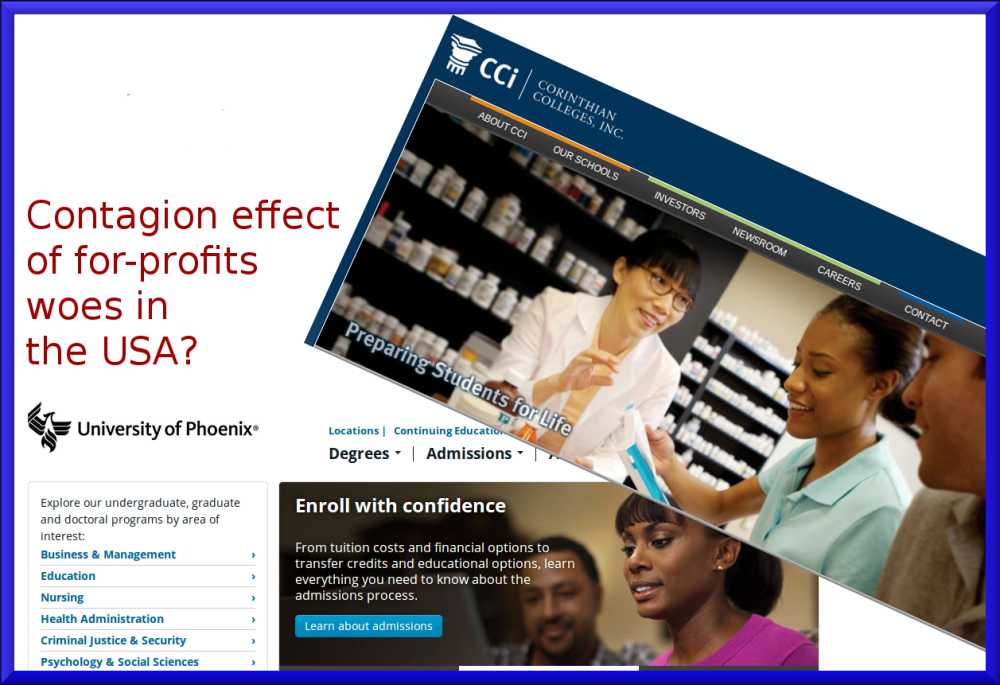
Contagion effects of for-profit colleges woes?

On the day that Americans celebrated the country’s independence day, The Huffington Post reported that one of the largest for-profit college groups in the USA, Corinthian Colleges was heading for disaster. The crux of the matter was due to Corinthian’s over reliant on federal government-backed study loans to the bulk of its 72,000 student loan which was effectively pulled back by the authority. For 2013 Corinthian had a revenue of US$1.6 billion, US$1.4 billion of which was attributed to federal government-backed study loans. 85 out of over 100 of Corinthian’s campuses over 25 states are now up for sale with another 12 slated for full closure.

Although Corinthian gave reassurance to affected students that their studies would not be disrupted, the damage to the confidence of the market is irreparably done.  Corinthian’s case has not been helped by a judge ruling that it does not need to disclose its financial woes in any of its advertising materials. This fuels speculations that there must be more that meet the eyes as far as Corinthian’s predicament is concerned.  It was disclosed that Corinthian’s case may just be the tip of the iceberg, another for-profit group, ITT Education Services Inc. is set to lose some of its federal government funding.

Just 10 days later, a routine audit and review by the U.S. Department of Education (DOE) on the largest for-profit education group, Apollo Education Group which, according to Apollo was a routine procedural matters was read by the market, in light of the Corinthian case with “controlled alarm“.

Are we seeing a contagion effect on the for-profit higher education sector in the USA? Will this contagion effect due to the pulling back and tightening scrutiny of for-profit players in the USA have a “mirror” image if PTPTN (Malaysia’s National Higher Education Funding Corporation) copies some of the measures taken by the USA’s DOE?

So far PTPTN has been concentrating on its efforts in the recovery of study loans and it has not been paying too much attention on the education providers. It is surely highly beneficial if PTPTN performs periodic auditing and review of all the education providers, both public and private to ensure that the study loans provided are spent prudently and achieving their intended purposes.

PTPTN can also collaborate with other agencies such as the Malaysian Qualifications Agency which oversees the quality of teaching and learning of higher education providers to ensure that their respective databases can be cross-referenced.

The yearly amount of RM5.0 billion injected to the entire Malaysian higher education industry as student loans. This is the fuel that sustains the bulk of the for-profit institutions of higher learning in Malaysia. More stringent reporting and auditing procedures should be levied on all institutions of higher learning whose students are receiving PTPTN loans. Institutions, whether public or private with high percentage of PTPTN loan defaulters should be made accountable and if needed, PTPTN should do like the DOE of USA, pull funding from these institutions accordingly.

If we let the status quo persists, the student loan contagion effect of the USA will reach our shores sooner than you expect!

Footnote: Dr. Chow has an opinion piece on his column in the weekly, The Heat dealing with his experience in repayment of study loan and why he sleeps soundly each night as his conscience is clear, he paid back all he had owed! 


Updates:

July 20, 2014: It seems that the contagion effect has started in the USA. Another for-profit education group is under the spotlight. This time, DeVry University is being investigated by New York Attorney General.

Negative comments on social media ain’t that bad

A recent posting by a social media marketer, Praveen Inbarajan on Linkedin describeed a scenario where a Indian cab company’s Facebook promo advertisement was bringing more than the cab company, TaxiForSure (TFS) bargained for: a deluge of negative comments.

Inbarajan went on to give a commentary on some of the more vocal feedback provided by Facebook users whom  the promo advertisement had targeted with good precision. While I agree with Inbarajan’s interpretation of the grouses of the respondents to TFS’s post, I feel that Inbarajan, as a social media marketer, missed the point of such feedback.

Negative feedback is not necessarily equals to bad public relation. No one, least of all a cab company with many drivers, can please every body all the time. The billion dollar question is, how TFS deals with these negative responses.

TFS could have deleted all the negative comments to “protect” its public image and we are none the wiser which fortunate for TFS that it did not. What has turned the tide in TFS’s favour is indeed it readiness to admit the errors as pointed out by the respondents and apologized. In my book, if I am not happy with a company’s services and complained there are three things I will be receptive to which will turn me from an irate respondent to a sympathetic listener:

(a) They apologize for the errors:

This will calm down most people with a grouse with the company’s services or products. It is the first step to resolve a customer relation issue.

(b) They (presumably after looking at the compliant) admit fault:

This will have the effect of defusing any explosive situation. However in some litigious business environment, admitting fault may have implications on compensation etc.  however, a company should always treat this as the first step to stop litigation. In most cases, the complainer just want to get heard. If you hear them out and ascertain the fact that they are right, you can, in most cases win them over.

(c) They offer some token redress to the complainer:

Most people who feel that they have been wronged by a company’s staff, services or products, will be very prepared to accept even token redress such as a Starbucks voucher, or discount coupons. This is because most people do not expect to receive any response from the company, let alone an apology (best from someone with seniority) and a token of appreciation. The good will generated from this gesture is worth many times the face value of the vouchers.

I think what is worst will be a situation where having put up a promo advertisement like TFS did, a company’s staff are not monitoring the Facebook post and respond to feedback in a timely manner. Timely means at most 3 – 4 hours after the comment is made, not three to four days! Wasting the promo ad cost is the least of the problems, giving negative impression to all those who have responded is worst.

I have a situation whereby my team put up a promo on a posting of a new property development project for a company and obtained over 90 responses, some asking to be contacted as these were clearly  prospective customers wanted more information. The RM90.00 (less than US$30) budget spent had created the kind of reach and engagement that we designed. I thought this posting and promo advertisement would have generated some good sales for the properties company. However, the lynch pin of the whole work was of course the timely and accurate engagement by the project owner, the marketing staff of this development project. No one from the marketing team bothered to take the effort to engage with the prospective customers despite desperate pleas from me. In short, no one took ownership for the campaign (except the poor social media guys). We had a situation that not only created negative vibes among the respondents but anyone else looking at the Facebook posting will have a negative impression of the company as a whole. This is the worst kind of social media nightmare compared to the one that TFS has to deal with!

After the above episode, I changed my operational principle: before I set up a campaign on Facebook for anyone, I would get the sign off from the senior manager to confirm that she/he would ensure that her/his staff would not only monitor the posting regularly, but put effort to respond to comments in a timely manner. I needed the buy-in for the whole campaign from the project owner, otherwise it would be no deal from me! This evidently has turned out to be a beneficial move. A social media marketing campaign is as effective as the campaign owner’s preparedness to engage directly, timely and effectively with the intended target audience. This is no rocket science!

Footnote: This article is contributed by Dr. Chow Yong Neng who for a period of close to 10 months was engaged fully with using social media to drive engagement and traffic to his employer’s news portal.

Multitasking, smartphone and easy distractibility

As supervisors, managers or bosses if we expect our staff to multitask, we should be prepared for our staff’s inability to perform with 100% efficiency and effectiveness. Instead fast-switching between tasks should be encouraged.

[show_post_categories show=”category” hyperlink=”yes”]

[show_post_categories show=”category” tag=”yes”]

Commentary (Apr 20.2018)

I contributed this article entitled, “Multitasking bad for work efficiency” to Focus Malaysia when I was working for HCK Capital Group Bhd. . The article was published under my moniker of  “Plantcloner”. At that time my son was a student of SEGi University  and we shared a ride in my car on each working day.


Observing multitasking by a “pretty young thing”

My son passed his driving test a few months back, but he lacks confidence in handling Klang Valley’s road and whenever I have the chance, I would be his “driving instructor” and let him drive. A few days back when I was being “chauffeured” home I noticed a pretty young thing (PYT) driving beside my car (but slightly behind) but she did not seem to pay any attention when my son indicated to join her lane on the highway. As it was the rush hour on New Klang Valley Expressway, the traffic was bumper to bumper. It gave me a chance to observe (and tried to find out) why the PYT was not paying attention to my son’s signal: she was talking on the mobile phone! As my car and PYT’s car were side by side for over 5 km, it gave me more opportunities to observe the PYT further. After finishing her mobile phone conversation, the PYT went on to send some text messages or instant messages on her mobile phone, then a few minutes later, she whipped out a makeup box with a mirror and went on to apply something on her face. All the while we were travelling at about 25 km/h in parallel! I guess the PYT was just multitasking. Luckily for my son and I (and for the PYT), she was a better driver than my son and no untoward incident occurred.

You’re dumber when multitasking!

I have read Joe Kraus’s blog posting on multitasking and watched his TED Talk video entitled, “Slow Tech” . This was what Kraus said about multitasking: “It’s shown not only that we’re dumber when we do this (an average of 10 IQ points dumber……), but that we’re also 40% less efficient at whatever it is we’re doing.” This probably sums up why multitasking is bad for your work efficiency or whatever you intend to do.

A few weeks ago I  completed the Massive Open Online Course entitled “Understanding media by understanding Google” by veteran journalist and Knight Chair in Digital Media Strategy of Northwestern University, Professor Owen Youngman. One of the written assignments asked, “If someone instinctively and repeatedly picks up a mobile device to consume media while engaged in another activity, which of the following do you believe is more likely to be true of that person: (1) he/she is engaged & seeking to enhance and deepen the first activity or (2) he/she is bored & is seeking to be distracted from the first activity?”  How often have you encountered colleagues (or even yourself) in a formal meeting doing just that: whipping out the smartphone and checking for emails, SMS, BBM, Twitter etc. every now and again? Is this multitasking or it this easy distraction? Is the person bored? In most cases, I think the person was forced to multitask. Sound familiar?

Demand of modern days for multitasking?

With the current “24 by 7” business operating environment, clients and colleagues across continents and many time zones have the expectation of having their needs taken care of & queries answered instantly. Thus it is inevitable that disruption and distractions from these sources via the smartphone happen during all hours of the day and nights. It seems that the 8-hours working day has now been, with the “always-on-always-connected” mobile internet, replaced by the 18-hours working day (with 6 hours left for sleep). I really enjoyed my stint working with Pearson plc where my British boss would not dared to call me after work and during public holidays. It could have been the Britishness in him but I guess the man was worried that if he were to call me, I would reciprocate when he would be on his holidays sunning himself in some beach with his family!

I think as a superior you should not demand that regardless of the hour of the day/night or the staff’s current situation, he/she must answer your text messages, emails etc. within 30 minutes or some tight timeframe. Despite the disruptions and distractions involved, your staff will have no choice but to check up on his/her smartphone periodically watching out for text messages, instant messages, Blackberry Messages, Tweets etc. from you and multitask. [Note: this piece was written long before the “Right to disconnect” issue made it to the fore!]

Fast switching vs multitasking

The best thing to do, it seems, is not engage in multitasking at all, which is just fast switching between tasks. You are spreading your mental capacity and attention too thinly. If you look at a juggler, he/she can juggle 3, 4 or even 5 items at most. But in today’s work environment, most staff are expected to juggle many more tasks than 5, with some staff ended up not “catching” any single item. I think bosses should recognise the peril of multitasking. Like the PYT, if she were to multitask more strenuously while driving, she might end up causing a car accident!

I think we cannot change the current work and business environment in light of the advance in technology. The best for one to do is to prioritise and perhaps do what I call “semi-multitasking”. You should have all the tasks in a prioritized list, instead of working your way down the list,  you should go on to commence work on every task in the list but paying more attention in accordance to the priority and importance of the task. In this way, you will have made at least a start in each task assigned and have a better chance of completing each with maybe not 100% but at least close to 80 or 90% efficiency . I think your IQ dip for each task will be much less than 10 points! It is also good to separate routine multitasks from ad hoc tasks because routine tasks usually have tighter deadlines. If possible enlist the help of and encourage ownership of tasks by your staff and you may find that your collective efficiency and IQ go up significantly.

Hilarious consequences of multitasking too much

There is a current TV advertisement about a secretary having to multitask, she needed to arrange for a parcel to be sent and to book a flight for her boss both at the same time. She ended up sending the parcel by business-class flight and the boss on a tin-pot airline flying with chicken in the plane. That sums up the peril of multitasking! I think as supervisors, managers or bosses if we expect our staff to multitask, we should be prepared for our staff’s inability to perform with 100% efficiency and effectiveness.

Footnote:

This is the unedited version of my original piece. I usually have to juggle more than 5 tasks in any working day. With “semi-multitasking” I managed to minimise “accidents” and still achieve a reasonable efficiency & effectiveness in the tasks I accomplished.


A great way to learn about genetics & how it affects you

I was one of the “guinea pigs” of Queen’s University of Belfast in 1985 when along with 5 others from the Class of 1985, I was awarded a scholarship to be the pioneer batch of Master of Science students in the newly minted Biotechnology programme.

A lot the then state-of-the-art knowledge that I was imparted with have indeed been superseded over the last 20 odd years of intense research in this domain. However, the basics in genetics, I hope do not change much.

When I first review this course, Genes and the Human Condition from The University of Maryland under Coursera, I thought to myself, since this course does not have any requirements in advanced biology, it may be too easy for me. I guess I did not know how much I have forgotten about genetics that I picked up about 30 years ago. After taking Week 1 classes, I have decided to stick to this course till its completion. I guess I have a lot of unlearning and re-learning to do. 

Although the course information states that there is no requirement for advanced biology. I think one will have to have at least some knowledge of high school level biology to appreciate the course fully. Professor Tammantha O’Brien (who gives Week 1 classes) is very animated in the way she teaches and the lectures can be a bit too fast at times, her enthusiasm to teach is infectious on the learners’ mood to learn. In short, you will learn a lot if you make the effort to keep up with her. Professor. O’Brien’s co-instructor, Professor Raymond J. St. Legar’s classes has yet to start.

There is still a couple of days to the end of Week 1 and I urge those who want to know about how genes work and how genetics affects you should give this MOOC a go.

Already this “revision” course for me has kept me updated on the subject of genetics. I will be a better teacher if I get to teach my plant tissue culture class again! It took me less than 3 hours to complete Week 1, but I expect that I will need to put in more in later weeks because Week 1 is a sort of revision for me!

(This article is contributed by Dr. Chow Yong Neng)

Creating tangible value from MOOCs?

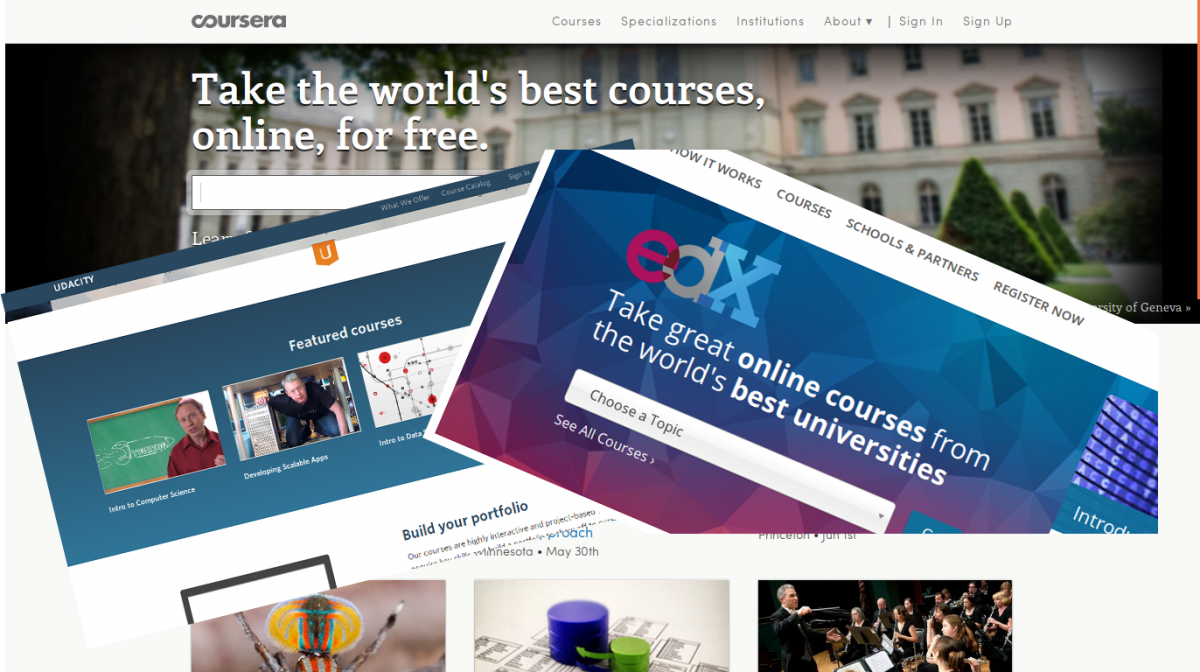
Since the pioneers of the MOOC movement have been the US universities, it is understandable for the World to expect some sort of leadership in this field from these pioneers. One thing that have been missing from most of these players is indeed a credible business model, without which MOOCs may not be sustainable.

[show_post_categories show=”category” hyperlink=”yes”]

[show_post_categories show=”tag” hyperlink=”yes”]

Since the pioneers of the Massive Open Online Courses (MOOC) movement have been the US universities, it is understandable for the World to expect some sort of leadership in this field from these pioneers.

One thing that have been missing from most of these players is indeed a credible business model. Along the way, both Coursera and Udacity have introduced “premium” assessment model whereby the identity of the MOOC learner is verified (in Udacity’s case, it even have an online proctored examination system) and hence the academic credit earned will be acceptable to some institutions. My son took an introductory statistics course from Udacity and under “ProctorU”  (an online proctored examination service company) his credit, granted by St. Jose State University should be acceptable to his US university. The fees for this was US$150.  However all these add-on services are not paying the bills for these players. For the massiveness of its enrollment, MOOCs only have completion rates of about 7%, and even lower percentage of these learners would be “buying” the premium services.

I have mentioned in my previous article on MOOC that there are several ways that the MOOC players can generate income streams. In fact a recent report stated that one of the income streams (as I have mentioned) is indeed the recruitment of students to the universities associated with one of the MOOC players. 2 years ago I mooted the idea of MOOC to some for-profit higher education providers in Malaysia, but none managed to see beyond the trees to the positive branding effects of MOOC. Perhaps now with this article they should say, “We should have listened to that fellow”!!

I do not think that this revenue stream will be large, but I think the branding effect of successful MOOCs are great for the providing institutions. Whether this will end up in positive foreign student recruitment (which is a very complicated and complex affair) and how the MOOC players are paid for the recruitment is a different matter (will it be cost-per-click through or full fledged recruitment services?).

I think there is one element that none of the big MOOC player:s have explored: the corporate training domain. Although Udacity’s “nanodegree” is a good initiative that plots a MOOC course-learning path for learners. If they complete the suite of Udacity’s MOOCs successfully, this will put them in a position of advantage with skill-sets that employers (who have collaborated with Udacity)  want. This model is still sticking to mainly academic learning mixed with professional-skills courses. In fact many of the existing MOOCs have elements of learning that can be easily re-purposed for corporate learning and training usage. These learning courseware and delivery system are the key to creating a recurring revenue stream for the MOOC players. If the learning outcomes of these can be pegged with college credits or “star employers” acceptance as in the case of nanodegree of Udacity, I think the corporate learning providers out there will be able to sell these to their clients and learners easily.

With more and more smaller MOOC players with varying degree of quality coming on stream these days, I feel that some sort of consolidation will have to take place soon, especially with the current lack of any profitable business models.

(This article is contributed by Dr. YN Chow)

HRDF Funding of training – the Malaysian employees’ perspective

[show_post_categories show=”category” hyperlink=”yes”]

[show_post_categories show=”tag” hyperlink=”yes”]

This is the unedited version of an article published as “Fairer disbursement of HRDF grant sorely needed” in Focus Malaysia on July 06, 2013, written by Dr. YN Chow under his moniker of Plantcloner. He  thinks that a boss who says, “our people is our greatest asset” or words to that effect must be prepared to put his/her  money where his/her mouths is and invest accordingly and do so on a regular basis.

__________________________________________________

Up-skilling, re-skilling, cross-skilling are the buzzwords these days in the corporate learning and training circle.

To ensure that Malaysia’s goal of attaining developed nation status is achieved by 2020, the Perbadanan Sumber Manusia Berhad Act (PSMB Act) was enacted in 1993 and revised in 2001. Thus PSMB, a corporatized government agency was formed.

PSMB Act enactment was followed by the formation of Human Resource Development Fund (HRDF) where manufacturing and service industries in Malaysia were mandated to contribute 1% of their payroll per month into the HRDF.  The idea was for HRDF to provide training grants from the levy for the purpose to training of employees of contributors.

The collection of levy by HRDF has been very successful, it has been reported in December 2012 that RM3.96 billions had been collected with RM3.21 billions disbursed since HRDF’s inception where utilization of the fund was at 80%.

One should ask how effective has the distribution of HRDF grant in improving the human capital of Malaysia been? Who actually calls the shots when it comes to the spending of the grant: the employer or the employees?

In fact there are more to those statistics published by PSMB in its annual reports that meet the eyes.

For starters, if the objective of HRDF is to ensure that Malaysians are continuously up-skilling, cross-skilling and re-skilling themselves, why would there be no provision for employees having any say in the utilization of HRDF grant?

A case in point, in 2009 when I was serving in a corporatized-state-owned entity, a conference on entrepreneurship in institutions of higher learning attracted my attention. The conference fees was only RM900 for this 2 days event. It was an event that would be attended by the “Who’s Who” of industries, higher learning institutions and regulatory bodies. The networking and learning potential of this event were great, especially for a practitioner in the higher education sector. My superior, instead of attending this event with me, went on to disallow the use of HRDF grant to pay for my conference fees. By then, the HRDF levy paid by my company and attributable to me was more than RM1,500. Later from the grapevine I heard that my superior went for a RM19,000-per-person, one week “senior management residential course” by an Ivy League university’s professors paid for by the company. Of course not privy to the company’s HRDF account I was in no position to say if any HRDF grant was given for this event.  A quick calculation would reveal that for an employee to have RM19,000 attributed to his/her payroll contribution to HRDF’s levy, he/she would have to be paid RM1.9 million in annual salary. In my case, I had the last laugh as I was invited by the organizers of the conference to deliver a paper and was given a complimentary ticket. However, not many employees had means and ways like me to find “alternative funding” to attend training or conferences to improve on our knowledge and skills, as was intended by the HRDF grant.

There were many cases of abnormal use of HRDF grant that have been uncovered, but it is beyond the scope of this article.

The crux of the matter is, both the administrator and the employers seem to view the HRDF levy and grant as “belonging” to the employers. It seems that the objective of the PSMB Act for employees to get their training (and hence up-skill, re-skill and cross-skill themselves) is incidental in this context. In fact, the “spending” of HRDF grant is fully decided by the employers. Employers also have the sole discretion on who among their staff is to benefit from the HRDF grant.

Thus for the benefits of the employees, in whose names that annual RM360 million or so contributions to HRDF is made, some changes to the status quo must be seriously considered by the power-that-be.

I have two suggestions that are complementary in their effects in fulfilling the objective of HRDF.

Firstly, it would be easy for PSMB to implement an audit whereby all Malaysian employees of HRDF levy contributing employers shall get at least 1 training spent on them every 24 months. This will mandate employers to plan the spending of the grant to fulfil this obligation. Thus posh retreats and Ivy League universities’ “senior executive programmes” will not be easily charged to the grant. PSMB should also put an upper limit to what employers could claim for an individual employee and take away all those luxurious programmes from their approved list. Implementation of this suggestion will require only minor tweaks to the existing PSMB system.

My second and most equitable suggestion, as far as the employees are concerned, is in splitting the disbursement of HRDF grant into two equal portions. The “Employer’s Portion” should be used for training and related programmes at the sole discretion of the employer. PSMB can also make it compulsory for employers to use this portion for mandatory certification and licensing programmes for their employees. The “Employee’s Portion” should be used for training at the sole discretion of the employee. This means that, like the Employee Provident Fund (EPF), all Malaysian employees should have individual “PSMB Accounts”. Levy/grant contributed to the employee’s account shall stay with the person if he/she  changes job. PSMB has already a good selection of approved programmes which could easily be made more “affordable” to employees. With the larger number of learners, PSMB can even organise these training programmes or seek volume discount from providers to reduce the course fees to further benefit employees. One of the main disadvantages of this suggestion is the extra administrative work involved, but since the current HRDF system already entailed having the individual employee’s name in the accompanied document when HRDF grant is disbursed, apportioning this levy to the respective “PSMB Accounts” is just a matter of a few extra clicks at the computer keyboard. A quick calculation tells me that if this system were to be in place for employees earning RM5,000 per month, in 10 years, their “PSMB Accounts” will each have a balance of RM3,000.

PSMB reported having over 13,300 contributing employers in 2012, and out of about RM360 million levy collected, RM288 million was disbursed as grants to employers. Each year about 20% of the levy collected, or about RM72 million remained “unspent”. I suggest that the “unspent” levy should be disbursed to all the employees’ “PSMB Accounts”.

To realize our nation’s quest for developed nationhood, we need more than just 13,300 business establishments to contribute to the HRDF. SME Corp’s 2011 economic census showed that there were 645,000 SMEs, 94% of which were in the manufacturing and service sector, and SME accounted for 97.3% of all business establishments in Malaysia. By a simple calculation, we can see that out of about 663,000 business establishments in Malaysia PSMB has only recruited just about 2% of them to contribute to HRDF. This  is not an achievement to brag about!

PSMB Act defines an employee as, any citizen of Malaysia who is employed for wages under a contract of service with an employer, irrespective of whether they are permanent, part-time or on contract, but does not include any domestic servant“. This definition  means that if you have less than 10 Malaysians supervising 100 foreign workers in your factory or your service business, you are not obliged to contribute to HRDF. Could this be the reason for the low registration of business establishments with PSMB? If each of these 650,000 “escapees” of the HRDF levy has only 2 Malaysian employees, we are seeing over  1.3  million workers not receiving the benefits of the PSMB Act.  I think PSMB needs to do something to reconcile this and do so fast.

Despicable act of an educator – inflating marks for bribes

Professor-Creation-3

It is disgraceful for an academic to inflate the marks of students in exchange for bribes so that they can pass their examinations. This is despicable.

It seems that the institution concerned, Curtin University, Australia, does not have a foolproof system to detect and check on possible abuse by academics.

I think all institutions should have an examination board rather than one person to decide on grades etc. When I was managing the academic operation of a college, all examination decisions were made by the examination board and no individual, including the head of academics had the right to make decisions on grades. The check and balance system worked very well. Also proper and judicious record keeping is crucial. In my case, for the lack of a functional examination operation system, I invented the use of Google Docs and the many features to provide a full paper-trails (or electronic trail, to be more precise) of all decisions and operational work. This allowed me to deal with all the malicious accusations made by people with ulterior motives and exposed their ill intend.

I feel that the institution is just as responsible as the disgraced academic on this issue.

___________________________________________________________________________

Malaysian lecturer escapes jail over bribery charges in Perth

DECEMBER 6, 2013


MELBOURNE, Dec 6 — A former Malaysian-born Perth university lecturer has escaped imprisonment after admitting he took thousands of dollars in bribes to increase exam marks for students who would otherwise have failed.

The Australian Associated Press said Foong Tuck Cheong, 54, pleaded guilty in the Perth Magistrates Court in June to three charges of corruption and two counts of bribery following a Corruption and Crime Commission investigation into offences committed at Curtin University in 2012.

Foong increased the marks of two students who should have failed units for their Bachelor of Applied Science (Construction Management and Economics) degree.

One student paid him A$3,000 (RM8,776) and the other paid A$1,500.

For a third student — whose father in Malaysia had known Foong for many years — he increased the marks on one assignment and gave him a pass mark on another project even though the assignment had not even been submitted.

Judge Philip McCann on Friday sentenced Foong to 16 months’ jail, suspended or two years.

He said the offences were very serious and had the potential to cause serious damage to Curtin University’s reputation.

While it was important to send a message to others that jail would follow such offending, and that academic integrity was taken seriously, McCann acknowledged Foong’s behaviour was “irrational and out character”, and accordingly suspended the sentence.

It followed Foong being told he was about to be made redundant after 24 years with the university, which left him “emotionally devastated” and affected his judgment.

Foong was also fined A$6,000 for his actions relating to the Malaysian student. — Bernama

From: http://www.themalaymailonline.com/malaysia/article/malaysian-lecturer-escapes-jail-over-bribery-charges-in-perth#sthash.np6kd2JG.dpuf

Dismal showing by Malaysian students in PISA 2012

The latest Programme for International Student Assessment (PISA) ranking showed that Malaysian students’ collective performance was way below par and had in fact retreated from previous PISA ranking in 2009.

PISA was carried out in 2012 over 510,000 plus students, aged between 15 and 16 years across 65 nations.

PISA-Malaysia-2012

On the whole, Asian nations did better than most other countries. Singapore took the number two spot. Thailand was 2 places above Malaysia at 53rd. Key findings of PISA 2012 can be downloaded from OECD’s site.

The funny thing was, compared to Singapore and Thailand, which spent 3.5% and 3.8% of their respective GDP on education, Malaysia’s 5.1% GDP spending (all were 2010 data from the World Bank) seemed to have very low Returns on Investment! Budget 2014 will see Malaysia spending 21% of her expenditure on education. With all these spending, we should expect better performances unless the expenditure has not been targeted at what that matters most: the learning outcomes of students.

Already there have been calls for urgent review by the media and politicians. But regardless of all the debates, unless the power that be accepts that there is an urgent need to review education policies and implementations that have been overly politicized, all the huff and puff will just be steam and nothing will stop the rot. It was not long ago that the government insisted that Malaysia has one of the best education system in the world. If we are playing the ostrich, we are forever not seeing the light with our rear end lay bare. Unless we take PISA 2012 ranking seriously like the Finns and Swedes do and face reality with courage, we will be blamed by future generations of Malaysians for our inaction.

Free college education: what about the private providers?

The Malaymailonline has a report on an exchange between Deputy Minister of Education, Mary Yap and Ipoh Barat MP, Thomas Su on the issue of PTPTN loan defaulters. The matter of free higher education was mentioned.

The whole debate was flawed. No considerations on both sides were given to the fact that higher education in Malaysia is not provided by the public institutions of higher learning (IPTA) alone. Over half of Malaysian students in tertiary institutions are studying in private colleges and universities (IPTS). Many of those students studying in IPTSs rely on PTPTN to fund their studies, at least for their tuition fees (PTPTN loan often is insufficient to cover the cost of living). 

It does not need a genius to figure out that you cannot leave out over 50% of the tertiary students when considering a shift in policy. Those debating on higher education issues must have their facts on hand. The IPTSs will not be able to continue providing education if the bulk of their students are unable to pay their fees. Will the opposition be willing to grant scholarships (or convert PTPTN loans to scholarships) for the IPTS students? Can we leave a strategically important sector of the economy, the private higher education industry high and dry with a stroke of the pen?

Until the issue is holistically reviewed, any debate is a waste of time.

___________________________________________________________________________

Free education will create subsidy addicts, claims Putrajaya
BY SYED JAYMAL ZAHIIDNOVEMBER 26, 2013

A student sleeps inside a classroom during the first day of school at an islamic local school in Kuala Lumpur on January 4, 2012. — AFP pic
KUALA LUMPUR, Nov 26 — Putrajaya continued today to defend its decision to keep the contentious National Higher Education Fund (PTPTN) running, arguing that abolishing the corporation would have severe impact, including creating a generation of students addicted to subsidies.

Dismantling PTPTN would also see spending on other key sectors affected as the government would be forced to provide free tertiary education which is costly, Deputy Education Minister Mary Yap Kain Ching told the Dewan Rakyat here.

“Among the reasons..is that this would incure higher cost for education and this would affect spending in other key sectors,” she said in a reply to DAP Ipoh Timur lawmaker Su Keong Siong during Question Time.

“This would also make students more dependent on subsidies and this could make them..uncritical,” she added.

The deputy minister also suggested that giving out free education would spoil students.

“If education is free they will take it for granted”.

Su at this point rebutted and argued otherwise, citing as example those studying abroad and their refusal to return due to the lack of education opportunities back home.

Yap’s reply was: “That is only your opinion”.

Over more than 45,000 PTPTN out 132,801 borrowers have been blacklisted recently for failing to make repayments amounting to RM239.44 million, up to October 31, Parliament revealed yesterday.

Yap had said the move to blacklist the borrowers was not carried out indiscriminately but it was a last resort after the borrowers failed to make repayments and came for negotiations.

The staggering amount of loans owned by borrowers and concerns of repayment evasion have prompted the government to revive its plan to list defaulters on Bank Negara Malaysia’s bad credit list, although the proposal was purportedly shelved following opposition pressure.

But the opposition have called on Putrajaya to reconsider, arguing that the government should conduct research instead and determine the root cause behind the failure instead.

Among the suggestions was that the federal government do a breakdown of PTPTN borrowers’ backgrounds and factors affecting them, including their monthly incomes, success rate in obtaining jobs related to their qualifications and the quality of the public universities, in order to determine the possible issues they face.

The plan to list borrowers on the CCRIS, or Central Credit Reference Information System, was announced recently by Minister in the Prime Minister Department in charge of education, Datuk Seri Idris Jusoh, as a measure to help the PTPTN recover loans.

It immediately earned criticism from politicians across the divide, including Youth and Sports Minister Khairy Jamaluddin.

Khairy confirmed the shelving of the proposal via his Facebook and Twitter accounts, saying the Cabinet rejected the idea at its weekly meeting.

The federal opposition bloc Pakatan Rakyat had proposed to do away with PTPTN and argued that free education was a viable idea.

It became one of its major election pledges in the last national polls and helped gain traction among the country’s youth voters.

See more at: http://www.themalaymailonline.com/malaysia/article/free-education-will-create-subsidy-addicts-claims-putrajaya#sthash.WLhmYrJx.dpuf