Rank universities by PTPTN default rate of their graduates

PTPTN should only give out loans to people who have the best chances of repaying and minimise its exposure to those with a high chance of default. Ranking of colleges by the rate of loan defaults by their graduates will allow PTPTN to be more equitable in distributing student loans.

Commentary:
I wrote this as one of my contributions to my former college’s blog. At that time, (September 01, 2016 to be precise) Hilary Clinton was set to pick up the US presidency. Now we know to take pollsters’ “conclusions” with a large table spoon of soy source! In view of the results of the poll in the US presidential election I had edited the last sentence of the last paragraph!

My argument is simple. If an institution keeps churning out graduates who are likely to default on their student loans, then the risk factor to the loan awarding body for this institution should be higher. Thus a ranking of colleges and universities with the highest rate of default among their graduates will force all colleges and universities to educate their students accordingly. PTPTN can also distribute its funding more fairly whereby colleges with good graduate repayment records (i.e. lower risk) will be given more allocation or even higher quantum of loans for its students. At present, the private sector students only get the maximum of 85% of the top loan for their respective fields of studies. This translate to no more than RM13,000 for most students following a diploma programme. With an average price tag of RM30,000 for a full diploma (for colleges not among the top players), the maximum PTPTN loan will cover no more than 43% of the tuition fees on average, putting students in private colleges and universities at a great disadvantage. By redistribution of money to the lower risk borrowers, PTPTN could “reward” the students of colleges with low rate of default by raising the ceiling of the maximum loan quantum for all fields of studies. The billion Ringgit question is, will there be the political will to do so?


An article in Education Drive entitled “Clinton hire signals more trouble for for-profits” caught my eye. In this analytical briefing, the author related that the hiring by Hillary Clinton of Rohit Chopra as a part of her presidential transition team would spell more troubles for the for-profit universities and colleges in the USA. The author opined that due to Chopra’s track record of exposing financial irregularities in two significant cases against for-profits (citing Corinthian Colleges & ITT Tech), any institution in the US  with high student loan default rates will be hit if Clinton clinches the presidency in November 2016.  Interestingly, Hillary Clinton’s husband, former President Bill Clinton served as the honorary chancellor of the for-profit Laureate Group’s Laureate International University, better known in Malaysia as the owner of Inti International University and Colleges from 2010 through to 2014. [At the time of writing, Hillary Clinton was set to win the presidency, but we all now know the outcome! But I think the Trump administration, putting the problems of Trump University aside, may also need to take some cues from this & go after the institutions with dubious student loan records.]

The bulk of the defaulters of student loans in the US are indeed coming from the for-profit universities and colleges. The aggressive and misleading recruitment methodology is the main cause coupled with the lower than average employability of graduates of some of these institutions in the US together created the student loan default crisis.

It was reported that till December 2015, Perbadanan Tabung Pendidikan Tinggi Negara (PTPTN) collected only RM7.9 billion from its borrowers which was much lower than the RM15 billion that it had targeted to remain financially healthy. Although PTPTN does not provide the demographic details of its 1.25 million loan defaulters, generally it is an accepted fact that the bulk of these people were students and graduates of public institutions of higher learning (IPTA) as opposed to private institutions of higher learning (IPTS). Although there has been good coverage of the consequences that blacklisted PTPTN loan defaulters  would face in the online press and personal finance sites such as  iMoney,  and even a popular motoring website, the message seems not to have percolated through.

Perhaps the power that be should seriously be considering arresting this problem “upstream”.  That is to make it harder for students from universities and colleges with high default rates to get loan or limit the number or quantum of loans for these institutions. A “league table” of the institutions with the highest PTPTN default rate (and number) should be published to make this policy more transparent. If this is implemented more funds will be channelled by PTPTN to institutions with better loan repayment records among its graduates and former students. This will have the direct effect of forcing all institutions to ensure that they produce employable graduates (who are also not underemployed).

The most heard of excuse from loan defaulters is the fact that they are unemployed or underemployed hence if PTPTN disburses its loan in accordance to the track record of the institutions (in terms of loan default rate), it will reduce the default rate and number accordingly. It is a no brainer really, you should only give out loans to people who have the best chances of repaying and minimise your risk by reducing the exposure to those with a high chance of default.

The billion ringgit question is, will the power that be and PTPTN collectively have the political will to publish this “league table”.

How to enjoy your Chinese New Year reunion dinner

Reunion dinner (or lunch in our case) is a time for family members (and clan) to gather, eat, celebrate and be merry together. What we end up eating should be put in a lesser significance than the togetherness of family members that the reunion meal brings.

Commentary: I wrote this article near the Chinese New Year of 2016 (published on Han Chiang News). It was the first year that we got to celebrate CNY after the mourning period for my late father was over. As the de facto “head” of the Chow clan, I had (after consulting with the “deputy head”, my younger brother) declared that we would not be eating reunion dinner in a restaurant. Instead, we would do a “combo- reunion-lunch” where simple dishes (those that were easily cooked) would be prepared, mainly for the ancestral prayers etc. while the main “dishes” would be the mandatory “yue sang” (tossing of salad with raw fish or “low sang”) which could be bought easily, friend chicken, roast pork, pizza or burgers etc. that we would buy. We would have plenty of time to eat and the “head” & “deputy head” would have lots of time to savour our amber nectar and red wine etc. etc. It worked out well in 2016 and we repeated this for CNY 2017!

Unfortunately for CNY 2018, due to the passing of my late father-in-law, we are not celebrating.

This writer would like to wish all readers of my blog a Happy Year of the Earth Dog for 2018.


Growing up in the 1960s and 70s in Ipoh I had the benefit of witnessing the evolving Chinese Malaysian custom of Reunion Dinner for several decades. Up till the passing of my paternal grandfather in 1976, reunion dinner for the Chow clan was an elaborate affair. As my maternal grandparents passed on very early (way before I was born), my paternal grandfather had been opening his home to my mother’s siblings for Chinese New Year and other main festivals for years. Reunion dinner during my childhood was a time when my late mother would be totally stressed out (she worked full time and had to be responsible for the reunion dinner as well!). Luckily for my mother, some of my aunts (from both sides of my family) would roll up their sleeves to offer their assistance. My mother and her “gang” of ladies had to cook for over 30 people and we even had a separate “children’s table” to accommodate everyone during the reunion dinner.

Aside from the main dishes which were used as offerings for prayer to the various Gods and of course the ancestors, there were many other dishes with particular auspicious sounding names in different Chinese dialects (my mother tongue is Cantonese, so the names cited henceforth are in that dialect) as ingredients such as oysters (fresh or preserved) – “Hou Si” (auspicious events); black fungus – “Fatt Choy” (making a fortune); sea cucumbers – “Hoi Sum” (happy) ; pig’s fore trotters – “Wang Choy Zhau Shao” (special fortune is on hand); etc.

As my mother grew more frail in the late 90s, my aunts took on more responsibilities for cooking the reunion dinner but the same “style” was preserved as my mother was still the buyer of food ingredients and the “kitchen director”. After my mother’s passing in 1998, we were faced with a big issue: both my brother’s wife and mine were not exactly great cooks and it was then that I decided in 2001 to eat out for reunion dinner where I would sponsor the dinner for the Chow clan.

Eating out for reunion dinner sounds a great solution for many to get around the “who to cook” (and who does the dishes) issue. But it does come with its own set of problems.

  • It costs a big bundle of money to have your reunion dinner at a restaurant. The cost can be easily 100% higher than if you and your family have a home-cooked reunion dinner.
  • You must book your table early. Popular restaurants tend to get booked up very fast and if you are slow in making your booking, you tend to get the “very early” (before 6pm) or “very late” (after 9pm) slots.
  • You do not get to order a la carte if you fancy a particular dish. It would be a choice from the “set-menu” with different combinations of dishes at differing prices.
  • It would be like eating in a “battle field” when it comes to having your actual reunion dinner.  You cannot hope to hold a decent conversation as the place will be packed and becomes very noisy.
  • You will need to eat your reunion dinner very fast, I mean really fast. Though it is often quoted that the restaurant will allocate 90 minutes for you to complete your meal, often you have got to wait for at least 45 minutes to an hour to get your food served, leaving you with precious little time to enjoy your food.
  • Be prepared for all (or at least 60%) of your dishes (usually 8 dishes) to come at once or at most at 2-3 minutes apart. Remember, after waiting for 45 minutes already, you have less than 45 minutes to eat! Be prepared for the next “shift” of eaters hovering near your seats while you are attempting to enjoy your meal.
  • Expect non-existence service from the restaurant staff (for your drinks and other needs) as the place will often be overbooked and understaffed. So you are best advised to self-serve your drinks etc.
  • It will be akin to eating in a packed commuter train such as the KTM Komuter at KL Sentral at 6pm on a weekday. Due to overbooking, restaurants tend to put in as many tables that they can get away with. If you have booked for a large table for 12, be prepared to be given one for 10 as chaos would be the order of the day. We once booked a large table for 15 persons but were given a table fit for 10 persons only. Recalling this, with a few “plus-plus sized” members, how we squeezed ourselves together on that occasion still remains a mystery to me.

A great deal of what I had described above would hold true and is “replayed” every Chinese New Year. There is only one word to describe the unethical business practices of some of these restaurateurs: Greed. However, it is a “seller’s market”. If you do not like the service and the conditions described above, there are many others who would gladly fork out the money to take over your place!  This is especially true for a city like Ipoh where thousands of Kuala Lumpur-based, Singapore-based or even overseas “Ipoh Mali” people (myself included) who would congregate at their home town for Chinese New Year. Thus with so much of yearly businesses coming to these restaurants, the merchants, especially those who are greedy, have no fear of mistreating, misleading and come to think of it, cheating these customers, many of whom would only be visiting their hometown on an annual basis.

So for Chinese New Year 2016 [and beyond], the Chow clan has decided that we would do something different. We will be having our reunion meal at our ancestral home in Ipoh where my younger brother and family are staying. We will have the necessary tossing of salad – “Loh Sang” (strive for prosperity) and the usual press duck, Chinese sausages, roast pork (for prayer to the Gods and to our ancestors). Instead of cooking the other dishes, we would have choices such as pizzas, fried chicken, McDonald’s burgers etc. for all the Chow clan. To facilitate our respective in-laws, we would be having a reunion “lunch” so that we could join our respective in-laws for dinner.

Reunion dinner (or lunch in our case) is a time for family members (and clan) to gather, eat, celebrate and be merry together. What we end up eating should be put in a lesser significance than the togetherness of family members that the reunion meal brings. It should be a time for family members (especially for those like my brother’s family and mine who live in different parts of the country) to meet, share a meal and to remember our departed clan members. It is also a time for us to enjoy each other’s company in a relaxing way (whether we need alcohol for this is immaterial, but for the Chow clan, it is mandatory!). All these could never be achieved if we spend the reunion dinner packed like sardines in an expensive restaurant which limits the amount of time we have to eat, to meet and to enjoy ourselves. It is about time Chinese Malaysians re-evaluate the meaning of reunion dinner and stop patronizing those greedy restaurants which force us to eat eight dishes in 10 minutes!

The trouble of replacing car alarm’s remote!

Don’t change your car’s alarm system just because your car remote is spoiled. There are specialists who have replacement units & re-programming skills to your rescue!

Declaration: I did not get a single cent from the vendor, in fact they “owe” me RM5 for the discount that the technician promised me but forgot to deduct from the final bill that I paid. This article was written purely to share a useful piece of motoring information and my experience with my readers, especially for those residing in the Klang Valley.

My fourteen plus years old MPV gives us very little trouble. The major grouse is indeed the Cobra car alarm system that came with this Toyota Unser. The remote control is badly designed with buttons that are made of easily degraded rubber and the “stem” that links the chip unit that controls the remote’s function is made of the same sort of lousy cheap rubber which breaks easily. For the past twelve years, my other half, ever the pseudo-McGuyver, had been improvising by replacing the damaged “stem” with coated wires and re-purposing cut out erasers from our children’s pencil box to “re-construct” the rubber buttons. For good measure, she further protected the whole unit with a plastic bag wrapping.

Recently one of the remote control’s chip unit had had enough and died. After three trips to different car accessories vendors located near where I live, we were resigned to the fact that either we live with having just one functional car remote, or change the entire car alarm system, costing at least RM500. This was because all three vendors told me that there is no supplier for replacement remote chip units, only the casings are available in the market. I was not convinced. If I can get the casing from Lazada and Mudah, there must be a supplier of the chip set too.

Thanks to “Mr. Google”, after a couple of hours of intense “desk” research, I managed to find a company which claims (on its website) to be the specialist for car and house alarm. Not only they did have my car’s ancient alarm remote control, their website stated that they would be glad to replace any damaged unit and even quoted a price for reprogramming the replacement remote. As I could not find the age of the information contained in this website, I was not really confident of getting my problem solved. Any way, the vendor is located on the other side of the Klang Valley (from my home), 32 km and two tolls away, which dampened my hope for a solution. Nevertheless, I made the call to Awantech and was told by the office lady of this vendor to call one of her technicians who picked up my call at the second attempt.

Off I went with my other half to Kajang, from Subang Jaya. As I worked briefly at Ikram College (now Infrastructure University) about 16 years back, I sort of still recognised my way to Kajang, a town I frequented with my friends for the extended Friday lunch break back in 2001. My other half drove and I navigated (she did not like to read maps!) with Google Maps. All went well until we went passed Kajang town centre. We lost our GPS signal! But seeing New Era University College on my left, and knowing that the commercial estate where this vendor was located would be in the direction towards Bangi town (where we were heading), I decided that Google Maps without GPS was still workable and found Awantech Trading and Services at Reko Sentral. The big sign in front of the shop actually said “K-Wang” but you cannot miss the big yellow key affixed to the front of the shop as shown in the feature picture of this article.

Direction to Awantech: it is easier (but takes longer) to go via Kajang town centre. If you come from the west via the Kajang-SILK highway, exit at Kajang town (you shall skip one toll!). Go pass the Polis Station at the town centre on your left and turn right at the traffic lights… drive straight on for another 3.5 km. You should see the MRT tracks and stations being built on your left. The key landmark is New Era University College on your left (we lost our GPS signal just after this point). Reko Sentral should be another 3 km on your right. Head towards Econsave supermarket form Reko Sentral 6 (the entrance road to the estate from the main road), Reko Sentral 4 is directly opposite Econsave’s entrance. If you look for Agrobank, K-Wang/Awantech is just opposite the bank  (well, a bit to the right looking from Agrobank).

This map below shows the GPS point etc. of Awantech, but it will be best if you can “memorise” the key landmarks on Google Map as your GPS signal may be lost!

Warning: GPS signals may be lost! So "memorise" your landmark!
Warning: GPS signals may be lost! So “memorise” your landmark!

The “damage” to my wallet: The website stated RM80 for the remote and RM40 for the programming, these were old pricing! Obviously someone from Awantech needs to update this. I was charged RM150 for the remote plus reprogramming. For good measure, we decided to change the casing for the remaining “original” remote as well for another RM35.

Learning point: you need not change the whole car alarm system if the remote dies on you. The guys at Awantech or others (but I could not find any one else) who do nothing but car and house alarm, have the spare parts and expertise to find you a replacement remote. The cost and trouble in changing an old car’s alarm system plus wiring etc. means that doing so must be your last resort, that is if people like Awantech tells you that not only your remote but the entire car alarm system is kaput! Changing the entire car alarm system because of a failed remote is just an over enterprising car accessories vendor’s way of solving this small problem with a loud ring to his/her cash register. You do not change your car tyre because you have a spoiled pressure valve or just a missing pressure valve cap! So why do you need to change the entire system for a kaput remote?

You don't replace a tyre if its pressure valve cap is missing, why the car alarm system if the remote is dead?
You don’t replace a tyre if its pressure valve cap is missing, why the car alarm system if the remote is dead?

Telegram: solving registration problem on mobile via desktop version

[show_post_categories show=”category” hyperlink=”yes”]

[show_post_categories show=”tag” hyperlink=”yes”]

I was on Facebook Messenger chatting with my old friend, ex-colleague and fellow parent-teacher-association pioneers of SJK(C) Tun Tan Cheng Lock (Chinese primary school), Dr. Margaret Liew today. She lives in the USA & told me that I could get her on Telegram much more readily than FB Messenger. She did not like Whatsapp because she gets too many messages especially from groups that might mask/push down friends’ crucial messages.

Off I went to put back Telegram on my Android powered Xiaomi Note 3. The installation via Google Play was fast and event-less. But I got stuck when I tried to register my mobile phone with Telegram’s server. “member_occupy_primary_loc_failed” was played out. I repeated the registration, getting yet another SMS with the required code from Telegram’s server and yet there was the same error message. Then I proceeded to reboot my mobile phone. Same frustrating error message came out. Then I remember, this was the very reason for me to give up on Telegram in the first place.

Not being a person who gets defeated so readily, I went on Google to find clues on how to solve this “Telegram mystery” and was somehow pointed to a site (I guess it is Telegram’s own) that provided desktop versions of the mobile messaging software in API format. There, I found not only the usual Windows version of the desktop app, there were even 64 and 32 bits for Linux too.

I use LXLE, a lighter version of the popular Linux distribution named Ubuntu (yeah, I prefer Linux which is faster and safer to Windows and my older computers can run just as fast as the new ones on LXLE). Of course if you are using Windows, the .exe file that you can download will self install when you click it and you need not bother with fiddling with the decompression of the file etc. set out below for Linux users.

I faced a slight problem. The Telegram API for Linux did not come in the easily installable format of “.deb” which I could just download and click (much like the “.exe” files for Windows). Instead it was a compressed file that needed me to use the terminal and commands to decompress and activate. After several sites which gave me the wrong instructions, I found a site that gave the correct instructions. I followed the “old fashion” way as listed in this site and viola, Telegram Desktop version was working on my laptop.

Good, clear & concise instruction to handle compressed file to install Telegram api.

I then proceeded to successfully register for an account with Telegram’s server after giving my mobile number. This solved the issue of registration. But it still did not solve my problem with registering Telegram on my mobile phone. Just when I was about to give up, I received the first message from Telegram itself. There was a code given that I was instructed to use on my mobile phone to link both the desktop and mobile versions of the app. The moment this code was keyed into my mobile phone’s Telegram app, the problem was solved. Telegram actually worked on my mobile!

screenshot-telegram-msg
A message with a linking code was sent to the desktop version for me to link up this account to my mobile app… Problem Solved!

For Whatsapp users, Telegram has most of the features that one will need including Groups, profile etc. What it has that is a bit unique is the feature to allow one to put in a username. It will generate a link that you can share with your contacts. This comes handy if you are not willing to give your mobile phone number to someone and it makes adding new contact very easy. In my case I did not have Dr. Liew’s US mobile number and I just use FB Messenger to share my username link with her and 10 seconds later we were connected!

The desktop app for Linux means that unlike Whatsapp, I do not need to open a tab on my browser each time I switch on my laptop and do the QR Code scanning etc., this makes using Telegram on desktop that much easier.

Lock in your tax benefit from SSPN-i saving NOW!

Hands up, if you have heard of SSPN-i?…

Hands up, if you have heard of PTPTN?…

My guess is, if you are a Malaysian living in the homeland, I would be surprised if you do not know what PTPTN is. Perbadaan Tabung Pendidikan Nasional (PTPTN or National Higher Education Fund Corporation) is the body that Malaysian students studying in accredited tertiary institutions apply for funding for their studies. One cannot help but notice news about PTPTN due to its defaulters issues.

Wait! What is SSPN-i? Is it related to PTPTN in any way? You may want to ask.

In fact SSPN-i (Skim Simpanan Pendidikan Nasional – National Education Saving Scheme) is the saving scheme of the PTPTN. It encourages parents to save for their children tertiary education. In fact, since Jan 01, 2012 tertiary students will need to have a SSPN-i account before they are eligible to apply for any PTPTN loans. SSPN-i pays dividend yearly which hovered between 2.5% to 4.25% with the latest figure for 2015 at 4%. Not impressed? But this should not be the main reason for you to invest for your children tertiary education fund in SSPN-i, especially if you are paying income tax. The key attraction to investing in SSPN-i for a tax payer like me is in the RM6,000 maximum amount of tax relief per year for net deposit in your child’s SSPN-i account.

You need not be a mathematics boffin to work out that the RM6,000 tax relief will count for RM1,200 for me as my average tax rate is around 20% (… gee am I revealing too much here?). Look at it another way, I would “gain” RM1,200 because I had deposited RM6,000 in 2016 to my daughter’s SSPN-i account. I would still gain a tax-free dividend of around 3 – 4%, which will be the same as what one would get from a normal bank saving account. 23% return on my investment with 20% “guaranteed” and “immediate” when I compute my tax for 2016 next year is nothing you can get legally anywhere in Malaysia. SSPN-i is also a government guaranteed investment. It is a no-brainer really, that is if you are liable to pay income tax for 2016.

In my case, I have just deposited another RM3,000 today adding to the RM3,000 I had already invested in October 2016 to  maximize my “returns”. As my wife’s business earning for 2016 is very minimal, and we have only one child who is a minor (thankfully our son has graduated from university last week!), we could not take full advantage of the “RM6,000 per child” SSPN-i tax relief. However if you have a dual-income  family where both spouses pay income tax (i.e. each of you earn more than the minimum “qualifying” annual income to earn the privilege to pay income tax), and you have children, you will do nothing better than to raid your children’s piggy bank, saving accounts etc. and invest to the maximum sum.

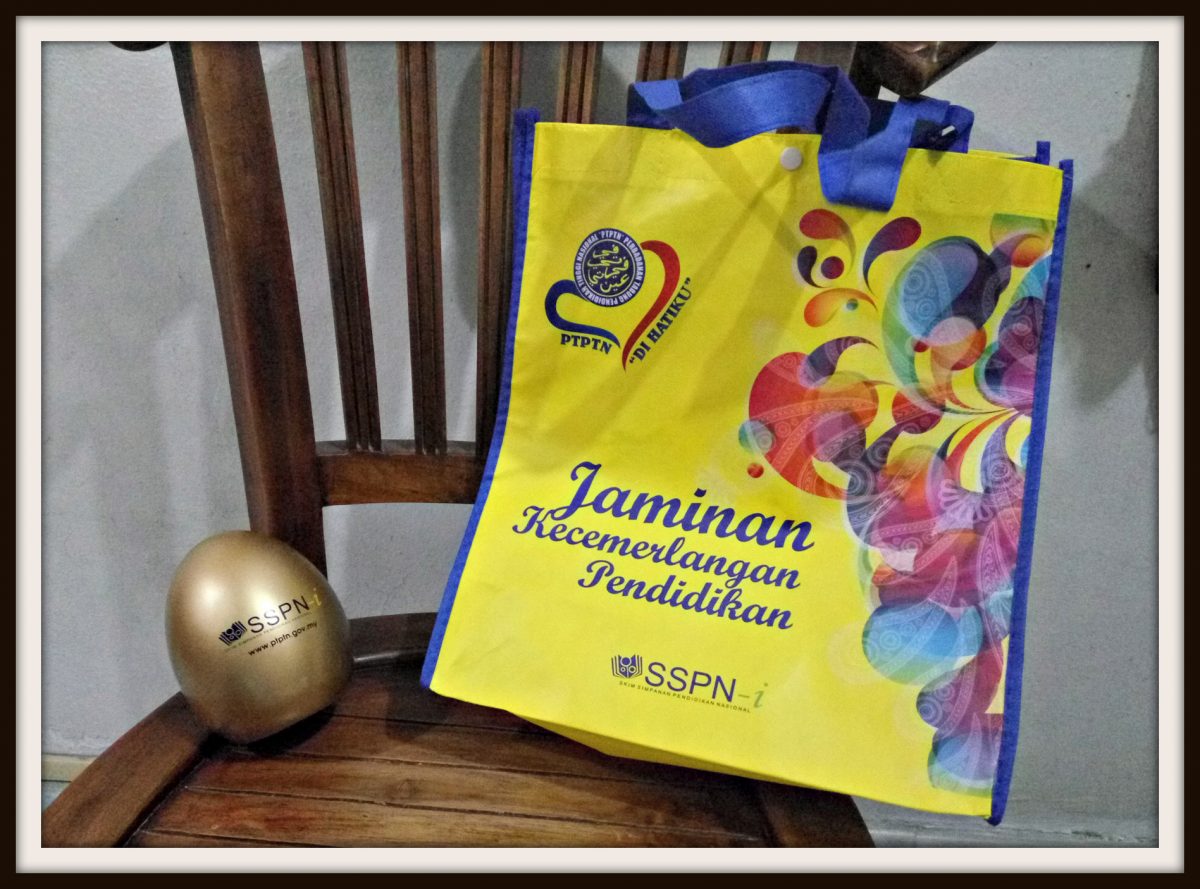
As the profile image has shown, if you hurry to deposit cash in related bank (I went to Maybank, USJ Taipan), a nice PTPTN staff will be on hand to help you with your SSPN-i if you need one and he/she will give you a nicely shaped “golden egg” as a piggy bank for your child and a very good quality recycle bag for mom or dad. Do hurry, at the time of writing (Dec 22,2016) there are only five more banking days left! If you have already opened SSPN-i accounts, you need not go the bank to deposit, Maybank and CIMB online banking portals also accept your money online. Whatever you do, please beat the Dec 31, 2016 deadline!

Since 2015, there is another type of SSPN-i account called SSPN-i Plus which comes with life insurance (Takaful) coverage. However you can only gain the additional RM6,000 tax relief (in addition to the RM6,000 for SSPN-i) if you have not topped the Employee Provident Fund /Life insurance quota of RM6,000. And for SSPN-i there is some monthly commitment of a minimum of RM50. So for most income taxpayers, SSPN-i may be the better choice. More details are found in this Lowyat discussion forum.

Wishing all my readers Merry Christmas (for those who are celebrating) and a happy and prosperous 2017.

All your customers are entitled to quality customer service

All your customers, regardless of their spending budget, expect and deserve good quality and prompt customer service, if you fail to provide this, they can always vote with their feet.

I was a guest of Professor Lin Hsiou-Wei, Dean of Management College, Tunghai University in Taichung, Taiwan in late July 2016. It was my first trip to Taiwan. Upon arrival at Taoyuan International Airport in Taipei, after immigration and custom clearance, I was looking to buy a local SIM card so that I could stay in contact with the office (and my family) back home as well as with my host. A counter was spotted and I proceeded towards it. I saw five very elegant looking young ladies (PYT – pretty young things as coined by the late Michael Jackson)  sitting at the counter. What happened next went on to show why Taiwan is such a great holiday destination.

As I arrived at the counter all five PYTs jumped up from their stools, greeted me with smiles and went on to sell me the most suitable SIM card package for my short trip. While one PYT handled my money, one was explaining to me the features of the SIM package, what I could do etc., the third PYT was busy working on putting the SIM card in my smartphone which had 2 slots for SIM cards. The whole episode took no more than 3 minutes, I was then able to send an “arrived safely” message to my family back in Malaysia. My first impression of Taiwan was several hundred percent boosted by this small encounter (PYTs aside!)!

Just a few weeks before, my former colleague Peter Tang brought his guest, Mr. Li Qunshan of Hunan University, China to visit me at Han Chiang College. Mr. Li needed to fly from Penang to Johor Baru (JB) at the conclusion of his visit to Penang. We booked him on a Malindo Air evening flight which required him to transit in Kuala Lumpur International Airport (KLIA). Mr. Li who could only speak Mandarin (and a bit of Russian as he is from the border region between China and Russia) made a frantic call to me at around 5:30 pm. He said that he was not allowed to board (15 minutes before his scheduled flight) and the people there could not tell him what was happening. I ended up asking him to pass his mobile phone to the airline staff at the boarding gate and spoke to the Malaysian Airline System’s (MAS) staff in Malay to discover that Mr. Li’s Malindo Air flight was delayed and the boarding gate for his flight was re-assigned. When I asked the MAS staff which was the new boarding gate, the answer was, “Saya tak tau, kamu suruh dia tanya orang Malindo sendiri” (I don’t know, you tell him to ask the Malindo Air people). By then, Mr. Li, who was to attend a key event in Johor Baru was panicking. I tried my best to convey the MAS staff’s message but Mr. Li kept asking, “Where should I go to board my flight?” I was not in the position to answer him as I was 500 km away in Penang. My attempt to get him to find the flights information LED screen was futile as Mr. Li reminded me that he could not read English. At the last resort, I suggested that Mr. Li look for a Chinese-looking staff or even young Chinese Malaysian looking person who might speak Mandarin for help. 15 minutes later, I called Mr. Li and both of us were relieved that he finally found the new boarding gate and his flight was delayed by 90 minutes so he did not miss it. Mr. Li told me that he asked a Cathay Pacific staff for help and luckily for us, he was willing to take the trouble to find for Mr. Li the re-assigned boarding gate.

I feel that the quality of service of Malaysian airlines (both Malindo and MAS) left much to be desired. Malindo Air, knowing that there was a transit passenger in a delayed connecting flight where the assigned boarding gate was changed in the last minute should have stationed someone at the arrival/boarding gate of the Penang – KLIA flight to take care of Mr. Li. But that did not happen. The MAS staff was even less customer friendly. It did not take much effort to look up the new boarding gate for the Malindo Air’s KLIA –  JB flight as this sort of information would be easily obtainable from their computer terminals. They could have also alerted Malindo Air staff of Mr. Li’s predicament. But the MAS staff had chosen to ignore the problem. At the very least, knowing Mr. Li being a China National, the MAS staff could have just ask any of the passengers who could speak Mandarin (I am sure with 97% Chinese Malaysians having studied in Chinese primary schools, SJK(C), it would not be an issue) and helped Mr. Li accordingly.

Can Malaysia hope to attain her tourism target each year with this low quality of customer service at our international airports? I seriously doubt it!

On the international front, I think customer service quality is the determinant factor for the success of an international business at any market overseas if prompt service can be provided locally. In my “early” days of social media marketing of 2013, Facebook local office in the region did not provide technical or customer support. Often if you had issues, it would mean that you were on your own. There was once that we had a credit card issue (where a payment was refused by our bank and the advertising account was barred), it took us more than two weeks to get FB to resolve the issue. Luckily for us, we had a backup credit card, but even then it took about 48 hours for the switch of the credit card to take effect. It meant  that we were really not able to have our advertisements reaching our target audience for 48 hours! Then recently  Facebook which opened its regional office in Singapore back in 2010 decided that customer service provided at the local level was important and one of their staff indeed made contact with us to provide both training and technical advisory to allow us to make full use of FB’s advertising power and get us more bangs for our advertising ringgit. My digital marketing team (there were only the three of us, yours truly included) were very happy and learned a number of tweaks and tricks to stretch our advertising budget and to have more effective social media marketing campaigns.

We also have an advertising account with LinkedIn at my college. However, LinkedIn did not provide us with a full administrator access to our advertising account and as such simple procedures such as the change of authorized users would have to be requested by us and carried out by LinkedIn. LinkedIn also has an office in Singapore which, like FB, is serving the region. When recently I needed to nominate another senior staff to be given access to our advertising account  I first sent a LinkedIn internal message to the service personnel assigned to our account. It took him a few hours to respond to say that it would be done. 24 hours later, the request was still not acted upon. A second message to this guy was replied a few hours later to say that for technical stuff, it might be best for me to contact the person directly…but neither the technical support person’s name nor his/her contact details were given! I waited for another few hours, to no avail. I then proceeded to do some research and found out who was the person actually acting as our “account manager”. But there was no way I could contact this lady directly. I had to send an internal message to ask to be connected with her first. After a day she accepted my request to connect and only then was I able to alert her of my problem. It took another few hours for her to get back to me to say that the request was acted upon. All in all, it took LinkedIn more than 96 hours to act on a simple “please take out User A and replace with User B” request.

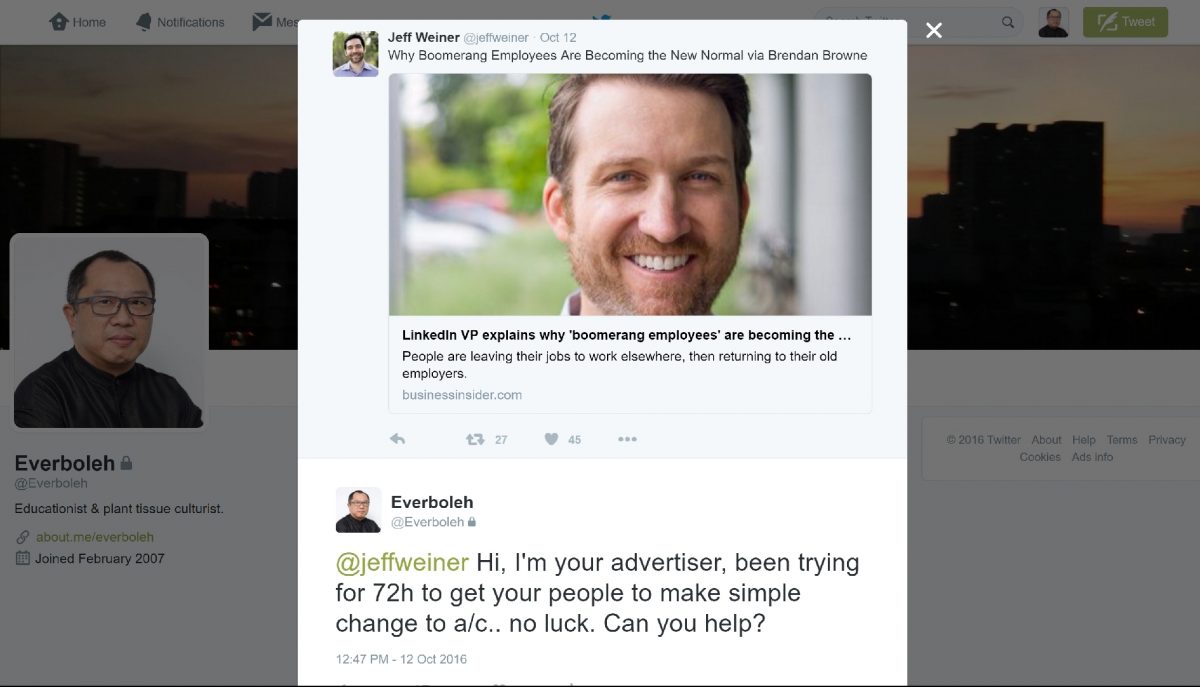
In desperation, before I was able to find and connect with my “account manager”, I even tweeted a message to LinkedIn CEO, Jeff Weiner but of course, I did not get any response. I am just a small fry of a customer in little ole Malaysia! The Pareto Principle (80/20 rule) applies, I guess and I belong to the “80” crowd!

Even clients with small budget deserve to have the basic service quality from Linkedin. I am not sure if LinkedIn realizes that some of those in the “80” crowd, if they are treated well, could well turn into your “star” customers of the future!

I wonder if it is because of the fact LinkedIn now is owned by Microsoft that it has a different customer service philosophy or if it was because of the relatively small (by their standard) advertising account we have which put us in the back of any customer service queue? Now would you wonder why advertisers are not flocking to LinkedIn?

I monitor my college’s social media pages closely and I have been known to show my displeasure to my staff if there was a delay in answering any Facebook messages left on our FB Page, respond to messages left on our “live chat” app by enquirers during our “office off” hours etc.. With the internet being used as the first line of enquiry today, providing your potential customers (and existing customers) with prompt and quality service is the key to success. This holds true regardless of which industry you are in but it is more crucial for service industries like higher education. If prompt responses are not forthcoming, the potential students (and parents) today can just move on to the next college for answers and may enroll with your competitor instead. Thus high-quality service is even more important in the private higher education sector in Malaysia which is facing tremendous turmoils with cut-throat competition amid a dwindling local student market where more and more alternatives are available both locally and overseas. I think colleges that provide the best quality and prompt service will be the ones that will ride through this storm.

I opine that the key to Taiwan’s tourism industry raking in good sales could well be the tourist-friendly nature of the Taiwanese people. Throughout the short four days visit I had in Taiwan in late July 2016, I was amazed by the care and quality of customer service that was provided by everyone in the service industry from the friendly hotel staff, the waitress at the local cafe to the express bus service counter guy, everyone was making me feel very welcome and everyone took pride in their jobs and exhibited great work ethics.  If Malaysians could emulate even 20% of the Taiwanese attitude towards visitors, we will be very much closer to being a developed nation and could rake in more tourism earning! The “not my problem” attitude shown by MAS staff towards my visitor, Mr. Li will not be productive towards Malaysia’s aim of 2 million tourists from China for 2016.

All your customers, regardless of their spending budget, expect and deserve good quality and prompt customer service, if you fail to provide this, they can always vote with their feet.

Compact Calendar for 2017 specifically for Malaysia (Selangor)

Dave Seah is the inventor of Compact Calendar that I have adopted for many years now.

I first introduced its use in 2008 when I was the Deputy Principal & Academic Director of Technology Park Malaysia College. This practice was extended when I took up the job of CEO & Principal of Han Chiang College in 2015.

Nothing beats the compact calendar when you need to plan events for the year and stay clear of “pit holes” like the eve of public holidays (have your event just before or after a religious event in Malaysia can bring on many complications and unforeseen political baggage!).  All Han Chiang College’s academic calendars (for different programmes) are now done using Dave’s compact calendar that I have introduced which are adapted to Peang State (to accommodate the differing state holidays in Malaysia).

I am enclosing links to the compact calendar that I have adapted for Selangor state where I will return to reside upon the completion of my stint in Penang. Two files are available, one is in PDF format and the other an Excel file (customizable by my readers, just change the holiday lookup table to your particular state). I have included the school holidays taking data from a holiday website and confirmed the data with the Ministry of Education Malaysia’s site. Of course, the school holidays are meant for Selangor state (where Perlis, Perak, Penang, Negeri Sembilan, Melaka, Pahang, Sabah, Sarawak and the Federal Territories of Kuala Lumpur, Putrajaya & Labuan are in the same group which observes Sat & Sun as the weekend).

To download the editable Excel file, please click this link. For the Compact Calendar 2017 customized for Selangor State in PDF format, please click here.

A word of caution for those wanting to customize this compact calendar. You will need to use Excel. Open Office / LibreOffice will somehow mess up the formatting a little. Google Sheets is a big “NO NO” as the formulae and formatting both have issues and affect the compact calendar. Please do not forget to read the instructions before you do any customization.

Enjoy your annual planning and say thanks to Dave Seah for his invention.

Remembering Dr. Michael Leong Hong Kah

[show_post_categories show=”tag” hyperlink=”yes”]
Chinese New Year is a time for reunion, not only for family members but old pals and schoolmates as well. This year’s reunion dinner for my school mates (especially for those who are based in the Klang Valley) happened on Friday, Feb 12, 2016. As I knew my guys would be consuming lots of alcoholic beverages for this function, and traffic in Bukit Bintang area (where our dinner would be held) would be a nightmare, I took the RapidKL 770 bus instead and planned to change at KL Sentral for the monorail.

Then the first “lightning” struck: one of the members of my Queen’s University Alumni Association Malaysia buddies, Andy Gan posted this on our Whatsapp group – “Our dear friend Michael Leong Hong Kah passed away this morning.” I spent the rest of the bus journey checking the various social media and chatting with Andy to verify this shocking news. Not wanting to accept this as Michael Leong just exchanged email with me in late November 2015 and he told me he was recovering well, I contacted our mutual friends, Dr. KK Wong and Seetho Tan who are based in Singapore (where Michael had been living since the early 1990s). I first heard of Michael’s fight with colon cancer when I read his blog in April 2015. In late November 2015, through an exchange of emails Michael told me, “I am still recovering from colon cancer. “ My worst fear was confirmed later that night when Dr. KK Wong called to confirm that Michael had left us. I have lost my best buddy of over 30 years. The second “lightning” struck!

Michael and I were real buddies. We helped each other with our respective weddings. I gave the “best man” speech in his wedding dinner and he was taking lots of photographs for mine…etc. and the list goes on.

Michael (front row, second from the right) was one of my photographers during my wedding dinner in 1991.

Michael and I came from the same hometown, Ipoh, but despite our being of similar age, our path never crossed until we both were in the UK. Our first meeting was around Christmas 1979 in London. But we were just acquaintances back then. Michael’s elder brother, Dr. Tony Leong was studying medicine at Newcastle University, England and I along with my three other friends (all former SMJK Sam Tet Ipoh boys) were students at South Shields Marine and Technical College, 10 miles away. Tony was asked by one of our seniors at school who knows Tony well to keep an eye on us as we were just 17 years old and living on our own for the first time in our lives.

In 1982, armed with my GCE “A” levels result slips I went to Belfast after meeting a fellow Malaysian, Clarence Ko in Dublin where I was accepted to read agriculture at University College Dublin (UCD). Clarence persuaded me to give the Queen’s University of Belfast (QUB) a try as it would mean saving of one year compared to UCD. Apart from Clarence, I only had two acquaintances in Belfast, Michael Leong and Khoo Thiam Chye. October 1982 was the start of my 30 odd years friendship with Michael Leong.

Michael took me to QUB’s admission office and then to different faculties to help me finally get a seat to read general agriculture.  As I had to “waste” one year studying in Remove Class on account of my having studied in a Chinese primary school, Michael who was 1 year older than me was in fact 2 years my senior at QUB.  As both of us were busy with our studies I only bumped into Michael once or twice during 1982/83 academic year. In 1983 I defeated Michael when both of us stood for the presidency of the Malaysian Students’ Society of Northern Ireland (MSSNI). I think it was not that I was a stronger candidate, but the fact that the “medic gang” (the medical students formed the largest contingent of Malaysians at QUB in the 1980s) was competing with the non-medic gang (mainly engineering students) and I being the “neutral” person somehow was the compromised candidate. Michael did get himself elected as the Vice President of MSSNI. I appreciated the great contributions from Michael especially when our Treasurer, Cheong Kok Wai had to relinquish the position suddenly. We had lots of fun together including successfully smuggling a fellow Malaysian (a young lady) back to Stranmillis College late one night after curfew! As we both embarked on our respective final year of degree studies (Michael’s medical degree took 5 years and mine took 3 years), we seldom get together in 1984/85 academic year. However I recall helping Michael take out the engine of his old Peugeot 305, sent it for repair and put it back together and did the test run. We also helped a fellow student, Mr. Lai to change his car’s clutch. All was done in the garage pit of Belfast’s Malaysian Centre.

564362_10150827606336799_1643002800_n
Michael Leong & I shared the joy of graduating on the same day with our respective bachelor degrees in 1985.

We also shared the joy of graduating with our bachelor degrees on the same day and at the same venue, the Whitla Hall of QUB in July 1985.

During my Master’s and PhD studies from 1985 to 1990, most of my peers had already graduated and left for home, save for the medical doctors working in Northern Ireland. Michael was always game to host a dinner once a month for our group of “oldies” and I was the only “non-medics” among them. In late 1988 Michael bought a house in Belfast and persuaded me to move from my digs (home for me for three years) to keep him company. Seeing that I was working well with my first “personal computer” , a now vintage Sinclair

Sinclair’s Z88 was a revolutionary computer at its time but still lacked the power of the IBM PC.

Z88, to write my PhD thesis, Michael went on to buy a second hand Z88 and proceeded to play with it. After 2 weeks, ever the entrepreneur, Michael learned that the Z88 was too limited in its functions, he promptly sold off his Z88 and bought a second hand IBM clone PC. He knew that I was already very familiar with the PCs having used these in my research work and naturally asked me to train him on how to use his new toy. It did not take Michael long to learn enough to do work on his PC. Soon Michael got a job working in a dermatologist’s practice in London and he relocated there. By late 1990s Michael got a job with a US multinational hardware company and relocated again, this time to Singapore as its medical systems specialist.

When I received the offer of a postdoctoral research position at the National University of Singapore in January 1991, I contacted Michael to seek his advice on accommodation etc. Michael found me a room and went on lending me two thousands Singapore dollars for me to get settled in. It took me more than six months to repay Michael.

After my stint in Singapore in 1996, my wife and I moved back to Malaysia. We kept in good contact with Michael and Irene by phone. For a couple of years, my wife, May also served as

Dr. Micheal Leong and Dr. Chow YN meeting in Kuala Lumpur in 2012.

a director of Michael’s Malaysian company. The Leong and Chow families had our meetings occasionally when Michael brought his family to Kuala Lumpur for holidays. The last time our families met was in 2012. The social media era of the past 10 to 12 years meant that I got to chat with Michael occasionally, usually via Facebook and sometimes via Gmail. The last time I met Michael and family was on June 02, 2014. May and I needed to be in Singapore to sort out some financial matters. Michael drove his family all the way to Changi Airport just

Dr. Michael Leong insisted on driving his family to Changi Airport to have dinner with the author and his wife in June 2014.

to have dinner with us. It could be that Michael remembered me as the guy who was a student surviving on subsistence level stipend, he would always buy the meal. I now regret never to have the chance to repay the compliment.

Michael was a quiet person despite the infectious laughs and that gentle smile of his. Perhaps only Irene knows his inner self best. In April 2015, not knowing the full extent of Michael illness I tried to help QUB’s Head of Alumni Relations, Ian Moore to seek a short meeting with him but Michael politely declined, “My life is for my family and for close friends only. Thanks.” That was his answer. By retiring at the age of 48 as a financially independent person Michael put his family first spending the last 8 years fully and filled with quality time with his wife, daughter Annabelle and son Aaron. I think not many of us could have had this joy of Michael’s.

On the morning of Feb 12, 2016 I lost a great buddy. The readers of pertama.com lost the “oldman”, Michael’s moniker. The community of investors in Singapore have lost a great role model. Most of all, his family lost a caring father and a very devoted husband.

Michael, may you rest in peace.

Author’s note: I feel that telling the story of Michael and his interaction with me is the best way I can preserve the memory of my late buddy. Michael Leong was a serial entrepreneur who was trained as a medical doctor. He had not practiced medicine since living in Singapore in 1990. My life has been made much fuller by having been Michael’s buddy.

[FILM] The Man from U.N.C.L.E. + A little of Fantastic Four

This film review and critique is the first by Leland Chow which is reposted here. Leland is a junior reading Finance, minor in communication & economics at the University of Nebraska-Lincoln.

Since this is technically my first review, I would like to explain some of the features I would use in my blog. The title, as you could see has hard brackets ([ and ]) first. This denotes the category I will be writing about. This is followed by the title of the post, which is usually the title of the film, music, or something that I want to write about specifically. Sometimes, a plus (+) sign is used to denote that I will also be writing about another film, music or other things. In this post, I will be writing about a film that is released on 14 August 2015, The Man from U.N.C.L.E., but in the theater near where I live, most, if not some, films are released a night earlier. Therefore, I have actually watched this on 13 August.

Without giving too much details (for now), The Man from U.N.C.L.E., or in short UNCLE, showcases an American spy and a Russian spy being forced to work together during the Cold War to, in general, save the world. This film is based on the 1964 television series of the same name that featured David McCallum as the Russian spy, Illya Kuryakin, and Robert Vaughn as Napoleon Solo. People might recognize McCallum’s name because he currently portrays as Ducky Mallard, one of the major characters in NCIS, and Professor Paradox in the Ben 10 series.
This film adaptation stars Henry Cavill (Superman, Man of Steel) as Napoleon Solo, and Armie Hammer (the title character in The Lone Ranger) as Illya Kuryakin. The female lead is Alicia Vikander (Vera Brittain, Testament of Youth), who portrays as Gabriella “Gaby” Teller. In the film, Cavill’s Napoleon Solo is charming, handsome, and quite a womanizer, dressed up very neatly (and probably very expensive as well), and speaks in a calm manner. Hammer’s Illya Kuryakin can be considered to be Cavill’s polar opposite. Kuryakin is quiet, dressed up more casually, and speaks in a less calm manner, sensing that he has slight temper issues.

Cavill’s portrayal of Solo was simply breathtaking and funny, and it was very enjoyable watching him being Napoleon Solo because he can crack a joke while speaking in a calm manner. Hammer’s portrayal of Kuryakin also did not disappoint because his Russian accent was quite convincing, and his background with a troubled family did aid in explaining his temper issues.
However, the film is not without its flaws. The plot was enough to explain the reason of the creation of UNCLE, but not enough to explain the backstory of both Solo and Kuryakin. I was left dumbfounded on what exactly did Illya Kuryakin’s father do to be a shame of Russia. Conversely, Solo’s backstory was well-explained, but it had not a lot of information of how exactly did Solo get caught stealing expensive artifacts. Besides, the plot itself, although sufficient to explain the creation of the agency, was not entirely interesting because it followed the standard spy film: Damsel in distress, saving the damsel, receiving mission, meeting the antagonists, spy in trouble, spy receives help from another character, spy manages to save the world. As you might be able to see, the flowchart is the standard flowchart used in spy films, and UNCLE used a similar formula.

In general, I, as a typical moviegoer, enjoyed this film for its funniness and sexiness (Cavill and Vikander). UNCLE, however, cannot be compared to Mission Impossible: Rogue Nation, because both of them had different settings, though they are both spy films.
Rating: 4/5
(Why did I give such a high rating? As much as I found flaws to the film, I thoroughly enjoyed the film and would be willing to watch it again.)

Fantastic Four
I did not watch Fantastic Four, not only because of its very low rating on Rotten Tomatoes (8%), but also because I felt that they did not have to remake the film. However, my largest issue was the casting of Miles Teller as Mr. Fantastic or Reed Richards, because I did think that Miles Teller was not the most suitable actor to portray as Reed Richards, as the Reed Richards I have read about was more matured. Miles Teller did not have the mature vibe, but he had a face that I could see that can portray an evil character. Unfortunately, Reed Richards did not have an evil-looking face.
Rating: 0/5
P. S. This is my first full-scale review on a film. I have never written reviews for films for this length. Hence, I do apologize if it is not up to the standards of a typical film critic.

Beware of pitfalls and surprises when hunting for an apartment in Penang

This is the unedited edition of my article first published in Han Chiang News yesterday (May 20, 2015).

properties-hunting

After “migrating” back from Singapore in the late 1990s, my family and I have been living in the Klang Valley. In early January 2015, I came to Penang with my wife to hunt for a suitable accommodation when I decided to take my present appointment. As both of us are not familiar with the local housing scene and more importantly, the most suitable location to take up residence, I had an idea of temporarily living in a budget hotel close enough to my workplace while I have a chance to get familiarize with the various options available. We quickly abandoned this idea after driving around Penang with the aid of Google Maps. Parking would be the most important feature lacking in most of these establishments and the surrounding would be the next.

After almost 5 hours of driving around looking for a suitable place for me to stay, we finally narrowed down our choices (via an online portal, ibilik.com) to a condominium (TSP) close to the “emerging hot” area of Persiaran Karpal Singh which looked very presentable online as well as in real life. As I was not sure of my preferences, having only stayed in the hotels along the tourist-belt of Penang from Gurney Drive to Batu Ferringhi, it would have been risky to commit to a yearly rental contract. Thus we decided that I should take up a room in this “up-market-ish” condominium with a flexible rental contract instead.  Suffice to say, the rental was not cheap, but it did come with a covered car park space.

Housemates from Hell

After staying in TSP for just one week, I realized that my housemates, a couple, occupying a small room (which was carved out of the living room by the landlord) treated the entire condo unit as theirs. The refrigerator, the hall, the front landing, the kitchen, the bathroom and even the balcony were conquered as their “own domains”. Newbies like me had to make do with whatever space that I could “muscle” in. No one bothereds to lock the front grill gate, we were protected from thieves just by a simple padlock. Cleanliness was never in the vocabulary of this couple and the kitchen sink was used often as the basin for brushing teeth and clearing of one’s throat. The common areas were never cleaned. Needless to say the common bathroom/toilet was a mess at any day which I had to clean regularly as I could not stand the grime and other bodily waste scattered all over the surfaces. After 2 months, when I got to know the local geography especially in relation to my work place better, I had had enough and decided that I should “upgrade” to my own condominium. I also consulted with my Penangite colleagues to hone in on the best available options for me.

Misleading to cheat

Having lived in the Klang Valley since the late 1990’s and having let out our own apartment, I was taken aback when I found out that in Penang both the landlord and the tenant are expected to pay the estate agent or agents (as sometimes one would be representing the landlord while the other brings in the tenant). In the Klang Valley, only the landlord are supposed to foot this bill.

I was looking for a unit that was unfurnished which would have allowed me to (1) pay a lower rental, and (2) to acquire furniture and electrical goods to my liking. I thought I had a unit when the estate agents brought me to an empty-unfurnished unit. I asked several times for confirmation about the rental and more importantly the car park space that would come with the unit. The agents confirmed all these each time. Off I went to pay one month’s deposit to secure the unit as unfurnished units in this particular location were hard to come by. While I waited for the landlord to get the rental agreement prepared, I went on to buy a refrigerator, a washing machine, an air conditioner and even a firm mattress. Then came the fateful day agreed by both parties to sign the rental agreement and to hand over the relevant keys. After both the landlord (a landlady in this case) and I had signed the rental agreement I asked to be shown the location of my car park space, I was given the first rude shock. The landlady insisted that the unit did not include a carpark space (even though it is a well known fact that each condo unit in this estate would come with one) and my agents disputed this. However the landlady stood firm and after half an hour of negotiation, I sensed from the eyes of the landlady that there was something that she wanted to attain other than renting out this unit. My suspicion and second shock came when she refused to return my one month’s rental deposit. This lady was out to cheat unsuspecting people of their rental deposit by reneging on there being a car park space (which she misrepresented to the estate agents as being a part of the “deal”). She knew that her victim, a.k.a. yours truly would not have taken the condo unit if the car park space was excluded. She would then be able to pocket the one month’s rental deposit as technically I would forfeit the said rental deposit for not going through with the deal!

I have lost not only the RM850 as deposit due to this scam, I had to deal with the fact that I had electrical goods and furniture already bought and paid for. “Luckily” for me, one of my colleagues has just taken possession of a new condo unit and he would “take over” all my electrical goods, but I had to give him a discount of 15%, losing about another RM400 in the process!

Off I continued with my condo hunt and nursing a RM1,250 financial wound. Luckily for me, the estate agent acting for the landlady, Ms DT was very ethical. DT took responsibility for both of us falling for the trap of this landlady (apparently it is not a standard practice to have the landlord signed on a piece of paper to confirm what are the features and facilities he/she is offering in the property for rent). She waived her fees in searching for a new condo unit for me. Thus this helped to cut my losses significantly but I am still RM400 down for having to dispose of my electrical goods at a steep discount, goods that I had never taken delivery of, I must add!

My advice to all who wants to hunt for a condo, especially in Penang: get to see everything that the landlord or agent claim the property has and make sure this tally with the list of facilities and furniture etc. in the rental deposit form before you hand over your money, or else you may, like me stand to be cheated!

One should try to get an estate agent whom someone who lives locally can recommend. I will surely recommend DT to you!

Incidentally, just 3 days after being scammed, I received a call from another estate agent whom I had contacted earlier. This lady informed me that an unfurnished condo unit at the location I wanted was available. The description of this particular unit (the block and floor it was located) matched the one I was scammed! Thus condo unit hunters in  Penang beware, the predator is now searching for the next victim (or has she been successful in securing more victims after me?)!

I think the authorities in Penang as well as the Penang property agent industry should come out with a clear guideline and best practices to protect innocent tenants like me from be scammed. Having a “standard” declaration of facilities, furnishing and features in the rental booking form would be a good starter.