Whose choice is it anyway?

I still get calls or Whatsapp messages a few times a year from friends asking for advice on how they can choose tertiary studies for their offspring. My favourite response, “It’s their future, let your kids chase their dreams. By all means, influence their choices but let’s not force them to live YOUR dreams!”

This article was first published in 2015 as a part of my contribution as a working committee member of Penang Chinese Chamber of Commerce’s Newsletter Publication Committee. As I am not sure of the reach of the newsletter, I am publishing this article on my blog to benefit more of my readers.

I still get calls or Whatsapp messages a few times a year from friends and acquaintances asking for advice on how they can impose their choice of tertiary studies on their offspring or which field of studies is “hot”. My favourite response, “It’s their future, let your kids chase their dreams. By all means, influence their choices but let’s not force them to live YOUR dreams!”

I published a related article on this area in late December 2014 citing an article I wrote for the now defunct The Heat (but the online version is still alive).

A survey carried out and published by Penang Han Chiang College on over 300 college-going-age students in early 2015  confirmed two important trends in Malaysia. When it comes to the choice of study and choice of college for high school students: (a) Parents are often the decision makers; (b) Students want to decide for themselves. One will wonder why these two trends are at a tangent to each other.

Parents in Asia, including those in Malaysia are very concerned with their offspring’s education. While Malaysian parents usually make pretty straightforward choices concerning primary and high school education, the same cannot be said about the tertiary education level. High school graduates and more importantly their parents are faced with more and more tertiary education choices and an information explosion that compounded the issue. While the bulk of the high school graduates want to decide on their choice of study and college, many, because of deep-rooted Asian upbringing differ to their parents’ wishes.

“I want him/her to study medicine/law/engineering etc.” is a common phrase one will hear from fellow parents with teenage children. In many cases parents think that they know best without learning about their child’s aptitude for the field of study and the child’s preference for a particular college. They also have the wrong impression that one must take up a career in the field of one’s undergraduate studies. This article gives four real life examples (though only the real name of this author is given!) of university graduates not taking up a career in their fields of study and making a success (or in this author’s case, a good career)  in what they do.

My Story

I studied agriculture at Queen’s University of Belfast, Northern Ireland and moved on to read Biotechnology for my Master’s degree culminating with a PhD in plant tissue culture. As yet, I have never farmed after my undergraduate studies. I have also not worked as a plant tissue culture scientist for close to 20 years after my stints at the National University of Singapore and later in a commercial plant tissue culture laboratory.

Instead, since 1996, I have been serving in the education and training industry at diverse capacities, allowing me to learn enough to be hired as the CEO and Principal of a private not-for-profit college (in 2015), working to upgrade it to be a university college. However, my three university degrees are not “wasted” as they allow me to pick up more knowledge and skills and prepare me to take on many difficult tasks. When I first started to work as a lecturer in Klang, Selangor, I had to call upon what I learned in “Farm Management, Planning, and Control” to provide tutorials to a group of engineering students on a twinning degree programme with the University of Adelaide, Australia in  a subject on project management. The “Business Policy” subject  I learned during my Master’s degree became very handy when I served as the Director of Special Projects for a publicly-listed education group where I often had to churn out full business proposals complete with financial details to bid for funding or “sell” to prospective business partners. The six months of 12-hour day writing my Ph.D. thesis forced me to pick up writing skills which allowed me to serve as a columnist and feature writer for the weekly publications, Focus Malaysia and The Heat recently. I think ‘education not wasted’ is a good way to describe my experiences in utilising what I learned at college!

ML’s Story

While at university, ML and I became very good friends. In fact, I stayed at ML’s house for almost two years when I was completing my Ph.D. studies. ML was trained as a surgeon and in 1988, he bought his first second-hand personal computer and asked me to teach him how to use it (I, being a scientist was always curious and was already a self-taught advanced user by then). ML also used to take things apart, fixed them and put these back together to work better. ML and I once spent a few days working in the pit of the garage of Belfast’s Malaysian Centre where he and I took apart the engine of his car, sent it for repair and put it back together (with me providing just the muscle as I was not into cars). Towards the end of 1990, ML got a job in Singapore, working for an international computer hardware & software company as its medical system specialist.  He came from nothing to an expert in a medical computing system in less than 18 months! He went on to form his own IT system company a few years later, but sold it when it was at its peak, finding his first pot of gold. Despite the bursting of the “dot-com” bubble in the early 1990s, ML founded the first share discussion platform in Singapore and built it to be the talk of the town, eventually selling it to a large publication house in Singapore. This medical doctor friend of mine retired at the age of 48. He had not practiced as a medical doctor for about 20 years, yet I think, like me, he made use of all the knowledge and skills he had picked up at medical school and from his many hobbies and applied these to his best advantage.
[Sadly, my good friend of 34 years, ML passed on on Feb 12, 2016, RIP.]

SB’s Story

I first met SB when she was a Jabatan Perkhidmatan Awam (JPA – Malaysia’s Public Service Department) scholar who was sent to my university. SB was very popular, smart, and networked readily with her peers. She earned her degree in Electrical and Electronic Engineering with ease. Our paths crossed again in the early 1990s when I was working in Singapore and she was then working as an electrical and electronic engineer. We met up again in the late 1990s in the Klang Valley when I learned that SB was doing well as an investment adviser handling her clients’ mutual fund portfolio. Naturally, I became SB’s client and I must say, I have not been disappointed with her professionalism and sound advice. Today, SB is very established in her business which brings her tremendous financial freedom. I think if she had stayed as an engineer she would not have attained her wealth so quickly. SB made use of her knowledge as an engineer to quickly became adept at financial investments to provide good advice to her clients. I was once told by a financial analyst that the best people to pick up financial analytical skills are those with engineering degrees as they know how to apply their mathematics knowledge easily. I think SB provides the classic example for this!

MP’s Story

MP was heavily pregnant when I first met her while I was working as the head of a department at a private college in 2001. She was very friendly and humble. I allowed her the 5-minute sale pitch that I would entertain sales people whose disposition earns my attention. She was at the right place at the right time as I was looking for some medical insurance for myself and my family. I soon learned that MP graduated from a local public university as an electrical engineer. Like SB, she did not pursue a career in engineering. MP gives great professional service and was willing to service my life insurance policies bought from another company. She also looked after my family’s general insurance needs. Naturally, not only my family but my sister-in-law also became her client. When my sister-in-law needed to file for her medical insurance claims, MP was fast and efficient in her service resulting in a quick settlement of the claims. One day, during one of MP’s routine visits to my home, I asked her why she did not pursue a career in engineering. I was not surprised by her answer: she wanted flexibility and a way to build up a business. Like SB, the technical training as an engineer made it relatively easy for MP to pick up the new skills and knowledge needed to be an effective professional investment advisor in the insurance sector.

You are what you make out of your knowledge

‘You are what you make out of your knowledge’ is perhaps the most appropriate way to describe why in the four real life examples above the people concerned did not follow the paths of their undergraduate studies when it comes to a career. So if you are the parent of teenagers, you should perhaps sit back and hear out what tertiary study plans that your offspring have. Your job is not to dictate which field of study your child should take. People of Generation Y are a lot more independent-minded and they have access to multiple channels to information relating to tertiary study options. As parents, you must try to draw out from your teenage offspring his/her real interests. You can influence them by providing sound advice while at the same time take their views into consideration. Parents should not impose their view forcefully upon their offspring. I have personally witnessed a few examples while I was at university of friends struggling to cope with their studies due to the lack of aptitude and interest. Give your child the benefit of thinking about his/her future “under their own steam” i.e. without you putting words in their mouths.

In my own experience, my son was able to decide on his choice of studies pretty fast when he was studying for his Sijil Pelajaran Malaysia (SPM is a public examination taken by high school students in Malaysia before graduation) and is now on the verge of completing his studies in Finance at the University of Nebraska-Lincoln, USA. My 16-year-old daughter’s tertiary education desire (now completing her SPM examination) was a bit more challenging for us to discover. But through many sessions of discussions and our sharing of our views and knowledge about different professions, my wife and I finally found out what she wanted to study recently. She was taking selfies as a child with my camera (and later my mobile phone) long before the word “selfie” was invented. Naturally, she hopes to pursue her studies along the videography and allied field!

Whichever the study options my children choose for their tertiary education, I am not sure these would be their career paths in the future. What I know for sure is, if they have inherited the combined wisdom of my wife and I, they would be using the knowledge and skills that they have gained at college to strive out a career for themselves in whichever fields that they so desire. Our job as parents is simple, to provide our children with our RINGGIT and support them with our SPIRITS.
Pursuing just a single PhD is tough enough!

The achievements of former beauty queen, singer, actress, producer, successful business woman, Soo Wincci have now debunked the negative notion about beautiful women. Dr. Soo is the first Malaysian beauty queen (dare I say, Malaysian actress/singer too!) who has earned her Doctor of Philosophy in business administration from the Open University Malaysia. Even someone as capable as Soo Wincci took 6 years of part-time studies to complete her doctorate studies. “Earn” is the key word here as those of us who have been through the PhD journey will tell you that you have to have what it takes to earn your PhDs!

Dr. Soo Wincci, the first Malaysian beauty queen, singer, actress to earn her PhD (This image was taken from Dr. Soo Wincci’s Facebook page)

December 17 this year marks the 26th year of my being conferred a Doctorate degree by my alma mater, the Queen’s University of Belfast, Northern Ireland. Everyone who has completed his/her PhD journey will have a story to tell. Each and every one of us who, I have often jokingly call ourselves, “the permanently head damaged”, has a unique PhD journey.

My full-time PhD journey took me just about three years during which I worked long hours in the laboratory or in the greenhouse. My PhD journey was shorter than many because my Master’s degree required me to embark on a one year research project where I had horned in many of the basic skills required of a PhD students and my scholarship would only support me for 36 months! My PhD journey is a “typical” of all who are lucky to have secured scholarships / sponsorships to make the journey as full-time researchers. The first six months of my PhD journey was one for soul-searching. I read copiously, made plenty of notes (it was in the late 1980s… we had no internet and the PC was a luxury that all research students and staff had to share) and tried my best to figure out what I should be doing for my PhD. In my case, I was helped greatly by some of my former lecturers and I was lucky to have my main objective very clearly: to find a way to clone Narcissus (daffodils) bulbs using plant tissue culture technology. A travelling scholarship from the British Royal Society which partially financed a one-week study visit allowed me to learn from experts in bulb science in the Netherlands. Dr. Piet van der Linde (of the Flower Bulb Research Institute at Lisse) selflessly taught me the key laboratory technique to obtain healthy and microbial-contaminants-free cultures. I thought then my work could be easily mapped out.

How wrong I was! For over 18 months after the visit (i.e 2 years into my PhD studies), I was not progressing well and I could not make the cloning process produce sufficient number of cultures. Even if I could do the magic in cloning masses of shoots, the end products required were bulbs. I was in great distress to say the least and at times my PhD degree seemed like a pipedream. Then, I happened to “mistreat” some of my cultures on a gloomy wintry Friday night in late 1989 mainly due to frustration. I did not know then that this “mistreatment” (I was brutal in the way I chopped the culture down) was the first turning point of my PhD journey. I had another turning point shortly after which allowed me to “make” bulbs out of shoots. The end of the tunnel was insight by early 1990 and I completed my work (actually was “barred” from the laboratory by my supervisors so that I could concentrate on writing my thesis) within 6 months and was awarded my PhD in December 1990.

The “brand new” Dr. Chow Yong Neng on December 17, 1990 with his late mother, Mdam Wan Sim Then and late father Mr. Chow Kong Yong by his sides, taken on the lawn behind the Lanyon Building, Queen’s University of Belfast.
The “brand new” Dr. Chow Yong Neng on December 17, 1990 with his late mother, Mdm Wan Sim Then and late father Mr. Chow Kong Yong by his sides, taken on the lawn behind the Lanyon Building, Queen’s University of Belfast.

I happen to belong to  a closed Facebook group, “Doctorate Support Group” which I think Dr. Soo is also a member. This is a mutual support group of those pursuing doctoral studies as well as some “oldies” like yours truly whose main aims for being in the Group are to (a) give moral support to fellow PhD aspirants (b) to receive and provide information on research, jobs, learning etc. All those who belong to this Group, especially those who have completed their PhD journeys have at least 3 things in common:
(a) being through “hell” is inadequate to describe the kind of hardships that all have been through;  (b) everyone has been through a period of soul searching, self-doubt and in severe cases, depression during the course of this PhD journey; and (c) everyone has to sacrifice some sort of family or personal life in order to pursue her/his PhD dream.

Having a PhD does not show that you are smarter than those without these 3 little letters behind your name. Instead it shows that the PhD holder has the kind of tenacity, the ability to apply knowledge and skills to work on a complicated problem, and to communicate her/his new found knowledge in an effective manner. Each and every one of us who has been awarded a PhD has one thing in common regardless of our fields of studies, be it social sciences, engineering, computer science, physical, chemical or biological sciences, we all have created a new piece of knowledge for the betterment of mankind. It is this new piece of knowledge that ultimately earned us our PhDs! By “permanently head damaged” it means that all who been through the tough process of working on their PhDs would have successfully endured the challenges, which at times created great nightmares, anxieties, sense of helplessness, dejection etc. which may affect the PhD students’ psychological well-being to the extent that some “damage” could result. I can assure my readers that (and I hope that other PhDs agree with me) all these “damages” are worth every single effort that we had to put in and all these “damages” are transient in nature!

I have met my fair share of “pretenders” –  those who hold dubious or fake PhDs. In most cases, those of us who have actually earned our PhDs like Dr. Soo just did would have little difficulties in figuring out the “dubiousness” of these so-called PhDs by asking 3 – 4 simple questions relating to these people’s PhD journeys. You cannot earn your PhD because of your “life experiences”, this is especially so if one is very young. There is no shortcut.

In 2003, when I first met Professor William Purcell (then of University of Newcastle, Australia and now the Deputy Vice Chancellor of University Technology Sydney) and mentioned to him about an individual who was an active Chinese educationist having laid claim to not one but three doctoral degrees. To this, Professor Bill Purcell’s response was a classic, “What’s wrong with the first one?”

I can understand someone with lots of determination, time and resources, after earning a PhD in one field (say engineering, or biological science) could then went on to study up to doctoral level in another different field such as management. These sort of people are very rare indeed as we can see from Dr. Soo’s example, it would take someone with a job and not working on the doctoral studies full time, around 6 years to complete their doctoral studies. Incidentally there is at the time of writing of this article (Nov 02, 2016) a Hong Kong TVB drama series where a very attractive actress was playing a boffin with not one, two but eight PhDs… we all know that in reality this is not possible!

Honorary doctorate degrees are another kettle of fish. These are awards often given out to people in recognition of their having made great contributions to society, to the community or to the awarding university. People holding honorary doctorates are, by tradition not supposed to call themselves “Doctor” but rather they should put their titles in parenthesis i.e. (Dr). It is very rare for an “average” person to be honoured with even one honorary doctorate as one might imagine the magnitude of contributions to society etc. that this person must have made to warrant the said honorary doctorate. Thus I read with great amusement (the story was picked up by the mainstream and online press) about a sort of “marketing whiz kid” cum motivational speaker who claimed to have not one but three honorary doctorates. These claims were resoundingly refuted by the institutions in which this gentleman claimed to have given him such awards. The tell-tale sign of this person’s dubiousness was the fact that he insisted on addressing himself as “Dr” XXX! No honorary doctorate degree holder worth her/his salt will want to show his/her ignorance by calling himself/herself “Dr So & so”!

To those who are working tirelessly on their PhD studies, do take Dr. Soo as a role model and do get yourselves into the closed “Doctorate Support Group” where people like me (the oldies) and some “youngster” (I dare say Dr. Soo and a whole cohort of recent fellow “permanently head damaged” people ) will be there to cheer you on. To those who aspire to come on board, do not wait. You do not need to be a genius to pursue your PhD studies, but what you do need to have is a strong will to succeed. Pursuing your PhD studies is a tough job but as the saying goes, “when the going gets tough, the tough gets going”!

Online degree from top universities made possible via MOOC technology

DaphneK_Coursera061515
Dr. Daphne Koller, Founder & CEO of Coursera (photo source: Coursera)

Coursera’s founder and CEO, Dr. Daphne Koller was reported by the BBC to opined that within the next five years complete undergraduate degree programmes will be available from top universities.

The disruptive technology of MOOC (Massive Open Online Course) is really the underlying cause of this development. This was somehow not covered in the BBC’s story. It has instead equated MOOC to “traditional” online learning.

A lot of ivy league universities have been dabbling with MOOCs for at least 3 – 4 years by now and most have had gained great expertise on how to produce good MOOCs. It is a natural progression for these institutions to move from offering short courses to “specializations” (a bundle of courses) and to see some revenue from the verified learning tracks. A few institutions under Coursera have indeed offered credits for MOOCs as evident from the following:

MOOC-academicrecognition2

However there are only a few institutions offering full MOOC-driven degrees as shown in the next photograph:

MOOC-academic recognition1

I think even the US universities are having to deal with accreditation issues when putting degree programmes online. Putting MOOC-degrees online thus comes with a few hurdles, especially on the regulatory side. In Malaysia, the soon-to-be finalized MOOCs Guidelines by the Malaysian Qualifications Agency (MQA) (for which this author had the privilege to provide feedback at the drafting stage) will be treating any MOOCs the same as conventional delivered courses when it comes to the recognition of these for academic credits. MQA’s further limit the number of MOOC courses that can be credit transferred to a maximum of 30% of an academic award. Somehow MQA’s guidelines are silent on the accreditation of fully MOOC-delivered academic qualifications. I think it will be necessary for MQA to state its position on this when it has the chance to study the decisions of other accreditation agencies.

But as Koller has said, full online proctoring of examination is not as difficult as people have thought and with MOOC technology, it is much more secured. Firstly MOOC technology now have produced artificial intelligence smart enough to detect a learner’s keyboarding style and even writing style. Online proctoring of examination as I found out in 2013 was no rocket science. My own son, Leland Chow was still in Malaysia preparing for his studies at the University Nebraska-Lincoln and I encouraged him to take Udacity’s “Statistics: The Science of Decisions”. The online proctoring on the day of the final examination was simple. The online invigilator contacted Leland to instruct him how to angle his webcam along with a mirror by his side. That was it. The invigilator supervised the entire duration of the final examination. Because of the online proctoring, UNL gave Leland 3 credits for the MOOC course.

With competition among universities getting more intense for the best students, the more “student-centric” a degree programme is, the chances of attracting better calibre students are better.

However, as a 20-years veteran in the higher education field, I think that for younger learners, a blended approach is still the best. In addition, all 18 year-old students would need to experience on-campus life to forge life-long networking opportunities with their peers. This is something MOOCs cannot provide effectively. Human-to-human direct interaction after all is still the best way to provide a holistic learning package for young adults.

Having said this, I think MOOC-degrees will be the thing to come. But it may still be targeted at adult learners rather than school leavers.

If I score 10 ‘A’s does any one owe me a scholarship?

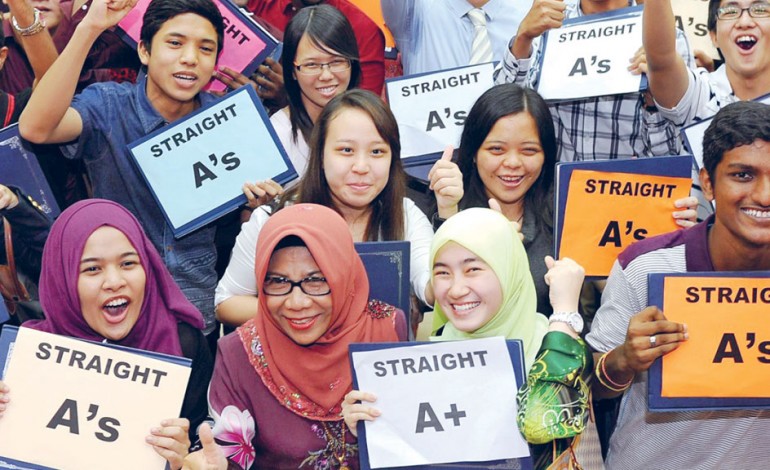
A student from a remote village in Sabah who did not have the means to attend private tuition classes for key subjects may scores “only” 5 “A+”s compared to a student from Subang Jaya who attended private tuition classes for these subjects who scored 8 “A+”s. As an educationist, I will put my money on the Sabahan student being academically a better student compared to the student from Subang Jaya. Further, because the Sabahan student could thrive without the benefits of tuition classes, I will opine that the chances of this student faltering at university-level studies will be much lower than his/her Subang Jaya counterpart. However by evaluating students based initially on just the number of “A”s scored the odd is stacked heavily against the Sabahan student.

This article is rather long and in its original form was published in two parts in Han Chiang News. It was written in response to the recent news in Malaysia of government bursaries/scholarships students who were promised full funding for overseas universities being told that the coffer does not have enough money and so the power that be had to renege on its promise. I have decided to republish the unedited version here in its entirety. 

In recent weeks the press has highlighted the case of many public service department (JPA) scholars having their collective dreams of a fully paid for undergraduate studies overseas being dashed. The lack of fund was the main cause of the drastic decision by the JPA to reverse course for these students who did spectacularly well in their Sijil Pelajaran Malaysia (SPM – Malaysian Certificate of Education) in recent years. However all were given full financial support for pursuing their studies in local public and private universities.

This case begs the question, “Does society owe a student who has scored straight “A”s in SPM an oversea scholarship?”

While it is disappointing to see talented students who obtain top scores fail to continue their tertiary studies overseas, one must view this situation in a holistic manner. SPM is not an easy public examination for one to score straight “A”s. However those who scored straight “A”s in SPM are not necessary the same people who eventually shine well at university studies. There are many cases of SPM holders with more than 10”A”s who struggled and even tumbled at their undergraduate years.

All of us who have been to college know that there is a big gap between SPM and STPM/”A” levels or equivalent pre-university qualifications. The gap from pre-university to tertiary level is even bigger. Although in general those who did well at SPM would be able to cope with pre-university studies, there are many examples of students with very good SPM and pre-university results faltering at university studies. Thus for a country to commit so much resources to send its citizen to study overseas at this early stage is somewhat of a gamble. The safer bet is in fact what the JPA has done: let these students with great SPM results and pre-university qualifications study for their undergraduate degrees in local public or private universities. If these students turn out not to be what the Chinese described as “Xiao Shi Liao Liao, Da Wei Bi Jia ” (小时了了, ,大未必佳 - being bright at an early age does not necessarily bring success upon growing up), the country can then commit great resouces to send them overseas perhaps on a 2 + 2 model, saving great resources at the same time allowing the selectors to fine tune their selection. Many established private institutions of higher learning have attained great expertise, reputation and network of good overseas institutions to take on this responsibility. For those students who have proven “track records” the country can then commit greater resources to send them for their Master’s or even PhD studies overseas.

Judging someone’s ability to learn well and flourish at university based solely on his/her SPM results is not a very fair method. A student from a remote village in Sabah who did not have the means to attend private tuition classes for key subjects (like Malay, English, Mathematics, Physics, Accounts or Additional Mathematics)  may scores “only” 5 “A+”s compared to a student from Subang Jaya who attended private tuition classes for these subjects who scored 8 “A+”s. As an educationist, I will put my money on the Sabahan student being academically a better student compared to the student from Subang Jaya. Further, because the Sabahan student could thrive without the benefits of tuition classes, I will opine that the chances of this student faltering at university-level studies will be much lower than his/her Subang Jaya counterpart. However by evaluating students based initially on just the number of “A”s scored the odd is stacked heavily against the Sabahan student.

I studied for my G.C.E “A” levels at a state-run technical college in England in early 1980s. The college’s “A” level students were mainly those who had taken the examination before but were repeating for one reason or another. Nearly all of them wanted just to pass. Because of clashing of timetable, in the first year of my “A” level studies I could only take the Applied Mathematics half of the “Pure and Applied  Mathematics” as a part-time-revision-class which had 50% of the hours of the full-time class, covering only 60% of the syllabus. Yet, I was able to score a Grade A for this subject after studying only for 1 academic year. In my case, my “struggle” was recognized by the university selectors and I received two offers to read dentistry in 1982. The lower offer was just any two subjects at grade E or better! Unfortunately, due to my family’s lack of fund, I had to decline both offers despite meeting the minimal requirement easily with one further Grade “A” and two Grad “B”s. Compared to a boarding school student with dedicated school masters and a greater teaching system who scored 4 Grade “A”s at A Levels, I think my achievement under a much less favourable condition would be more reflective of my ability to learn and survive at university level and beyond. Who should you think is deserving of a scholarship to study at university?

To those students who are expecting (or have scored) straight “A”s at SPM and are now at a crossroad as far as tertiary studies is concern, I urge you to take note of the following points:

  1. No one owes you a scholarship just because you scored well. There are a lot of other influencing factors that the selectors of scholarship fund need to consider. You have no right to demand for a scholarship no matter how well you think you have done in your SPM. As a holder of 2 postgraduate scholarships, I can tell you that getting a scholarship is a privilege indeed and not a right!
  2. Because of (1), you must show courtesy under all circumstances. The matured response reported of the recent JPA “Bursary” students’ case in appealing for help rather than “exerting their rights” is the correct approach. You will not get far if you adopt a confrontational approach and project the image of the world owing you something just because you have the talent to score “A+”s!
  3. Have a Plan B, C or even D.
    • Local private colleges provide lots of scholarship opportunities. Most will regularly contribute to the Nanyang Siang Pau’s and Sin Chew Daily’s respective scholarship scheme. However based on this author’s observation, in many years, most of these scholarship awards were not able to find rightful recipients due mainly to the lack of qualified applicants. This shows that there are lots and lots of scholarships out there! Go and grab these!
    • Be flexible in your aspiration. Have an open mind in choosing for at least one other alternative field of studies. Remember Sun Tze’s “Art of War”,  “Zhi Ji Zhi Bi, Bai Zhan Bu Dai” (知己知彼,百战不殆: know yourself and know your enemy, and you will never be defeated in a 100 battles). Often you are your worst enemy in this context! Be realistic. Know your own strengths, weaknesses and interests, match these as far as possible with the different tertiary fields of studies. This will help you to formulate your Plan B, C and even D.  Make use of the knowledge of your school counsellors, talk to your seniors who are already at universities/colleges, attend as many education fairs as possible. Whatever you do, be honest with yourself.
    • Do your research on what scholarships are available early, preferable BEFORE taking your SPM. This will allow you to evaluate which fields of studies or which institutions are your top choices. You can also test out your own ability, aptitude and interest in each of the shortlisted fields. Do not wait till after your SPM results are announced to do this “homework”.
  4. Have an open mind. Not getting a scholarship for overseas studies is not the “be all and end all” episode of your life journey. Remember the saying, “When a door shuts in your face, one will open up somewhere else for you.” In my case, not getting to study dentistry was a blessing in disguise. I found out why I did badly on 3 dimensional vector in Additional Mathematics and why I could not for the life of me figure out the technical drawing of my roommate only when I was already at university reading general agriculture. I have a form of learning disability in spatial recognition. I would have made a very lousy dentist, assuming I could pass in the first place! The “door” which opened for me was indeed my undergraduate studies in general agriculture, through it, I managed to secure two different scholarships for my Master’s and PhD studies! See a counsellor if you are really depressed but get this bout over as soon as possible. Remember the Chinese saying, “ Everybody has something that they were born to be good at (天生我才必有用 ).  Your job is to find that “thing” that you are good at and pursue your tertiary studies in that “thing”. Having good SPM grades definitely will put you head and shoulder above most candidates.

The most memorable line from the highly successful local movie, “Olabola” was uttered by an actress in Cantonese: “Even though I scored As in every subject in Form 5, I am still stuck here as a rubber tapper…..” That was in the 1970s. In today’s environment with close to 500 private institutions of higher learning chasing after students, the protagonist would have secured a scholarship somewhere and PTPTN loan would have covered most of her tuition fees. However, if you are one of those SPM holders with less than 9As and wonder if there is any chance of getting some financial assistance, you will be glad to know that there are still opportunities available to you.

Editor’s Note: Most private colleges have many academic-merits-based and need-based scholarships and bursaries specially designed to help students contemplating tertiary studies due to financial constraints. You don’t need to scored As in every subject in Form 5 to receive a bursary!

Compact Calendar 2016 (optimised for Malaysia)

Compact Calendar for 2016 incorporating public holidays and school holidays for Malaysia is now available.

  1. I have prepared a compact calendar based on David Seah’s creation for 2016. This calendar is optimised for Malaysia, especially so for the state of Penang (where I work).

The recently announced school sessions means that I was able to incorporate Malaysian school holidays into this calendar.

I now have the planning of the academic calendar of Han Chiang College (where I work) done on compact calendar.

As before, you will need to use Microsoft Excel to fully use this calendar. The 2016 Compact Calendar for Malaysia is available here.

I hope this compact calendar will help you in planning work / play for 2016 effectively and efficiently.

My time at Queen’s University of Belfast

I was contacted by Dr. Gerry Power, an old friend and the man responsible for keeping tab on alumni relations at Queen’s University, my alma mater to contribute to “My Time at Queen’s” in 2015. MT@Qub is in fact a series of visits down memory lane by former students, ‘old and young’. Here I detailed a new chapter of my life’s journey as a university student, one which took me close to 9 years to complete! I am one of the few living individuals who have earned not one but three degrees from Queen’s and this is my story.

[show_post_categories show=”category” hyperlink=”yes”] :
[show_post_categories show=”tag” hyperlink=”yes”]

I was contacted by Dr. Gerry Power, an old friend and the man responsible for keeping tab on alumni relations at Queen’s University, my alma mater to contribute to “My Time at Queen’s” a few months back. MT@Qub is in fact a series of visits down memory lane by former students, ‘old and young’.

It took me a few hours to write and edit the original version which is quite long and detailed. An abridged version was published in The Graduate (page 37) in Oct 2015.

Here is the original contribution.


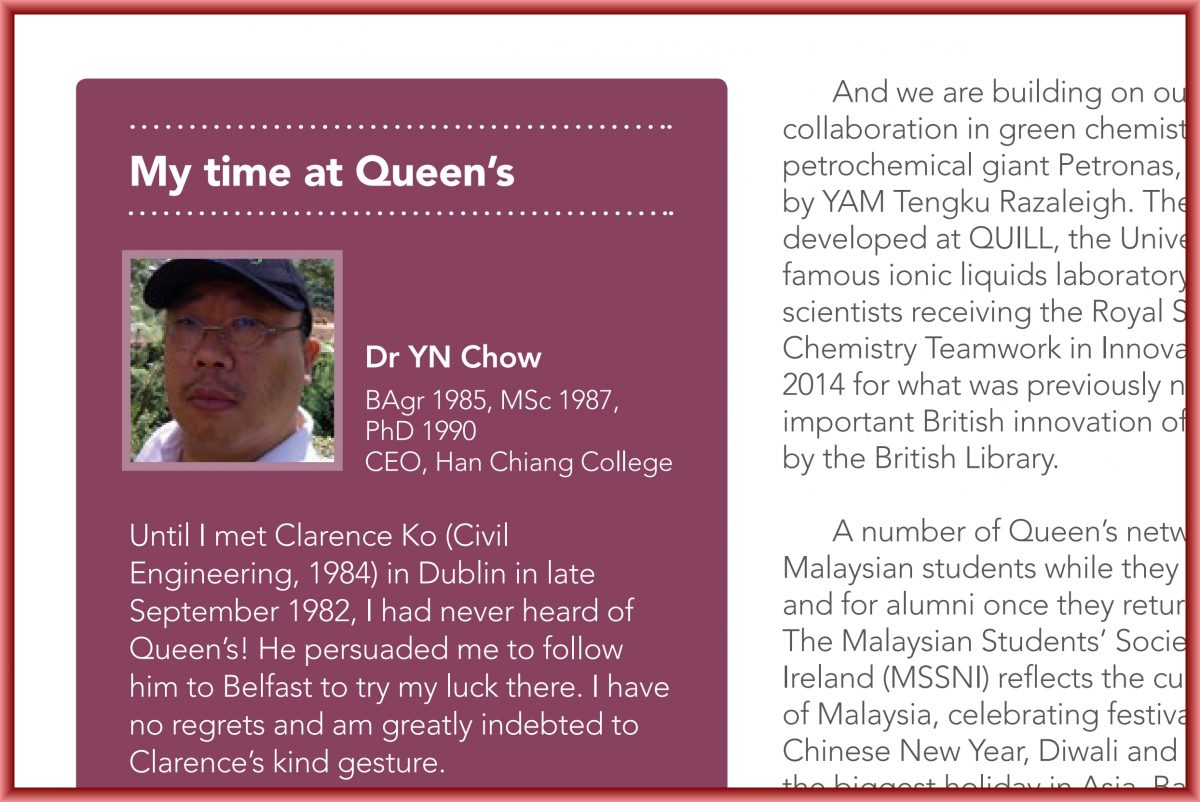
Until I met Clarence Ko (Civil Engineering, Class of 1984) in that fateful day in Dublin around late September 1982, I had not heard of Queen’s University of Belfast (QUB). In fact it was a coincidence that I ended up at Queen’s as I could not afford the high tuition fees of the universities in England and resorted to Plan B: study in University College Dublin. Clarence persuaded me to follow him on a visit to Belfast to try my luck at QUB. I have no regrets and am greatly indebted to Clarence’s kind gesture. As an “Accidental Queen’s Man”, I often wonder why I stayed as a student of QUB for almost 3 times longer than most people and perhaps ending up being one of the few living individuals who have earned three degrees from Queen’s.  I graduated with a Bachelor of Agriculture degree from Queen’s in 1985, followed by a M.Sc in Biotechnology in 1987 and finally a PhD in plant tissue culture in 1990.

Life as an undergraduate in agriculture was tough for me as I had never been near a cow or a sheep until I read agriculture at QUB. My classmates were mainly from farming background and they had an upper hand when it came to understanding what our lecturers were teaching us. I had to content with the many different accents of my classmates but the generosity of some of them helped me cope and I blended in. There were only 3 foreign students (all were Malaysians) in the Faculty of Agriculture and Food Science during my time. Lim Wui Phen (B. Agr, Class of 1984) was my senior and free tutor. I also inherited a lot of books and notes from Lim. Having to be on field trips almost every week visiting different farms gave me a better insight to life in rural Northern Ireland than most Malaysian students would have and these were the occasions that I got to learn at first hand what was covered in class.

In 1983 I was elected as the President of Malaysian Students’ Society of Northern Ireland (MSSNI) more as a compromise candidate (there were two groups  of Malaysians which could not agree on most things and as the ‘outsider’ not allied to either, I won!). I learned about the meaning of democracy truly when we were courted by candidates vying our votes for the post of QUB Student Union President. The low turnout at the Student Union AGM meant that Malaysian students, even if we had only 10 persons attending would be the kingmakers!

As a student who did not come from a farm, I needed to gain some farming experience in order to graduate. I spent the summer of 1984 working at the experimental farm of Agriculture Research Institute of Northern Ireland, Hillsborough. I was the general farm hand and it was the first time I played the role of a sheep dog! Marshalling sheep, as I found out was a very skillful and physically demanding activity, especially for the “sheep dog”. It was during this time that I took the first driving lesson: on a farm tractor!

Organising the annual Merdeka Ball for MSSNI in 1984 took a toll on my studies. I received a sharp warning from my director of studies that if I did not work hard for the final year, I would have problems graduating. That made me worked on a tight regime of studies during my final year. But despite this, all of us living in the self-catered house (I forgot the name, it was the biggest house with the rugby team captain as the sub-warden) took time off studying for our  final examinations in late April to watch Dennis Taylor defeat Steve Davis at World Snooker championship in 1985.

My postgraduate years at Queen’s were very “quiet” as the laboratory work was a lot more taxing than the undergraduate years. Yet I still found time to attend most of the MSSNI’s functions and as one of the “oldest” Malaysians, I was appointed the Chairman for MSSNI’s AGM twice. I came closest to the “troubles” on the eve of my Master’s graduation. After collecting my graduation gown, I took a lift back to the laboratory at Newforge Lane from Sean D’Arcy (PhD, 1987). We were on Sean’s Morris Minor driving on Malone Road when we were diverted by the police. As we were turning onto a side road, a car bomb went off in the next street. Neither Sean and I nor his beloved Morris Minor suffered any damages, but it was shocking nevertheless to be so close to a car bomb!

I think because of my years being a student at Queen’s (and my faculty), the selection committee awarded me the McGeough Bond Studentship / Harold Barbour Scholarship in 1987 for my doctoral studies thinking that I was a “local” student. In the end, my overseas student tuition fees almost bankrupted the trust funds! I had a “guardian angel”, Ms Audrey Griffiths who was the Faculty’s Secretary coming to my rescue when the Dean had an idea of cutting my stipend to pay for the additional tuition fees!

I found a great casual job during the final part of my doctoral studies: I was manning the security desk of one of Queen’s examination halls and earned a good sum during the 1990 May – June examination session. On top of that, I wrote about 70% of the first draft of my PhD thesis while sitting at the security desk helping to invigilate examinations! I could not afford a laptop computer then but bought a Sinclair Z88 computer instead. The now spoilt Z88 is still lying somewhere in my house.

Z88 – an idea of PDA/tablet computer that was 25 years ahead of its time!

Graduands must respect and appreciate university graduation ceremonies

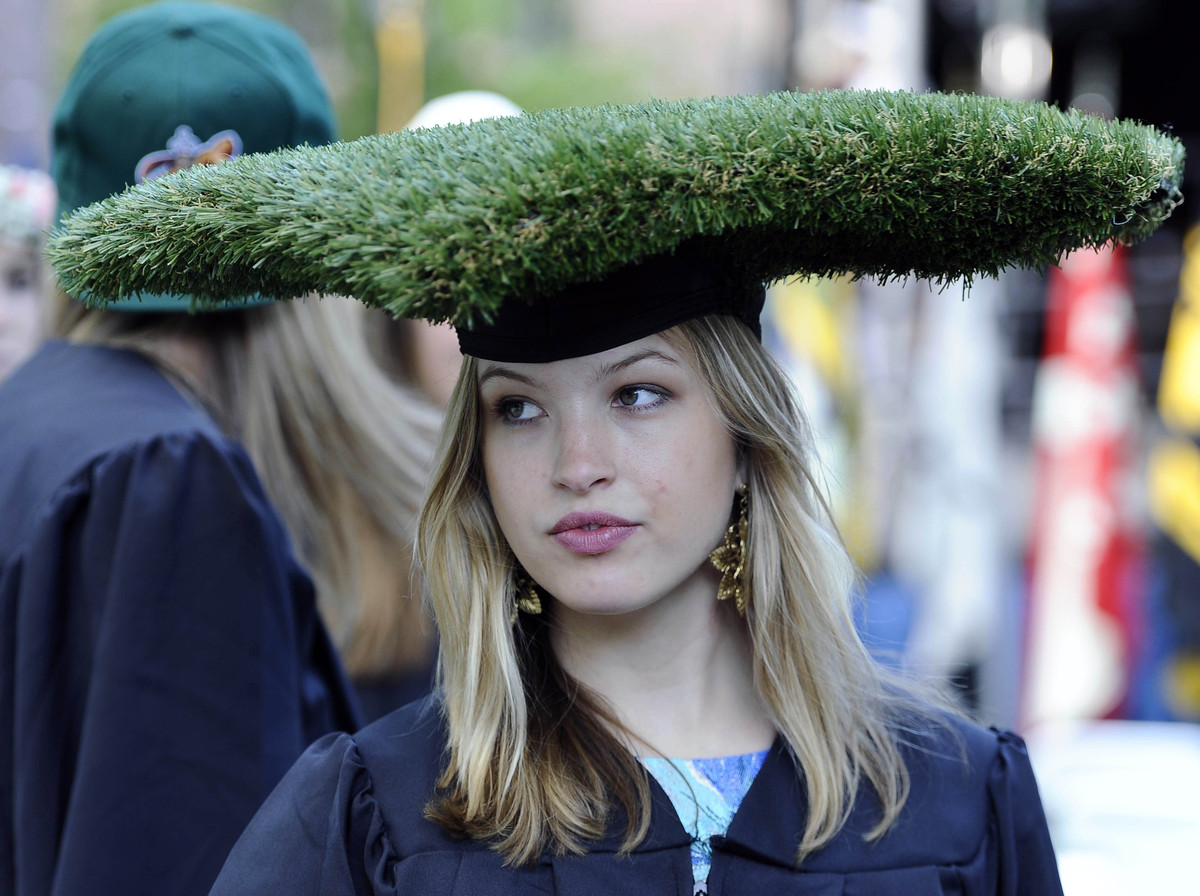
This piece was inspired when I read about some graduating students at local universities pulling “selfie” stunt on stage during their respective graduation ceremonies. This article was first published in Han Chiang News on June 02, 2015.

***************************************************************

I read with much anguish and amusement recently about graduands of local public universities doing some antics such as taking a selfie while they were getting their testamurs on stage during their respective graduation ceremonies. A lot of debates have been generated in the press and in cyberspace over the “rights” of these students versus the “prerogative” of their university to take disciplinary actions on these “rogue” graduands. However, I think all these debate and discussions have missed a crucial point: that the “rogue” students have disrupted the proceeding of one of the most important academic rites of passage called the graduation ceremony. Their university owes it to the rest of the graduands (and more importantly, their families and sponsors) to ensure that this rite of passage, the most solemn of all academic ceremonies is carried out in accordance to the tradition, custom and ritual befitting their alma mater.

My first experience with a university graduation ceremony was in the late summer of 1983 when my elder sister graduated with a degree of Bachelor Pharmacy (Hons) from the University of Wales Institute of Science and Technology (which has since merged with University College Cardiff in 1988 and known as Cardiff University today). There we were, my late parents and I sitting in a great hall in Cardiff, Wales, as guests of my sister. The entire proceeding was conducted in Welsh, and rightly so as it was a Welsh university that my sister had attended. But, we had the entire proceeding translated in English for us in the graduation booklet so that we could be a part of this important rite of passage for my sister.

We could follow everything that went on during this graduation ceremony, even though not a single English word was uttered. The graduation ceremony was steeped in tradition and I remember watching my sister went up the stage, bowed to the Vice-Chancellor and then bowed to the President of the Guild of Graduates, who in turn took off his mortar board and formally welcomed her to the Guild. The English text in the graduation booklet stated that this would be the crucial step in the ceremony as a graduand can only be considered as a “graduate” after receiving the blessing and acceptance into the Guild by the President. Now, fast forward to 2015 and faced with these “rogue” graduands who disrupted the sanctity of a graduation ceremony. Do you not think that the rest of the graduands should have the right to have their rites of passage protected? Would it not be a waste of time if every graduand spends an extra 10 seconds to pose for a selfie / wefie?

No one with the right mind in Malaysia will think of taking a selfie if he/she is getting a prestigious award such as a “datukship” from HRH The Yang Dipertuan Agong. This is because we know that it is a great honour to be bestowed such an award and we need to show the greatest of respect to HRH during the ceremony. Yet many in the raging discussions advocated the freedom of expression to justify the actions of these “rogue” graduands.

What about a simple word, RESPECT for the institution and the leadership of these institutions for awarding an academic credential to a graduand? If a graduand cannot show the simplest form of respect for his own institution and the highest officials representing his institution, then IMHO, the said institution has every right to revoke the graduand’s academic credential or take other severe disciplinary action against him/her. When I saw photographs of some graduands of US universities wearing self-designed mortar boards with all sorts of ugly displays, it dawned on me that the founding Vice-Chancellor and the officials of my alma mater, The Queen’s University of Belfast must have had great collective foresights to do away with mortar boards altogether in our graduation ceremony!

(Featured photograph sourced from:  http://i.huffpost.com/gadgets/slideshows/421528/slide_421528_5395340_free.jpg)

Will Corinthian Colleges’s kind of education meltdown happen in Malaysia?

nnu2yb-corinthian
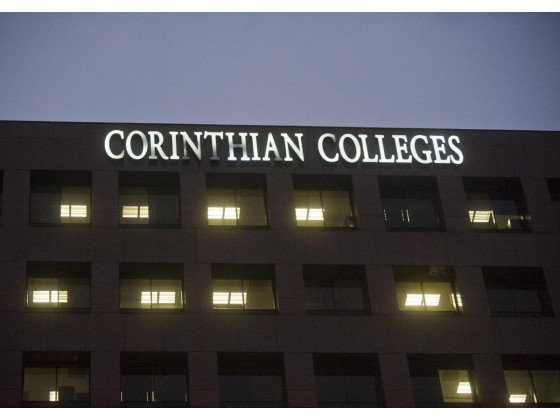
Photograph source: http://images.onset.freedom.com/ocregister/nnu2yb-corinthian.jpg

The final nails are being hammered into the coffin of Corinthian Colleges, once one of the largest for-profit education groups in the USA. The impact of this private higher education meltdown is far and wide. Many of its remaining 16,000 students are left out in the cold, most are shouldering huge personal / education debts with bleak future. Many of Corinthian’s problems that led to its downfall are related to inappropriate management of state-funded education loans to students and over promise of job prospects and pay levels. Can we find similarities in cases of education institutions’ collapse in Malaysia?

If PTPTN can finally get it’s act together (it looks as if it has began the clean-up which it should have been doing in terms of defaulting borrowers management long time ago), will we witness similar higher education meltdowns in Malaysia too?

There are just too many colleges (private, community, public etc.) chasing a Malaysian youth population that is not growing in tandem with their collective capacities. The growth in international students population can help to redress this only a little. Not all the smaller players have what it takes to attract foreign students!

Should PTPTN now also start honing on errand colleges and universities which have been over promising its students with job prospects? Let’s be fair on this, PTPTN should include every institution, both private and public where the most loan defaulters have come from. It also owes the citizens of Malaysia an explanation on why it had decided in November 2014 to whack 15% from the private college students’ PTPTN loan amount while taking only 5% from those in the public institutions of higher learning. This reduction has already showing its impact on the enrollment figures of many private institutions relying heavily on PTPTN loan to fund their students (does this ring a bell?….think Corinthian!).

Consolidation of the higher education industry of Malaysia was called for by some politicians recently. But these people may not have a full understanding on how the higher education industry works and they have no idea of the complexities that the act of consolidation (along the idea of banks mergers) would entail. Colleges and universities are not like banks, the “products” are all very different, the pricing systems and delivery schedules are all unique to individual institutions. It would be easier to let “sick” colleges die than to “cross infect” the healthier ones! No sane edupreneur will be willing to buy into someone else’s huge debt!

With more stringent entry requirements for private colleges and universities set to come into effect in 2016, and the possibilities of PTPTN getting tougher on institutions which produced the largest number of bad debtors, there is a huge storm that the higher education industry as a whole and the private sector in particular are riding into. The “Corinthian Meltdown” may yet to be witnessed in Malaysia!

I for one will not be buying any education stocks for now!

(Declaration: I do not hold any direct shares in any of the 4 public listed education groups in Bursa Malaysia!)

Learning and commenting about Duke-Kunshan University

I have been a loyal student of Harvard University’s highly successful massive open online course (MOOC) on the history of China, ChinaX for the last 14 months. I have successfully completed 9 out of the 10 mini-courses and am now more than half way through the last mini-course.

In week 46 of ChinaX, we were introduced to the remarkable success of Kunshan, a formal agricultural region between Shanghai and Nanjing. We learned that present day Kunshan has a per capita income of over US$19,000 and if we exclude the internal migrants’ income, the per capita income of the population with household resident right (hu kou) is US$52,000. The local government, in the era of the late 1970s (after Mao’s passing) took an unilateral decision to develop the economy of this agricultural region and this gamble (which did not receive any endorsement from the central government) paid off.

This particular module focussed on education, in particular how Kunshan’s local government made the decision to work with one of the elite universities from the USA, Duke University which roped in Wuhan University to form the Duke-Kunshan University. It showed the farsighted leadership of Kunshan in investing in human capital development and innovation as the twin pillars for their residents to stay competitive amidst greater & greater competition from other Chinese cities & regions. But the key phrase IMHO is ” Location, location & location “. No other cities have the great location of Kunshan for being nested between China’s two great cities of Shanghai & Nanjing and having two high speed rail systems having stops at Kunshan!

We were asked the following question as a part of the discussion/ assessment for our course:

What are some challenges Duke University and Kunshan face moving forward? What advice would you give Chancellor Liu and Vice-chancellor Bullock?

I am honoured that my answer was one of the few (among thousands of MOOC learners) picked up for discussion in the weekly “Office Hour” where either Professor Bill Kirby or Professor Peter Bol will review last week’s module, further the discussion and answer questions post by the learners. This is the second time that my contributions get picked up and I am really thrilled to share this with you. I am impressed with Duku Kunshan University’s Vice Provost, Dr. Nora Bynum for her “deciphering” of my online moniker of “everboleh”!

The following is my answer to the question above which ‘earned” me a mention by Professor Kirby. My moniker as an MOOC learner is “everboleh”. The segment of Office Hour Week 46 which touched on my contribution is between 11:30 to 13:00 minutes of this video.

ChinaXOfficehour46

 everboleh

I think Kunshan will have to figure out why it did not involve the Taiwanese whose support was the cornerstone for its eventual success. Both Duke, Kunshan and Wuhan will need to ensure that there are significant landmark successes that DKU can score. Nothing of the prior successes that each of these three partners can guarantee the success of DKU. Being the two largest economies in the world China and the US need not only to engage with each other but the rest of the world, especially India. The challenge for DKU is to fulfill its mission to create human capital not only for Kunshan but which can bring in the kind of human interactions with the rest of the world.

For Duke, the challenge as related by Kunshan Party Secretary, Guan Aigo that the city needs more than just DKU to be successful. How Duke can secure the biggest part of this interaction before other big universities from the US and UK make a move on Kunshan is a relationship game that it must succeed in to ensure Duke’s investment in time and effort (and reputational risks) will pay off.

The departmental-less approach of DKU is new even to Duke, how the cross disciplinary approach in the face of fierce guarding of their respective turf by academics (which is a tradition that cut across all culture and national boundaries) is something Professors Liu and Bullock have to iron out fully. However as a practitioner in education management, I think the idea of a Masters in Management Science that cater to the needs of liberal arts and humanity graduates to take on business administration is a concept that may take hold in not only China but other regions. It is a concept that I will surely adopt for the new university that I am currently helping to establish in Malaysia. I shall watch the progress of DKU with great interest and hoping to learn and emulate its success.

(Source of feature photograph:  http://dku.edu.cn/sites/all/themes/kunshan/images/overview.jpg )

Life’s lessons learned from Harry Potter

What life’s lessons can you get from Harry Potter books? Read what a young fan, Potterhead got to say about this.

[show_post_categories show=”category” hyperlink=”yes”]

[show_post_categories show=”tag” hyperlink=”yes”]

Commentary about this article (revised –  Apr 19, 2018)

The author, Leland Chow was a junior reading Finance, minor in communication studies and economics at the University of Nebraska-Lincoln when he wrote this piece. This article originated as an assignment for one of the author’s classes and is presented here for our readers’ enjoyment.

In late 2012 Leland Chow took the Malaysian Sijil Pelajaran Malaysia (SPM) which is a national high school diploma equivalent examination that most Malaysian school leavers will take. My wife and I were very worried for Leland. Instead of burying himself with SPM study guides, textbooks etc., he was reading Harry Potter books during most of this month-long examination. We joked that if Harry Potter books are included in his examination, he would score grade A+ hands down. Leland simply smiled and told us that it (reading J.K, Rowling’s books) was his way of relaxing. He claimed that reading Harry Potter calmed his nerves as well. Well, Leland might have a point there. He did extremely well in his SPM to win a full scholarship at SEGi University. But after reading what he wrote, I think Leland gets more than just a calming of his nerves! I also learned two things from this piece, (i) Leland was a victim of bullying at high school (& wish I knew earlier to help him to tackle this),  and (ii) the meaning of a new term, “Potterheads”! ————–> Chow Yong Neng, PhD.

~~~~~~~~~~~~~~~~~~~~~~~~~~~~~~~~~~~~~~~~~~~~~~~~~~~~~~~~~~~~~~~~

This was the third and final essay of my English: Rhetoric as Inquiry. My instructor, Ms. Maria Nazos has asked me to write an essay regarding a person or a group of people who I admire. Instead of choosing a real-life person or a group of real-life people, I decided to choose my favorite characters from my favorite childhood series, Harry Potter, Ron Weasley and Hermione Granger from the Harry Potter series. I utilized textual evidences from the book to support the characteristics of the three unlikely best friends. —————–> Leland Chow

Introduction

He was an orphan as his parents were brutally murdered by a horrendous man. He lived with his maternal aunt and uncle since he was born. His aunt and uncle treated him as if he was their servant. He did not feel loved, happy, cared for. His cousin also did not help to the fact that he was literally neglected and bullied by his aunt and uncle, as his cousin was spoiled by his aunt and uncle, giving his cousin new gifts and toys, while he could only get hand-me-down, second-handed gifts and toys. His room was worse, as he literally lived in a small storage closet, barely enough to fit his small body. His life was basically miserable for the past 11 years, until a letter was written to him, telling him that he was accepted into a prestigious school, a magical school, Hogwarts School of Witchcraft and Wizardry.

It was not until 2005 when I started noticing the world of Harry Potter. People usually read the books before watching the film. I, on the other hand, took notice of the first film, Harry Potter and the Sorcerer’s Stone. I really liked how magical it was, and immediately bought the second film, Harry Potter and the Chamber of Secrets and watched it. I felt that Harry Potter was in a way, sad, but very inspiring to me. Then, I persuaded my parents to buy the three books that came after the first two films. I loved reading books as well, and hence I read the three books quite quickly. Suddenly, I realized that I was actually really enjoying all of the Harry Potter books and films, I was a Potterhead.

Background

Harry Potter was created by a British author named J. K. Rowling, in a delayed train from Manchester to London in 1990. She used that name as she had no middle name, borrowing Kathleen as K. from her grandmother, and this made J. K. Rowling’s initial identity to be more anonymous. She wrote the first few ideas of Harry Potter on a napkin, and in later times, used a typewriter to type the first book, Harry Potter and the Philosopher’s Stone. When she was writing, she usually wrote in cafes in Edinburgh, and her then baby daughter would be around with her (Farr). I found it to be quite ironic that J. K. Rowling got her ideas of Harry Potter in a train, as in her books, a platform in King’s Cross Station, Platform Nine and Three Quarters, is used as the platform for the official school train, Hogwarts Express, which is used to transport students to Hogwarts (Rowling, “Sorcerer’s Stone”, 87). This coincided her writing with her true experience in the train. Her way of writing this type of transportation used in all books of Harry Potter resembled a relation between the land of magic and the land without magic. It served as a bridge between the wizards and witches, and the normal non-magical people, the Muggles (Rowling, “Sorcerer’s Stone”, 53). A bridge whereby there were quite a few similarities between the magical world and the non-magical world, which was quite fascinating because to me, I would not have expected wizards and witches to use just the same mode of transportation: a train. Even though it may be a magical train, but still, it was the same type of transport, using a similar type of train tracks.

The younger me at that time read books pretty quickly, so in a month or two, I have already finished reading the three books, ranging from a thin Prisoner of Azkaban, to a very thick Order of the Phoenix. But, unlike now, where I take my time to read and understand carefully about the books, I was just reading and not understanding the plot of the books. Somewhat, this old habit of mine reflected on my personality that I did not understand deeply enough about the true nature of things. I was technically bullied at that age, but I did not know that I was bullied, nor did I know why I was being picked on. I was just too immature at that time to understand things from a different perspective.

Harry’s Love

Love was one of the themes in the Harry Potter book series, and it was evident in Harry himself. Unlike his nemesis, Voldemort, Harry Potter had been loved by his parents. He was born into a dangerous world, and was bullied by his aunt and uncle, but when he was in school, he was loved by his friends, Ron Weasley and Hermione Granger, Ron’s parents, the headmaster, Professor Albus Dumbledore, and even the deputy headmistress at that time, Professor Minerva McGonagall. Molly Weasley, Ron’s mother, in fact claimed that Harry can be her son, and even gave Harry her brother’s watch as Harry’s 17th birthday present (Rowling, “Order of Phoenix”, 90; “Deathly Hallows”, 114). Harry’s love for his friends was also evident when he saved them in the Chamber of Secrets, where he successfully slayed the Basilisk, a dangerous monster, faced many Dementors, which were soulless creatures, and as mentioned in the previous paragraphs, sacrificed himself for the safety of his friends (Rowling, “Order of Phoenix, 527; “Deathly Hallows”, 703).

If he did not love any of the people mentioned, I believe that he would not have sacrificed himself because the existence of love in him was one of the key reasons he did not join the evil side. The darkness that was present in the society was growing more than ever, but his love for everyone and vice versa kept him grounded. Voldemort utilized his followers as if they were his tools, and when his followers were useless or dead, he did not shed a single drop of tear, nor did he show any signs of remorse (Rowling, “Deathly Hallows”, 656). Harry, on the other hand, showed his emotions clearly. He was sad and cried for the death of his loved ones, even in the case of a death of a non-human creature, Dobby the elf! He manually dug a grave and engraved “Here lies Dobby, a free elf” on top of the gravestone (Rowling, “Deathly Hallows”, 478-481). Would Harry be less emotional, and worse, less likeable, if he cannot feel love? In my opinion, definitely! This is what sets Harry and Voldemort apart, as Harry understood the ability to love someone, while Voldemort, unfortunately, could not feel love, and did not love anyone, as he was born under a concoction of a love potion made by his mother for his father (“J. K. Rowling Web Chat”).

Hermione’s Logical Intelligence

Of course, the adventures of Harry Potter would not be as great if Harry was not accompanied by his friends, Ron Weasley and Hermione Granger. Hermione Granger possessed a trait that many people would seem to admire and hate, all at the same time: logical intelligence. It was because of her logical intelligence that she solved the Potion Riddle to help Harry to defeat the professor who had Voldemort stuck at the back of his head (Rowling, “Sorcerer’s Stone”, 286). However, it was also because of that intelligence that Harry and Ron were not fond at her at first. She was described as a know-it-all, having read and studied every book in detail even before the semester has started (Rowling, “Sorcerer’s Stone”, 105). Her intelligence came from the fact that she was outspoken, and because of her outspokenness, the two boys did not like her (Jusino). She proved herself worthy though, and through her kindness towards everyone, she has won many people’s hearts, including Harry’s and Ron’s, and they eventually became good friends. To me, she has also won my heart, as she resembles me in some ways. I am considered an outspoken person. Because of this though, many people think that I am intelligent, especially when it comes to getting good grades in my exams. Unlike Hermione, however, I am the one who works hard, pay my fullest attention in classes, and try my best to get the grades I want. Unfortunately, when it comes to house chores and other life skills, I am the worst person to ask. I cannot cook, I cannot assemble a shelf properly, and I definitely cannot fix a car. Hence, Hermione possesses a trait that is somewhat relatable to me and I admire her because of this.

Soon, as I grew older, I started rereading the Harry Potter books. I now had four books, including Half-Blood Prince. I slowly began to understand more about the struggles Harry, Ron and Hermione faced in the books. I understood the pain the trio faced, especially Harry, after rereading those books. I have slowly started to change my habit of reading, preferring to read slowly and understand more about the plot development. At the same time, I started to realize that I was not very happy in life. I realized that I was being bullied, and I did not dare to tell my parents about it. I just kept everything to myself, like what Harry did by hiding his pain from Ron and Hermione.

Ron’s Humor and Maturity

Ron Weasley, Harry’s male best friend, on the other hand, was not as smart as Hermione, nor as skilled as Harry, but he had a trait that the both of them lack: His sense of humor. He was a character that provided some comic relief in the books, making sure that the books were not dark and sad at all times. At the beginning where Hermione was not on Ron’s good shoes, he kept on mocking her, saying that she was scary. When Harry and he were stuck in a plant and Hermione was freaking out, he questioned by shouting at her if she was a witch. He also joked that Harry had to get his Inner Eye tested during a class when Harry tried to read the tea leaves from Ron’s cup but failed miserably. When the fake Professor Moody Transfigured Malfoy into a ferret, Ron told Hermione to not say a word, as he was trying to remember that scene forever (Rowling, “Sorcerer’s Stone”, 172, 278; “Prisoner of Azkaban, 105; “Goblet of Fire”, 207). In the first two cases, although he was mean to Hermione, he was funny and in a way, was a joker to the other two of his friends. Rowling has said that the reason why Ron had a good sense of humor was because he was immature as well (Ferreol). He, however, became more mature where he came back to Harry and Hermione after leaving them. At the end, when he married Hermione and had kids, he said to his children that he’s extremely famous, prompting them to laugh, showing that he still had his sense of humor (Rowling, “Deathly Hallows”, 380, 759). In my opinion, Ron was one of those people that no one could hate, as he was hilarious in many situations. Rowling wrote such a contrasting character to accompany Harry and Hermione, but because of what she wrote, Ron was easily likeable by Harry Potter fans, or commonly known as Potterheads. He was the type of guy that every guy would want to be when dating with a girl, as he knew what to say to make the girls laugh.

When the last book, Harry Potter and the Deathly Hallows was released, I was delighted and requested my parents to buy the book for me. As it was quite expensive, they were initially reluctant to buy the book for me. After several plead from me though, they decided to buy for me as they knew I liked books. A few years after owning the last book, after many times of rereading, I finally realized that I had changed after reading Harry Potter, somewhat quite a lot. I learned to look things at a different perspective. When I realized I was being bullied at first, I kept on wondering why I was picked to be the victim, why other people would not be the victims. Then, I realized that maybe it was because of some misunderstanding with them, or they had a huge issue on me that even I did not realize.

The Trio’s Bravery

Harry, Ron, and Hermione, however, possessed one of the few traits that no one else in this real world could compare: Their immense bravery. Lord Voldemort tried to kill Harry many times after he killed Harry’s parents, including the night where his parents died, the time where he was fighting for his life in the Triwizard Tournament, and the time when he was a legal magical adult, facing Voldemort, and came to accept his apparent death (Rowling, “Sorcerer’s Stone”, 12; “Goblet of Fire”, 663; “Deathly Hallows”, 703). He was not alone, as Ron and Hermione bravely stood beside him in nearly all occasions, trying to help him to defeat Voldemort once and for all. They were not cowards, and they did not bother running away. Even until the end, the trio did not surrender, even though Harry sacrificed himself to his death. In fact, Harry knew that he had to do so because that was the only way to defeat Voldemort. He knew that a part of Voldemort’s soul was attached to him, and as long as he lives, Voldemort cannot be defeated. Ron and Hermione did not know about that, but when they found out about it, they were sad and continued fighting against Voldemort and his followers (Rowling, “Deathly Hallows”, 686, 731).  Harry chose to die, and not live, as if he chose to live, everything that has done for by his parents and everyone else he loved will be betrayed (Deyoung).

The trio’s bravery was the main reason why Potterheads, including me, admire him. In my opinion, bravery was something lost in the whole of Harry Potter book series. There were too many characters who were afraid of losing something, including losing Harry’s life. These characters then decided to stay silent and be passive in the general public, unlike Harry, Ron and Hermione. They were one of the only few who decided to take action against Voldemort. They were the one of the few who sought light against all the darkness. They were the ones who stood up against all evil, never giving up, and bravely assumed their roles that they must defeat Lord Voldemort in order to successfully vanquish the evil, and restoring peace in the world.

2012 was the year when the final film adaptation of Harry Potter was released. It was a bittersweet moment for my life as I realized that this was THE final film of Harry Potter. No more Harry, no more Ron, no more Hermione. Deathly Hallows Part 2 was very heartfelt as I finally got to see the truth, as read in the book. My life took a turn for the better after reading and watching the last book and film adaptation, respectively. I finally understood that people were still immature at that time when I was bullied, as when I was finally leaving high school, I was not bullied, but on the contrary, I had friends who I can count on. I finally got to experience true friendship from these great friends.

Conclusion

It was and still is surprising that a pure-blood, a half-blood and a Muggle-born could be good friends together. Harry, Ron and Hermione, from the Harry Potter series, have inspired many people to be brave, to be themselves, to fight against evil. I dare to admit and say that I am one of those people. I applaud Rowling for writing such a great series of books, timeless stories, and most of all, creating a magical world that many Muggles like me try to realize in the real world. I hope that everyone who reads Harry Potter could take something home after reading the series, because I have.


Works Cited

Deyoung, Rebecca Konyndyk. “Love Bears All Things: Thomas Aquinas, Harry Potter & The Virtue of Courage.” Virtual Library of Christian Philosophy. Calvin College. 12 Sept. Web. 16 Nov. 2014.

Farr, Emma-Victoria. “JK Rowling: 10 Facts about the Writer.” The Telegraph. Telegraph Media Group, 27 Sept. 2012. Web. 16 Nov. 2014.

Ferreol, Yvette. “Rowling Reveals `Marriage’ to Harry Potter at Reading (Correct).” Bloomberg.com. Bloomberg, 22 Oct. 2007. Web. 30 Nov. 2014.

“J.K. Rowling Web Chat Transcript”. Bloomsbury. The-Leaky-Cauldron.org. 30 July 2007. Web. 11 Nov. 2014. Transcript.

Jusino, Teresa. “Hermione Granger: Minority Geek Girl”. Potterpalooza on TOR.com. TOR.com, 14 July. 2011. Web. 13 Nov. 2014.

Rowling, J. K.  Harry Potter and the Deathly Hallows. New York, NY: Arthur A. Levine, 2007. Print.

—. Harry Potter and the Goblet of Fire. New York: Arthur A. Levine, 2000. Print.

—. Harry Potter and the Order of the Phoenix. New York: Arthur A. Levine, 2003. Print.

—. Harry Potter and the Prisoner of Azkaban. New York: Arthur A. Levine, 1999. Print.

—. Harry Potter and the Sorcerer’s Stone. New York: Arthur. A. Levine, 1998. Print.

________________________________

Below is the grading & comments from the author’s instructor at the University of Nebraska-Lincoln

Grade: ___A_____Comments: Leland, well done! Your revisions all went in the right direction. It is great to see (after the Doyle essay) how truly athletic you are as a writer, slipping from one challenging essayistic form to the next. You have been a delight to have in my class. Please keep in touch if you need anything.

[Feature picture of this post was derived from: http://blogs-images.forbes.com/markhughes/files/2014/10/Harry-Potter-1940×1212.jpg]