Mind where and how you use your smartphones

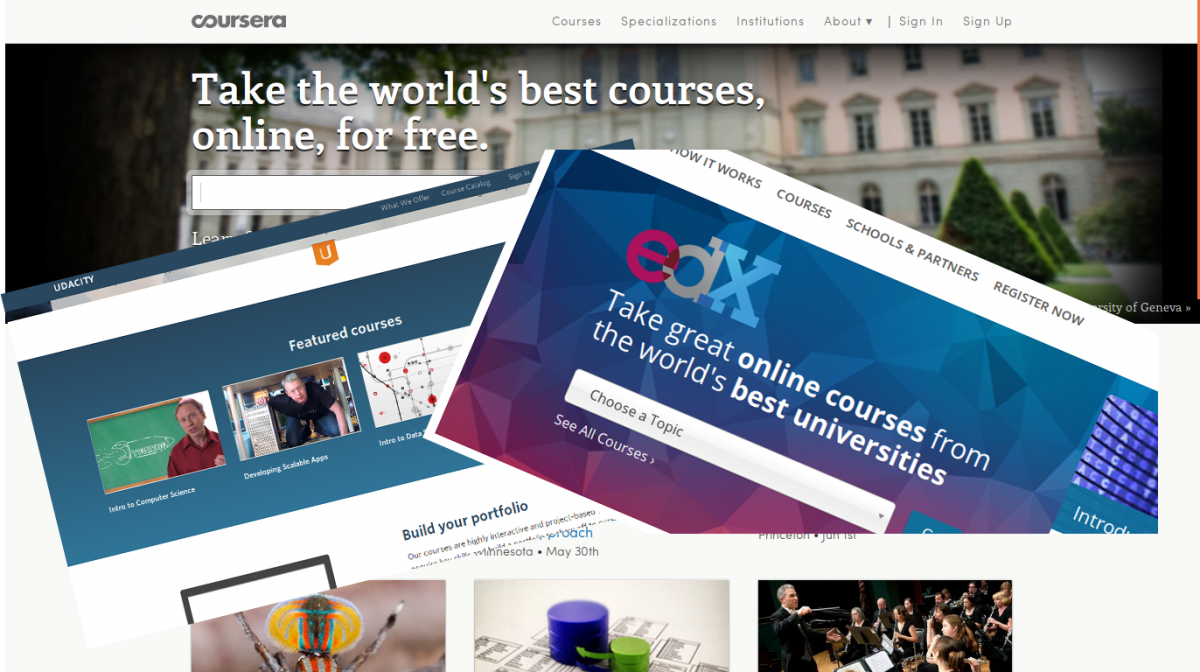
I am learning Edx.org’s Wiretap to Big Data as an MOOC at present. One of the lessons is on how exposed you are if you are not careful in the way you use your smartphones. This infographic tells the story well!

After reading this, you should modify the way you use your smart phones!

More details about the article that comes with this infographic is available.

Dismal showing by Malaysian students in PISA 2012

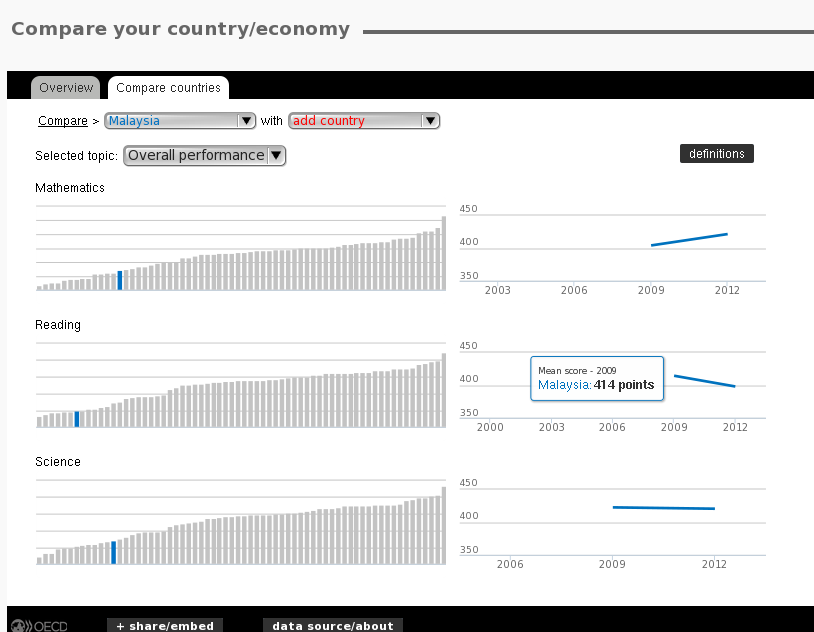
The latest Programme for International Student Assessment (PISA) ranking showed that Malaysian students’ collective performance was way below par and had in fact retreated from previous PISA ranking in 2009.

PISA was carried out in 2012 over 510,000 plus students, aged between 15 and 16 years across 65 nations.

PISA-Malaysia-2012

On the whole, Asian nations did better than most other countries. Singapore took the number two spot. Thailand was 2 places above Malaysia at 53rd. Key findings of PISA 2012 can be downloaded from OECD’s site.

The funny thing was, compared to Singapore and Thailand, which spent 3.5% and 3.8% of their respective GDP on education, Malaysia’s 5.1% GDP spending (all were 2010 data from the World Bank) seemed to have very low Returns on Investment! Budget 2014 will see Malaysia spending 21% of her expenditure on education. With all these spending, we should expect better performances unless the expenditure has not been targeted at what that matters most: the learning outcomes of students.

Already there have been calls for urgent review by the media and politicians. But regardless of all the debates, unless the power that be accepts that there is an urgent need to review education policies and implementations that have been overly politicized, all the huff and puff will just be steam and nothing will stop the rot. It was not long ago that the government insisted that Malaysia has one of the best education system in the world. If we are playing the ostrich, we are forever not seeing the light with our rear end lay bare. Unless we take PISA 2012 ranking seriously like the Finns and Swedes do and face reality with courage, we will be blamed by future generations of Malaysians for our inaction.

Free college education: what about the private providers?

The Malaymailonline has a report on an exchange between Deputy Minister of Education, Mary Yap and Ipoh Barat MP, Thomas Su on the issue of PTPTN loan defaulters. The matter of free higher education was mentioned.

The whole debate was flawed. No considerations on both sides were given to the fact that higher education in Malaysia is not provided by the public institutions of higher learning (IPTA) alone. Over half of Malaysian students in tertiary institutions are studying in private colleges and universities (IPTS). Many of those students studying in IPTSs rely on PTPTN to fund their studies, at least for their tuition fees (PTPTN loan often is insufficient to cover the cost of living). 

It does not need a genius to figure out that you cannot leave out over 50% of the tertiary students when considering a shift in policy. Those debating on higher education issues must have their facts on hand. The IPTSs will not be able to continue providing education if the bulk of their students are unable to pay their fees. Will the opposition be willing to grant scholarships (or convert PTPTN loans to scholarships) for the IPTS students? Can we leave a strategically important sector of the economy, the private higher education industry high and dry with a stroke of the pen?

Until the issue is holistically reviewed, any debate is a waste of time.

___________________________________________________________________________

Free education will create subsidy addicts, claims Putrajaya
BY SYED JAYMAL ZAHIIDNOVEMBER 26, 2013

A student sleeps inside a classroom during the first day of school at an islamic local school in Kuala Lumpur on January 4, 2012. — AFP pic
KUALA LUMPUR, Nov 26 — Putrajaya continued today to defend its decision to keep the contentious National Higher Education Fund (PTPTN) running, arguing that abolishing the corporation would have severe impact, including creating a generation of students addicted to subsidies.

Dismantling PTPTN would also see spending on other key sectors affected as the government would be forced to provide free tertiary education which is costly, Deputy Education Minister Mary Yap Kain Ching told the Dewan Rakyat here.

“Among the reasons..is that this would incure higher cost for education and this would affect spending in other key sectors,” she said in a reply to DAP Ipoh Timur lawmaker Su Keong Siong during Question Time.

“This would also make students more dependent on subsidies and this could make them..uncritical,” she added.

The deputy minister also suggested that giving out free education would spoil students.

“If education is free they will take it for granted”.

Su at this point rebutted and argued otherwise, citing as example those studying abroad and their refusal to return due to the lack of education opportunities back home.

Yap’s reply was: “That is only your opinion”.

Over more than 45,000 PTPTN out 132,801 borrowers have been blacklisted recently for failing to make repayments amounting to RM239.44 million, up to October 31, Parliament revealed yesterday.

Yap had said the move to blacklist the borrowers was not carried out indiscriminately but it was a last resort after the borrowers failed to make repayments and came for negotiations.

The staggering amount of loans owned by borrowers and concerns of repayment evasion have prompted the government to revive its plan to list defaulters on Bank Negara Malaysia’s bad credit list, although the proposal was purportedly shelved following opposition pressure.

But the opposition have called on Putrajaya to reconsider, arguing that the government should conduct research instead and determine the root cause behind the failure instead.

Among the suggestions was that the federal government do a breakdown of PTPTN borrowers’ backgrounds and factors affecting them, including their monthly incomes, success rate in obtaining jobs related to their qualifications and the quality of the public universities, in order to determine the possible issues they face.

The plan to list borrowers on the CCRIS, or Central Credit Reference Information System, was announced recently by Minister in the Prime Minister Department in charge of education, Datuk Seri Idris Jusoh, as a measure to help the PTPTN recover loans.

It immediately earned criticism from politicians across the divide, including Youth and Sports Minister Khairy Jamaluddin.

Khairy confirmed the shelving of the proposal via his Facebook and Twitter accounts, saying the Cabinet rejected the idea at its weekly meeting.

The federal opposition bloc Pakatan Rakyat had proposed to do away with PTPTN and argued that free education was a viable idea.

It became one of its major election pledges in the last national polls and helped gain traction among the country’s youth voters.

See more at: http://www.themalaymailonline.com/malaysia/article/free-education-will-create-subsidy-addicts-claims-putrajaya#sthash.WLhmYrJx.dpuf 

Is our command of English really good?

This was a well received opinion piece published in theantdaily.com written by one of us.

Last updated on 11/11/2013 – 07:06

Posted on 09/11/2013 – 18:32

Chow Yong Neng

COMMENT: Recently, a local daily carried a story regarding a report by Education First which has a chain of English language schools internationally, showing that Malaysia ranked 11th among a group of 60 countries in English proficiency. Not only that, the report also put Malaysia as the top Asian country in English proficiency, one position above Singapore.

There seems to be cause for celebration. It implies that reports of employers and job placement agencies complaining of erosion of our command of English are not in sync with the results of this report. It also implies that the RM270 million spent over the last three years on mentoring 7,500 English teachers by the government was bearing fruit. But hold the champagne or the non-alcoholic grape juice version. Things are not as rosy as it is portrayed by Education First’s report.

If one downloads and reads Education First’s English Proficiency Index 2013 (Third Edition) (EPI), one would be able to learn a few more things about this report.

Firstly, the EPI was compiled using two online tests. The First Test comprised 30 questions which were available (and still are) free of charge to any visitors to Education First’s website (or that of its associates). The Second Test was a 70-question English Placement test conducted on enrolment on Education First’s students in those countries where it has operations. The analysis of the data as reported in the EPI did not distinguish between test takers who took the free online test (First Test) and those who were Education First’s students taking the Second Test. Education First also did not give any indication of the nationality of the students taking the Second Test. It could well be that the majority of students taking the Second Test in Singapore were foreign students as the national school system in Singapore has adequate teaching and assessment regime. And more importantly, all other surveys and reports have been indicating the higher English proficiency of Singaporeans among all the population of Asia. Thus the Singapore result could well have been a reflection of the English proficiency of the foreign students learning English there. I believe Singapore learners enrolled in Education First’s programmes who are not foreign students would have been those who have a lower English proficiency than the general population (which would have been the reason for them enrolling in English classes in the first place). Thus this would at best be a gauge of the level of English proficiency of those enrolled in Education First’s schools in Singapore which may not reflect that of the general population. Interestingly, Education First’s website does not show that it has any operation or associates in Malaysia. Thus one could only assume that the Second Test was not available in Malaysia and the result for Malaysia was based solely on the First Test.

It could well be that the free online First Test was taken by Malaysia-based takers who were a mix of Malaysians and foreign students. This may explain why test takers in Malaysia scored higher than those in Singapore (assuming that the majority of takers of the tests in Singapore were foreign students of Education First). As there was no data captured on the nationality of takers for the two tests, we will not be able to read too much into the results. The result could also reflect the possible better command of English of foreign students in Malaysia rather than a representation of the general population.

It is also not a good practice to compare the scores of takers in two different tests and combine the results where some but not all participants had taken both tests.

To be fair, EPI 2013 did explain its methodology reasonably clearly and also stated clearly the limitations of the analysis. With regard to the free online First Test, it says, “We recognize that the test-taking population represented in this index is self-selected and not guaranteed to be representative of the country as a whole. Only those people either wanting to learn English or curious about their English skills will participate in one of these tests. This could skew scores lower or higher than for the general population.” Thus one should not read too much into the findings of EPI 2013. However, the Second Test, which was administered to students of Education First, would measure more accurately the English Proficiency of the test takers and at the very least the aggregate profiles of these takers could be ascertained easily.

With the data from 750,000 test takers, the EPI is a reasonable measure of their English proficiency, but unless there is demographic data associated with the report, one will not be able to draw concrete conclusions from the report.

Thus we can only claim that test takers of the free online First Test based in Malaysia were collectively ranked 11th among 60 countries where the tests data were analysed. The result from the EPI does not represent any of the general population of those countries. In other words, Malaysia still needs to do a lot to arrest the decline of English proficiency among our people. We should not be celebrating.

Dr Chow Yong Neng has served the education and training industry for over 17 years in diverse capacities.


Dubious qualifications and fool’s gold

What’s the difference between real gold and fool’s gold? Dubious qualifications is just like fool’s gold with the holders being the fools!

[show_post_categories show=”category” hyperlink=”yes”]

[show_post_categories show=”tag” hyperlink=”yes”]

The original post was published in The Ant Daily which is now closed: http://www.theantdaily.com/news/2013/10/10/dubious-qualifications-and-fools-gold . In view of the recent news reports in the Chinese press about traditional medicine practitioners being conned up to RM50,000 for dubious Ph.Ds, I think it may be good to remind people about what I talked about in this article. … (commentary: Feb 23, 2017)

In response to a federal minister trying to defend his dubious qualifications, one of us wrote this piece for theantdaily.com.

Last updated on 10/10/2013 – 12:34

Posted on 10/10/2013 – 12:31

Chow Yong Neng

COMMENT: The recent debate in Parliament on the issue of cabinet ministers having dubious degrees and the inapt defence provided to sweep this under the carpet provided lots of amusement for the masses. In this week’s The Heat, the story of dubious qualifications has been well covered. However, at issue is a few facts that could perhaps put paid to the defence provided by those who have purchased such qualifications.

Fake or genuine

I agree fully with the Minister of Human Resources Datuk Richard Riot Jaem’s contention that the qualifications he had presented were not fake. Indeed these are 100% genuine, with one big caveat; the qualifications were issued by degree mills. There is no academic standing whatsoever in these pieces of paper that the good Datuk holds. Let us call these papers by their proper collective name: dubious qualifications.

Recognised and accredited

A check with Jabatan Perkhidmatan Awam’s (JPA) website revealed that neither Preston University (USA) nor Chartered Institute of Business Administration (Ireland) was listed. Similarly, Preston University was not listed in the website of USA’s Council for Higher Education Accreditation (CHEA). Thus the minister’s dubious qualifications are not only unrecognised but also unaccredited. CHEA also provided links to several US state governments’ websites which specifically warned that anyone using dubious qualifications will be deemed to have committed a felony.

Funny as it may seem, I personally have seen a JPA letter of recognition issued for another famous degree mill, Irish International University, on the latter’s website (which has since disappeared from cyberspace). Thus JPA’s letter of recognition is not a good yardstick in telling if a qualification is of the dubious kind. One should check with JPA’s website for confirmation.

With the minister having access to the civil service machinery during his many years of service, especially his stint as a deputy minister, he could have asked his officers to check with JPA on his qualifications, since he had “worked very hard for it”. As a six-term Member of Parliament he would have been involved or at least seen the papers tabled for the amendments to Acta 555 a few years back. Acta 555 governs the operations of private institutions of higher learning (PHEI). Part of the amendments was to deal with degree mills. Thus it can be assumed that the minister comprehends fully the penalties and so on for PHEIs to offer and/or conduct academic programmes without proper approvals and the measures taken to deal with degree mills. If my memory serves me correctly, the commercial outfit that was part of the Preston University (USA) degree mill scam was located in Puchong, Selangor. I think that a learned person like the minister would have no trouble differentiating the “real McCoy” for a college from a degree mill which this outfit in Puchong was. Thus there were ample opportunities for the good minister to “discover” that what he “worked very hard for” was worthless. If he then had taken the path of burying these qualifications, since he was already so good as to represent the country over 50 times to give speeches in English, none of us would have been wiser and the issue would not have arisen.

Integrity & country’s reputation

The common copper ore, copper pyrites resembles gold and is called fool’s gold. If one tries to pass off copper pyrites as gold, he would have been branded as a cheat. In the same context, dubious qualifications are the same as copper pyrites. There is still no law in the country to stop anyone from buying a dubious qualification for self-satisfaction, frame it and hang it on his wall as suggested in Parliament by another minister. However, if you are getting jobs, highly paid corporate appointments or cabinet posts using dubious qualifications, it is the same as selling fool’s gold as real gold.

There is a Chinese saying, “real gold will withstand the fire from the stove”. Thus the fool’s gold presented in this case is melting easily and now burning its holder’s fingers.

Dr Chow Yong Neng has served the education and training industry for 21 years. He takes particular interest in discovering and collecting stories about dubious qualifications and their holders.