Is there a better way to translate non-Chinese names?

A better way to translate names into Chinese must be implemented. Those translating non-Chinese names into Mandarin Chinese should be familiar with the background, culture and language of the persons or places. The translated name must be phonetically as accurate as possible and at the same time conveying as much of the context or “personality” of the original name as possible.

[show_post_categories show=”tag” hyperlink=”yes”]


When one of the greatest contemporary scientists, Stephen Hawking passed away on Mar 14, 2018, all the press the world over was covering this piece of sad news.

Stephen Hawking
Stephen Hawking, one of the world’s most renown scientist, passed away on Mar 2018) (Image source: http://bit.ly/2FUswBb )

As I was reading this newsflash on one of the Chinese newspaper (e-paper to be exact) which, as newsflash get presented on mobile newspaper app, no images are usually provided. It took me quite a while to figure out that 霍金 (Huòjīn) as the great man was referred to in the newsflash was indeed Stephen Hawking.

Delayed recognition of Hawking’s translated Chinese name

The main reason for my “delayed recognition” was indeed how the phonetics of the word “Hawking” was being represented in the Chinese written text, I guess using hanyu pinyin.   There is no Chinese word, or more accurately, in Mandarin phonetics that can accurately represents or sounds close to “Haw”. And “-king” (the second part of the word “Hawking”) also does not have any equivalent sounding word as pronounced in Mandarin, so 金(jin) or gold would have to do. Interestingly, with nine tones, Cantonese does have two very simple words to represent the great man’s name: 学(Haw)   劲 (Geng). “学” means to learn and “ 劲” means strength. Thus the great man’s name could have the meaning of “strength in learning” which represents Stephen Hawking’s great strength and his ability to learn very accurately.

Could do a better job on Steve Jobs

Another famous person that had left us and whose name was not that well translated into Chinese was the late Steve Jobs. Jobs name was translated into 乔布斯 (Qiáobùsī) in Mandarin Chinese. In fact there are two Chinese words that could have done this “job” better. 作 (zuo) 士(shi). These two words, 作士 together could mean “a creative literati” which the late Steve Jobs was surely one! There was a interesting discussion on this topic in Quora.

How about Warren Buffett’s name in Chinese?

Warren Buffett
Are there better words in Chinese to translate Warren Buffett’s name? (Image source: http://bit.ly/2u9EdhD)

The legendary guru of investments, Warren Buffett was given a Mandarin Chinese name of 沃伦·巴菲特. While  “巴菲特” does give a good phonetic representation of the word Buffett, there are two words that may do a better job.    坝 (ba) which means “dam” or “embankment” – something to stop or slow down the flow of water and 佛 (fó) which means “Buddha” or “a merciful person”. Thus  坝佛 is a much better and meaningful name for Buffett who, has built an embankment to amass his wealth and sharing his wealth as a philanthropist.

[I am extremely proud of the fact that my son got the chance to meet Buffett in Omaha. Buffett happens to be an alumnus of the University of Nebraska-Lincoln too!]

Political leaders & administrators need good sounding Chinese names too

A number of former governors of Hong Kong, especially the more recent ones did take up names that would sound good in Cantonese. But some, like Chris Patten (彭定康 – Péng dìngkāng) took a further step and adopted a Chinese name that did not resemble their Western names fully. However this gave the local Chinese population an easier time in pronouncing their names!  Sir David Wilson (衛奕信 ) is another person who adopted a Chinese name. But in this case Wilson’s name sounds exactly like its English phonetics, provided you read it using Cantonese Chinese!

Kevin Rudd
Kevin Rudd perhaps has the most interesting translation of his name in Chinese (Image source: http://bit.ly/2GQw0l3)


Some prominent Westerners do have translated Chinese names that are both phonetically accurate and more importantly, with great meaning in Chinese. One such person is former Australian Prime Minister, Kevin Rudd who is fluent in Chinese. Rudd created his Mandarin Chinese name by putting his family name, Rudd in front of his given, Kevin (following the Chinese convention) and came up with a good name in Chinese, 陆克文 (Lù Kèwén).  He has chosen 陆 (Lù) to represent his family name, Rudd and 克文(Kèwén) for Kevin. 克 ( Kè) means “having the ability” and 文(Wén ) means “civilization, culture or language”. This Chinese name suits Rudd well, he is not only proficient in the Chinese language, Rudd is very learned in Chinese culture, history and civilization too.

Include the original name as a standard practice

IMHO, the Chinese press in Malaysia should continue to adopt the convention of translating non-Chinese names from China. But as a good and standard practice, the original names of the person mentioned should be given too. This will facilitate not only people like me who may have difficulties recognizing these names in Chinese, but it is doing good service to all the readers to have the chance to learn about the original name of the person mentioned. I must admit that I still struggle with some of the names of places in Malaysia which I know the respective “original names” in Malay or English well but when these are translated into Chinese as they appear in the Chinese press, I would be stumped at times. Often, I had to do further research (if the news article excited me that much!) to discover the original name of the place mentioned.

Translating to Chinese
More thoughts must be given when translating names into Chinese (Image source: http://bit.ly/2uball6)

On a whole, I feel that those translating non-Chinese names into Mandarin Chinese should familiarize themselves with the background, culture and language of the persons or places. The translated name must be phonetically as accurate as possible and at the same time conveying as much of the context or “personality” of the original name as possible.

Revisiting a 2010 story on Malaysians’ Water Usage & Conservation

[show_post_categories show=”tag” hyperlink=”yes”]


Commentary:

This article was first published in March 2010. In view of the current water supply disruption experienced by folks residing in the Klang Valley, I think that a reminder to be mindful of water conservation and careful usage is timely. Commentaries based on more updated findings etc. are inserted in the article below and highlighted accordingly.

As most of the newspaper articles cited in 2010 are no longer easily available online, luckily, I have curated the originals and shared these from my Google Drive.

Interestingly, the National Water Services Commission (Suruhanjaya Perkhidmatan Air Negara – SPAN) has published water consumption data overall for different states in 2015 and 2016. For 2016, the overall domestic consumption was 6,495 million litres per day (MLD), a rise of 217 MLD compared to 2015’s figures. Thus with a population of  31.634 million in 2016, 205.32 litres per capita was consumed per day in Malaysia. 

It seems that we are still way ahead of our neighbours in our excessive consumption of water! It seems we had moved only slightly (less than 20 litres per capita per day) since 2010 when this figure was 225 litres per capita per day!

Water Consumption 2015 – 2016 (source: http://www.span.gov.my/index.php/en/statistic/water-statistic/water-consumption-2017)

Water Usage & Conservation: How do Malaysians fare?

written by Chow Yong Neng at 2010-10-17 12:34:50,  revised at 2011-12-29

On the Sunday’s edition on 3rd Oct 2010, the New Straits Times (NST) published a very interesting headline article on how wasteful Malaysians are in our usage of water. The article drew mostly from “The Domestic Water Consumption Study”, which was a research collaboration between the Federation of Malaysian Consumers Associations (Fomca) and the Energy, Green Technology and Water Ministry.

The most striking fact that came out of this report was that on a daily basis the average Malaysian, despite our lower industrialised status, is using 225 litres of water, which is 71 litres (or 45%) more than our Singaporean cousins (at 156 litres) and a whooping 135 litres (or 135%) more than our Thai neighbour (at 90 litres). [The same message on our excessive usage habit was highlighted again in March 2011 in the Star.]

A look at the water usage data as depicted in the pie chart of the NST article revealed 17% of the usage of water is indeed wasted on leaked pipes. Now what the article did not reveal or it could be that the study did not have sufficient coverage of, is how such leakage have been classified. As without a detailed knowledge of the the types of leakage, it will not be possible to gauge how much of the 17% wastage can be saved by the consumer. This is because the leakage could have occurred in pipes and water conducting system from the source prior to the supply getting through to the households. However, the author thinks that a large proportion of this wastage could have been due to leakage that occurred inside the households. And the bulk of those affected may not have any of such knowledge as the sources of leak may be due to pipes that are buried in the gardens or on pavements leading to the house. Thus to stem this leakage, a lot of focus should be placed on educating the public on how to spot these leakages.  

Malaysia domestic water usage (Image source: http://www.nst.com.my/articles /Wat-erwaste/single)

(Image source: http://www.nst.com.my/articles /Wat-erwaste/single)

The article also quoted Fomca’s President, Datuk N. Marimuthu’s comment that Malaysians waste a lot of treated water to flush toilet and that a dual-flush cistern system can save up to 60 litres of water per day for a household. However, realistically speaking, many people who are living in older houses or apartments will have the single-flush cisterns and the re-fitting of these will only be possible if there is a need to replace the cistern system and dual-flush system can only be attractive if the price of installation is equal or cheaper than the traditional single-flush system. Thus on the “toilet” front, what can we, as consumer who are environmentally conscious can do? For a start, there has been many ideas on saving cisterns water by putting in a small plastic bottle (a used shampoo bottle, preferably 500ml or less) that is filled with water and put inside the cistern. This will mean that the amount of water to fill the cistern is reduced because the volume is now partially occupied by the shampoo bottle. This may not be applicable in some cases where your cistern is not easily accessible….but with the shampoo bottle trick being a sort of “one-off” project, this should not be a deterrent to anyone with the initiative!

The separation of treated water for drinking and untreated for toilet flushing will surely be the way forward but it will require substantial policy change and political clout to compel those in designing and building houses and apartments to install such systems. Of course the authorities controlling supply of water will also have to be in the position to supply both treated and untreated water in their systems. The second factor is more difficult to achieve as it will require substantial reconfiguration of piping of water and installation of new piping systems.

So how do we find a way to save water usage on flushing toilets? Or more specifically, how can we have two supplies of water, one treated and one untreated for flushing toilets? In Malaysia, the only economically viable solution to have treated and non-treated supplies of water is to collect rainwater. Again, this collection of rainwater to be used as untreated water for flushing toilets can only be viably applied to new housing projects and commercial developments as it again involved having the necessary changes to the infrastructure to collect, store and distribute this second source of untreated water. However, having said this, it is still possible for those living in landed houses to do some collecting of rainwater for washing cars and for gardening. In this case, health and safety considerations have to be invoked so that the very act of saving water usage does not result in the spread of mosquitoes that leads to diseases like dengue fevers! There are many examples of innovations using basic tools and materials: a collecting tank (covered), some pipings to convey water from your rain gutters, a crude filter to remove debris (dead leaves and related stuff) and simple fish tank water pump to pump water up to a second tank in the roof or similar high places….then all you need to do is to wait for the rain to come to fill your lower tank.

Malaysians are car lovers, so it will be a great achievement indeed if we can persuade car owners to use recycle or untreated water to wash their cars! This, the author thinks will deserve another study to determine.

A few years ago, it was shown that in Japan wash basins are routinely piped in such a way that they can feed the cisterns of toilet directly with the waste water. This means that the water used with the wash basin (in most cases are for washing of hands) will fill up the connected cistern tank of a toilet thus reuse the water at least once more. Thus if we adopt the same idea in Malaysia, it will definitely contribute towards a substantial reduction in the demand for treated water to flush toilets. With clever re-positioning of the waste water outlets to feed a cistern (which may involve re-positioning of the cistern as well), this idea can be easily implemented.

Japanese water conservation wash-basin-on-cistern (Image’s source: https://www.flickr.com/photos/gjones/4398413098)

The author still remember as a young kid of 7 or 8 years old visiting Singapore for the first time in the 1970s that his aunt was keeping water used for washing clothes and using it to flush the toilet. It was his first experience of water conservation & recycling! But the modern lifestyle in urban Malaysia nowadays with automatic washing machines for clothing which accounts for a massive 22% of water usage in the country being a reality, it will take great innovation and a lot of education and political will for us to change this lifestyle to cut down that 22% usage to something more respectable. Firstly, it will need the policy makers to compel manufacturers of white goods to re-design their washing machines to consume less water and to do some recycling. But this may not be easily implementable or will only make an impact if the current crop of washing machines are replaced, which will take at least 10 years. The current designs of washing machines do not make it easy to harvest the water discharged, especially the those automatic washing machines. This is because all machines demand that the user place the discharge hose flat on the floor or directly into the waste water discharge hole in the sewage system and the collection of this water is very difficult indeed, unless one is placing the machine on a platform a couple of feet higher and let the waste water drain into a water tank or build a waste water tank below floor level. Putting these practical issues aside, it seems that the best potential for Malaysians to reduce the use of water is to recycle the washing machine water for flushing of toilets…..even if we can half the 22% usage to 11%, that is still a great deal of water. Perhaps it may be the most obvious way for the authorities in Malaysia to tackle water wastage issue, but the structural changes to new home designs (which is relatively easy to implement and “green-design” is helping to sell new housing projects) and some clever innovations on how existing landed property owners can easily and economically adopt such changes are badly needed. However, with many households in the country having relatively low water bills, the immediate incentive for any of such measures is difficult to be demonstrated.

One question that lingers in the mind of the author is: why Malaysians are so wasteful when it comes to the usage of water? Is it because of the cost of water supply being so low? Is it due to the fact that we are spoilt by our being fortunate enough to have abundant supply of water and have no notion of conservation of water? Has the experience of water rationing in 1998 lost from our collective memory? All these could be, in singularity or collectively be the reason(s)!

Perhaps we all should look at Malta where there may be an impending water crisis by 2025 to realise that if we do not do something now, eventually we will have to face the same problem. The fact of the matter is that the Maltese currently only uses 76 litres of water per capita [this figure was revised upward to 135 litres per capita per day in 2013]. Even with re-distribution projects being in place to pipe water from Pahang, the Klang Valley (according to the most optimistic statement coming from the current Menteri Besar) will be in water crisis by 2019, 6 years ahead of the Maltese!

How long more are we to be taken for a ride?

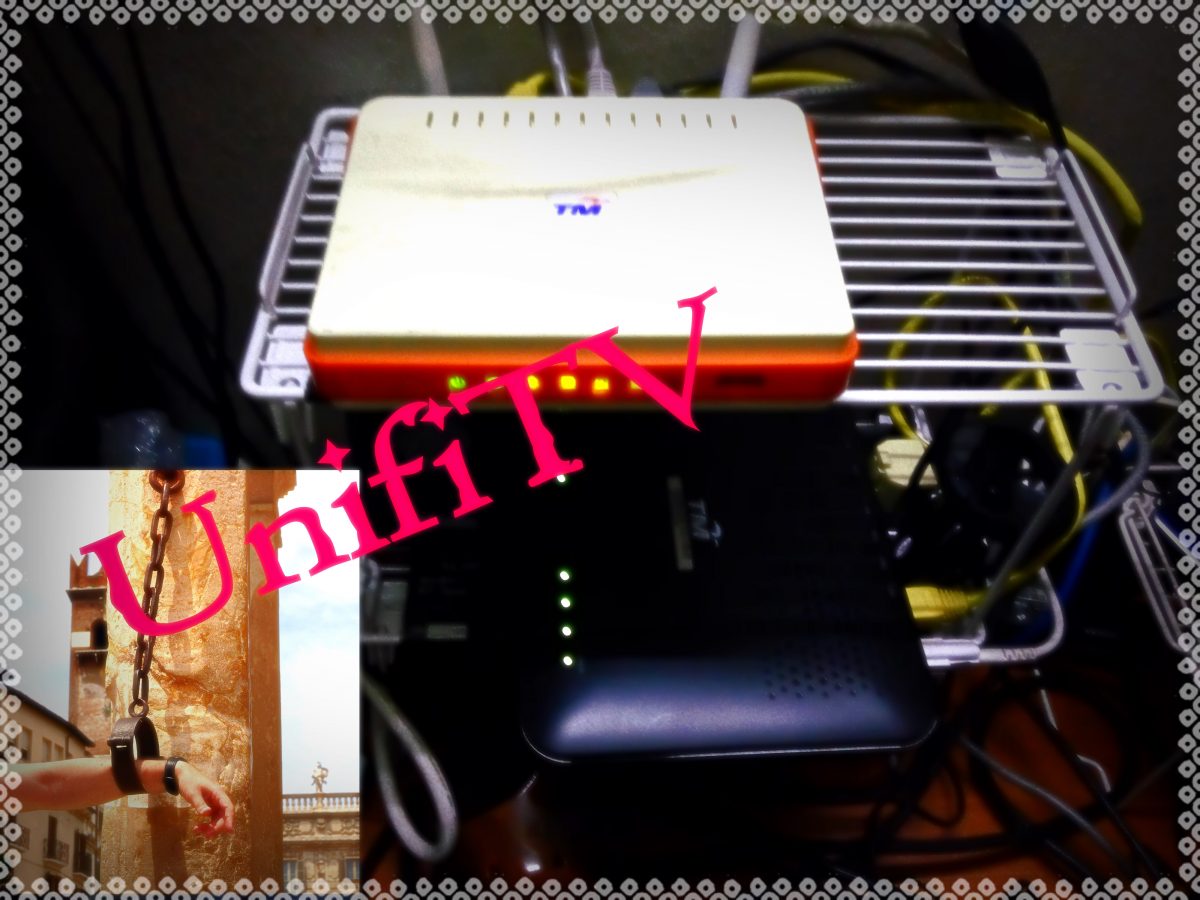
I sympathize with fellow Unifi subscribers who also subscribe to Astro’s satellite TV broadcast and like me, are forced to pay for an IPTV service that they clearly do not need. I think it is about time the Malaysian Communications And Multimedia Commission (MCMC) and Ministry of Domestic Trade, Co-operatives and Consumerism (MDTCC) look into this unfair practice of TM. It is because TM has a sort of “captive” market where it provides the last-mile for most household’s internet service that it can afford to mistreat subscribers like me, forcing us to pay extra for IPTV, that we have no option to terminate,  providing substandard selection of channels and gets away with it.


[show_post_categories show=”tag” hyperlink=”yes”]


I was working on a WordPress project on my computer for a friend-cum-client on a hot afternoon very recently. Suddenly my mobile phone rang.
The caller ID showed that the call was from somewhere in the Klang Valley. I picked up my mobile phone. The conversation, conducted in Bahasa Malaysia went something like this:
“Mr. Chow, you are a current subscriber of Unifi internet service, correct?” asked the lady caller. She went on the identify herself as calling from Telekom Malaysia. I did not catch her name.
“Yup, I’ve been on Unifi since 2012,” I replied.
She then went on to try to sell me an “upgrade” to my current Unifi broadband internet service.
“It costs only RM10 for you to upgrade from your current 30 megabit package to 50 megabit,” the lady said.
“I don’t need an upgrade, I want to stop my subscription to UnifyTV because my contract is long over and I do not need this IPTV service and don’t want to pay for something I don’t use,” I replied firmly.
“Mr. Chow, you can’t. The IPTV subscription comes packaged with your Unifi broadband service, you just can’t detach it” she replied.
Needless to say, I was not too pleased with the information. There was no sale for her!

Can’t detach IPTV subscription from broadband’s

In fact 3 months before this, I did go and downgraded my IPTV subscription from RM50 per month (the “old” Jumbo pack) to the cheapest package of RM30. I wanted to terminate my IPTV service but I was told by the counter staff about the same thing – my broadband subscription is packaged with the IPTV subscription.
Consumers like me are shackled to an IPTV subscription that we do not want. In that occasion, after filing in my complaint of being forced to pay for a subscription where there was a periodic cancelling of channels with no replacement channels for my subscribed package (the latest incident happened in July 2017). I was told that someone “senior” from Unifi will call me to discuss the matter within three days, their “standard operating procedure”, I was told by the young man. Customer service is never TM’s strength. The call from this “senior” person, needless to say never materialized! I was none the wiser on the rationale for being shortchanged (sudden reduction of IPTV channels) and unable to detach the IPTV subscription.

Was told detaching IPTV possible at end of contract

I sympathize with fellow Unifi subscribers who also subscribe to Astro’s satellite TV broadcast and like me, are forced to pay for an IPTV service that they clearly do not need. Worse, there is no explanation from Unifi of why even after the initial contract is over that we still have to pay for something that we do not need? I was given the impression when I subscribed to Unifi in 2012 that upon the cessation of the initial contract, we would have the option to terminate our IPTV subscription. Clearly this has not been the case.
The stability and speed of my so called “broadband” internet can only be described as “patchy”. For a 30 megabit line, one would have expected a relatively stable bandwidth at all times. No such luck. Every evening, one of my security webcams will have its “status light” blinking. This means that it is working but having trouble connecting to the home wifi network. I doubt upgrading to 50 megabit will solve the problem.

No longer “shackled” to home phone number! Now can switch!

If not for the fact that I would have to live with a change in the home telephone number a few years back and the fact that Maxis broadband internet’s performance reputation near my neck of the woods is not stellar (in fact it is not much different from TM’s!), I would have switched already. Time dotCom which has been giving a much bigger bandwidth in Penang (where I lived for 2 years previously), if it eventually decides to make the effort to extend from USJ 6 to my neigbourhood of USJ 9, will surely get me as a subscriber. The house phone is seldom used anyway so it will not have much of a disruption if the telephone number is changed or if we do away with it altogether!

Will the power that be take action?

I think it is about time the Malaysian Communications And Multimedia Commission (MCMC) and Ministry of Domestic Trade, Co-operatives and Consumerism (MDTCC) look into this unfair practice of TM. It is because TM has a sort of “captive” market where it provides the last-mile for most household’s internet service that it can afford to mistreat subscribers like me, forcing us to pay extra for IPTV, that we have no option to terminate, providing substandard selection of channels and gets away with it. None of the other two major competitors, Maxis and Time force their customers to pay for an IPTV package.

Mushrooming of private schooling options in Malaysia, what are the pitfalls?

With the much longer duration of stay compared to college students and that the greater impact of early education on a person’s development, it is vital that children, especially those enrolled in learning centres outside the purview of the Ministry of Education, be given better consumer protection. Hence tighter governance of these learning centres  is badly needed.

[show_post_categories show=”tag” hyperlink=”yes”]

My article on private school education in Malaysia has just been published in Feb 2018 edition of the Selangor Journal. In this article I posed a few considerations that Malaysian parents of school-going kids must think through if they’re contemplating on “going private” and opined that “more choices need not necessarily lead to better options”

cf0d7044-c75c-4f47-b026-315cf495e470

The difference in governance between school and college sectors

I think because historically there have been a multitude of political implications due to policies on higher education, this sector is very tightly controlled by the government where there are six notable Acts of Parliament governing the industry, namely:

  • The Private Higher Educational Institutions Act 1996 (ACT 555 which has been amended a few times with the latest version being published since Dec 01, 2015);
  • The Universities and University Colleges Act 1971 (latest revision: 2012);
  • The Malaysian Qualifications Agency Act 2007 (latest revision: 2017);
  • The National Council For Higher Education Act 1996 (latest revision: 2006);
  • The Educational Institutions (Discipline) Act 1976 (latest revision: 2006); and
  • The Perbadanan Tabung Pendidikan Tinggi Nasional Act 1997 (latest revision: 2006).

In contrast, after an extensive search of the website of the Attorney General’s Chamber of Malaysia, I could really just find the Education Act 1996 (latest revision: 2012) which governs the entire pre-school, primary to secondary school sectors.

Tighter control over private schooling?

The proliferation of private schooling options over the last five years has resulted in Malaysia having 423 such institutions under the purview of the Ministry of Education. I think the governance of these 423 institutions is well set out in the Education Act 1996 and the many guidelines etc. that have been developed over the years. It is the mushrooming of homeschooling centres and tuition centres offering foreign secondary school curriculum that seem to escape the radar of the power that be.

Even for the higher education sector which has six laws governing it, there were many notable instances of the consumers (parents and students) being short changed. Thus for a sector like the homeschooling and iGCSE tuition centres that has been very loosely governed, in my humble opinion, there will be cases of the consumers getting a raw deal soon.

Longer duration of stay of the schooling sector

Higher education players typically have their students studying with them for between 2.5 to 5 years and their students are technically young adults, most of whom are aged 18 and above pursuing diploma (2.5 years in duration), pre-university (1 to 1.5 years in duration) and degree (3 – 4 years in duration). As young adults, college students are much better than their younger counterparts at schools to fend for themselves and to know their rights and obligations of the institutions of higher learning that they are enrolled in.

In contrast children will receive typically two years of preschool education, six years of primary education and at least five years of secondary education, making a typical duration of stay in the private schooling institutions of 13 years, that is 2.5 to over 5 times the duration of stay at the higher education sector.

Hence with the much longer duration of stay and that the greater impact of early education on a person’s development, it is vital that children, especially those enrolled in learning centres outside the purview of the Ministry of Education, be given better consumer protection. Thus higher rigour in governance of such private homeschooling centres should be considered by the power that be. Unlike physical goods, you just cannot undone or “return” inappropriate schooling received!

[You can get a hardcopy at selected Giant Hypermarkets and the town council office (I couldn’t get hold of a copy as yet!). But if you want to read it now, you can download a copy here: http://bit.ly/SelangorJournalFeb2018 ]

Is PTPTN out of the woods yet?

My former senior colleague, Mr. Yeap Boo Yam, formerly the Chief Editor of the online news portal, theantdaily.com had kindly invited me to contribute one article to the relatively new publication, The Selangor Journal recently.

Mainstream press missed the forest for the tree

The topic of my article was a commentary on the performance of the National Higher Education Fund Corporation (PTPTN) where I noted this was glaringly missing from all mainstream reports when figures on PTPTN were released. Everyone seemed to be fixated by the magic 410,500 bad debtors who never repaid a single sen! No one cared to notice the tremendous difference that the stringent (or more like “industry standard practice”) debt recovery efforts coupled with the barring of bad debtors leaving the country had on the debt collection figures.

As a student of higher education management, I started to collect historical data on PTPTN’s performance and was able to pull these out to compare PTPTN’s performance for the last 11 months. The funny thing is, why PTPTN could not publish a report card regularly and why do we have this seemingly odd “11 months” data rather than a yearly figurs to make comparison more valid?

PTPTN’s fund is for local studies only

Lately, there has been some talk of, in view of PTPTN’s greater recovery of debts, to consider giving loans to Malaysians for overseas studies. In my humble opinion, this is beyond the scope and duties assigned to PTPTN. PTPTN’s main role is to make sure that the playing field, as far as access to higher education is concern is made as level as possible for all eligible Malaysians. PTPTN’s main mission is therefore to ensure that qualified student should not be kept out of universities or colleges because he/she comes from an underprivileged background. We have collectively 500 plus colleges and universities (both private and public) providing academic diploma, degree and higher level studies where most, especially those in the private sector are chasing after students.

College “seats” are not being filled up. Partly this is due to a cut back in PTPTN funding in November 2014, especially severe for the private sector. I feel that the priority is to maximize PTPTN’s pool of funds for local tertiary studies where the cost of degree studies is a fraction of what you can buy overseas (principally in the West). Anyone aspiring to study overseas should be free to do so but at  his/her own financing. PTPTN, I feel should be reserved for students who are enrolled in local institutions of higher learning ONLY! One needs not go overseas for a degree if one does not have the financial means to do so since there are plenty of local alternatives, many are just as good academically as their overseas counterparts.

Putting my money where my mouth is

My wife and I practiced what we “preached”, we paid for our son, Leland’s entire 3 years of studies at the University of Nebraska-Lincoln using our own savings.  Leland found work on campus to help pay for some of his expenses to help to lessen our burden. If for whatever reasons that we were not able to fund this, our son could have had the option of remaining at SEGi University to complete his Bachelor degree, after all, our son was awarded a full tuition-fees waiver as a scholar of SEGi University in 2013. The fact that we “broke the bank” in so doing (the US$ went from US$1=RM3.20 to touch US$4.50 at its peak  during our son’s studies, adding 40% to the total cost) was a consequence that we had to accept and had to bear in order for our son to experience living and learning in the USA. We are still “nursing” a “sizable” bank overdraft and we still owe my elder sister for the US$9,000 that she loaned us! That is the price we had chosen to pay (and the kind help we received from our sibling). We would never expect PTPTN to help us in any way at all.

The Selangor Journal  –  a ‘hot’ item!

It seems that The Selangor Journal is an hot item at the various distribution points and I could not get hold of a copy till Mr. Yeap gave me one today! A photograph of my article is provided below.

CYN-SelangorJournal-Dec06-2017-PTPTN

Is the new Google Sites functional enough to replace the “old Sites”?

The 10-months-old revamped Google Sites still has a long way to go to match the functionalities of “Classic” Google Sites that it is supposed to replace. “Classic” users will be very reluctant to migrate due to the lack of functionalities in “New Sites”.

When I first ventured into the freelance consulting business, I had to watch my budget. Back then (in 2007), Google was very generous in providing a cheap domain name registration and just launched Google Apps (which is known as Google Suite now). For US$10 a year, not only could I get a domain name registered, I was given a suite of web apps that were great for a start-up consulting business like mine. I had, three domain names registered and did up all three websites using Google Sites, slc2u.org, powerof3consultants.com and slc4u.org.

In fact, you do not need to register a domain to use Google Sites, anyone with a gmail account has access to, and is able to publish his/her own website using Google Sites. It is just that, without your own domain, you will need to rely of Google’s assigned domain, something like, https://sites.google.com/view/testing-new-sites/home  which is not easy to remember and hence not great for business usage.

Google Sites Classic was simple but functional

Although “Classic” was not as flexible as WordPress (that has to be hosted by a web hosting company and costing a lot more), if you compromise a bit, you will be able to live with its shortcomings and utilize its many features (which are free!). “ Classic”, though a bit fiddly , does have many useful features, among other things, it allowed a website to be created, mapped to my domain relatively easily. It did not like “scripts” to be inserted but if you are just needing a simple website to do business with, “Classic” will do. There were also a lot of “gadgets” created by users that conferred greater functionalities to websites created using “Classic”. Sadly, many of these once powerful gadgets have now faded or no longer functional.

Revamped Google Sites to replace the aging “Classic”

Just over 10 months ago, on Nov 22, 2016, Google announced a full revamp of the Classic Google Sites )”Classic”). A TechCrunch article infer that “New Sites” “is now a product people will want to use. It finally feels like a modern applications and not like the last vestige of Google’s old and forgotten design principles.

As I was content with “Classic” for the past 10 years, I did not bother to check out the “revamped” Sites till now. It is not “scientific” of me to take TechCrunch’s words for the truth and thus I spent some time tested “New Sites” out.

Test driving “New Sites”

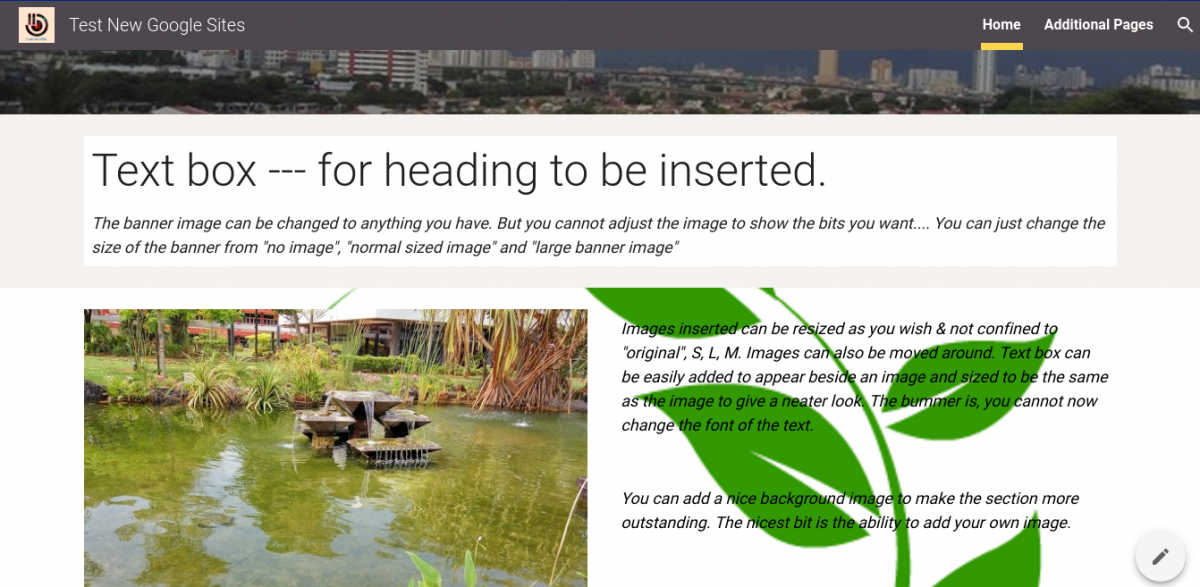
As my web hosting deal for one of my domains hosted with Mochahost will end in November 2017, I had decided, a few days back to migrate this domain name mapping back to Google Suites and what better time than to test drive the “New Sites”. Though “New Sites” has many user-friendly features, I had discovered that it was more rigid in many ways compared to “Classic” and decided to revert to “Classic” to hold the landing page for my domain name. Nevertheless, I had set out to give the functionalities of “New Sites” a good checking over.

To show how the functionalities of “New Sites” work, I had to bring my readers from this blog (hosted by WordPress.com) to my “New Sites” hosted by Google Suite. Readers will see for themselves what I meant when they visit my test site.

I suggest that my reader visit my test site first then return to this article to see if you agree with my take on “New Sites”.


The Good of “New Sites”

  • Very easy to use.
  • Integrate almost seamlessly with other apps in Google Suite (Sheets, Docs, Slides, Calendar and Form) and other Google’s apps such as YouTube, Maps etc..
  • Dynamic adjustment of image size.
  • Ability to put text box anywhere and mix this with images easily.
  • Each section / segment of a page can have its own background colour (but only yellow) or image.
  • Via “Embed URL” you can create a “frame” in your website and embed another web page so that your users will not need to navigate away from your site.
  • Much neater looks and feel compared to “Classic”.

The Bad of “New Sites”

  • The ease of use of “New Sites” does come with a price…. Editing flexibility and functionality are curtailed.
  • You have virtually no choice of fonts (well you can choose only three each from the six themes available). At least “Classic” gives me 6 different front & I can apply any font to any section independent of each other.
  • You cannot change the colour of the text font or highlight your text.
  • Captions for images are not integrated into the image and you cannot use a different font for captions
  • A lot of functionalities of “Classic”, especially to do with domain name settings etc. are either missing or hidden from users when you are using “New Sites”.
  • No choice of whether you want sitemap or not.
  • Features of “Classic” such as using a page as a Web page, Announcement, List, or File Cabinet are missing, restricting its use. Announcement is especially important as some use it as a news page or even blog page.
  • No “gadgets” available, thus I could not for instance RSS this blog to my websites if I migrate to “New Sites”.
  • Sites are now stored with Google Drive and not their own dedicated storage under Google Sites (sites.google.com) as in “Classic”. If like me, you have thousands of files in Google Drive, organizing files for “New Sites” is that much harder.
  • And the list goes on…..

Who/when one should use “New Sites”?

Because of the ease of use of “New Sites” coupled with its almost full integration with Google Apps, “New Sites” will be great for situations where one will need to put up a website quickly.

For example, a lecturer or teacher will be able to put up a site to share with her/his students images, links and even full Google Docs / Sheets. A social group can easily embed a Google Form in “New Sites” for instance to let members register for an event. “New Sites” is also very useful when a company’s usual website is suddenly nonfunctional (DOS attacks or problems with the web hosting company) and an emergency site has to be put up.

Should “Classic” users migrate to “New Sites”?

TechCrunch mentioned that Google may want all “Classic” users to migrate to the “New Sites”. Will I be willing to do this? At present, my answer is ABSOLUTELY NO!

Well not until all the existing domain name handling and editing features of Google Docs (or at least the old “Classic”) can be made available to users of “New Sites”.


Money Saving Tips: extending the useful life of razors

Disposal razors market is worth at least RM4 – 5 million a year in Malaysia. What if you can extend the useful lifespan of a razor blade by over 700%? Will you want to use this technique to save a few RM & cut down on plastic wastes?

This article was written originally for an environmental portal for which this author was associated briefly. But since it was not utilized (more importantly, since the author was not remunerated for his work) he had decided to publish this in the previous version of his blog instead.
Seven years after this article was published, the author is still using the same technique to extend the lifespan of his razors and in fact most of the twin-blades and triple-blades razors that was mentioned in the 2010 edition of this article are still in “active service” today (Sep 25, 2017) , over 7 years after the experiment started!
Apart from the companies making razors, it can be deduced that most consumers should try out the method described below which not only will save you a few precious Ringgit a few months but will help to reduce plastic waste to the environment.
The author had also taken the opportunity to update his estimation of the size of the razors market and other figures accordingly in view of more “data” and a reflection on his initial estimation.

Money Saving Tips: Extending the useful life of razors
Written by Dr. YN Chow at 2010-08-31 12:08:09

Removing hairs from bodily surfaces for cultural or aesthetic reasons has been a big business. While traditionally this has been viewed as the guys’ issue where shaving has been viewed as a sign of one reaching “manhood”, in reality, the razor blades have more customers than just men.

It is not surprising that a significant amount of advertising and promotion have been levied on selling “new” designed razor blades to the consumers and now they have even segmented this into the “guys” market and the “ladies” market. While the writer has not a single clue about how large this market is, a simple estimation of the market for Malaysia can be “guessimated” as follows:
  • There are 27 32 million people in Malaysia, about 50% are male
  • 60% of the males are late teen or older  =  50% * 32 * 60% = 9.6 million people
  • Assuming 30% of the 9.6 million late teen to older males shave regularly = 2.88 million people
  • Assuming each “shaving customer” uses equivalent of 3 razors per year @RM1.50 – RM2.00 per razor = RM4.32 – 5.76million
  • Every one uses the razor blade directly (self applied) or via your barbers or hairdressers, including ladies some of whom do shave their appendages!

Hence a conservative estimation of the market for razor blade in Malaysia is about RM4.32 to 5.76 million. Of course this figure will go much higher if we take into account of the fact that many of the branded razor blades sold are priced at much higher than RM1.50 a piece.

Even if you are spending RM3 a year on razor blades, and you are “hooked” on the twin blades or higher specs models…..you know that the razor will blunt itself after about 30 to 50 usages (or less, depending on how much shaving your face needs per day). What do you do? Throw away the old one and get a new blade? This article will tell you that is not a good idea as the average branded twin blades razor (or those of higher specs) have at least 80 or more good shaves ahead of it after the initial 30 usages!

A report in the Chicago Tribune in 2007 advocated that you should let the razor blades dry off before using again to extend its life. But there was no concrete proof that this was the case. And the writer has been letting his branded razor blades dried themselves each time after use but that did not seem to extend their lives. That is, until he reads an article about a video on how simple it is to extend the life of your expensive branded razor blades and actually went to view the video concerned, posted by a gentleman with the handle of Terrypun in late March 2010 that he was intrigued enough to want to try this simple experiment.

The Terrypun Technique:
This was taken from a short write up by Ben Popken of the Consumerist:

“When he (Terrypun) notices his blade getting dull, he rubs it on his forearm in the non-cutting direction for about 10 strokes. This is all you need to keep the blade honed and sharp. You can also rub it against the heel of your palm.

Contrary to popular misconception, it’s not water or rust that dulls the blades, which are often stainless steel. It’s just the fine edges getting dulled on your face (or legs, or chest, whatever you would like the shave).”

Traditional single-bladed razor
T-shaped single-blade razor was used as a control with new blade at each use.

This article is being written on 31 Aug 2010, Merdeka Day (and revised just over 7 years later,) and the writer has been experimenting with the technique shown in the embedded video for just about 5 months (over 7 years by Sep 2017!). He has summarised his findings (which, as a trained scientist, he must qualify that this was done without any statistically analysis, replicates, blocks etc. etc. & purely came from his own observations of his face & chin after each shave!).

  1. Resurrecting An Old & No-longer-used Twin-bladed Razor
    He tried to “resurrect” a twin-bladed razor (of a leading brand) which he had “abandoned” in his father-in-law’s house for close to 2 years using the Terrypun technique: He was able to sharpen the blades but no matter how much of the sharpening he has done, the razor still could not be resurrected and there was always remnant of stubbles left on his chin after shaving.Conclusion: You cannot flog a dead horse! The Terrypun technique will not return your very old & long abandoned razor blades to their former glory! Buy new ones!
  2. Resurrecting Two Branded, Recently “Abandoned” Razors (a Twin-bladed & a Triple-bladed)
    He has two branded razors (a twin-bladed & a triple-bladed) which he was going to replace their respective heads with new ones that he had bought (mind you at very high prices!) just as he thought about the Terrypun Technique. He applied the Terrypun Technique each day (by rubbing the razor on his forearm in the non-cutting direction for about 20 -30 strokes). He remembers his scientific training and replaced his T-shaped traditional razor with a fresh single blade and use this as a “control”, where he shaves with this razor once every week and compared the results with the resurrected Twin-bladed and Triple-bladed razors. The Terrypun Technique was able to return both razors to “functioning” level. The effect lasted till recently, about 5 months or 60 shaves for each razor. Over 7 years later, in Sep 2017, his two razors are still functional, each time after the “standard” Terrypun Technique is applied!Conclusion: The Terrypun Technique works for branded twin-bladed or triple-bladed razors, by extending their useful lives by more than 700%, but there is a finite limit to which you can “flog the horse” before it becomes a dead horse! You should, using Terrypun Technique, expect at least 80 – 90 300 – 400 shaves from a brand new branded razor.
  3. Resurrecting Cheap Disposable Razor
    The writer had to travel to China in Sep 2010 for work and was supplied with disposable razors at the hotel that he was staying. When it comes to disposable, supposedly single-use razors, it is quite a shame to have to throw these away after only a couple of shaves. Often you can use it for at least 3 -4 shaves. He therefore decided to apply the Terrypun Technique on one of the single-bladed disposable razors supplied by the hotel. The razor was good as new even after the 10 shaves (which the author “consumed” after his 5-days trip to China when he went on a few short local trips to the hometown).Conclusion: You can apply the Terrypun Technique to extend the lifespan of those disposable razors for as long as the plastic holding the blades are intact. Each of this type of razor can give you, via the Terrypun Technique, at least 10 100 – 200 shaves or more.
The observations given above were done on twin or triple bladed razors and the writer had tried doing the same on an old fashion “T-shaped” razor  which he had used as the “control” in this experiment (the type where you have to pop open the contraption & replace the individual blade, risk cutting yourself in the process)….he lost some hairs from his right forearm. So a word of warning, apply the Terrypun Technique only on the “new safety” razors and leave those T-shaped razor well alone!
 
What has all these got to do with being environmentally aware? You may ask.
First extending the life of your razors by 3 – 4 folds save your some money.
Secondly, and more importantly, as most of the razor’s parts are made of plastic, the less you have to throw away, the less you will contribute to the mountain of waste.

Lefthanders have “rights” too!

It is about time the lefties of the world (there’re 7% of us) stand up for our LEFT! Forcing a young left handed person to use her/his right hand is tantamount to child abuse!

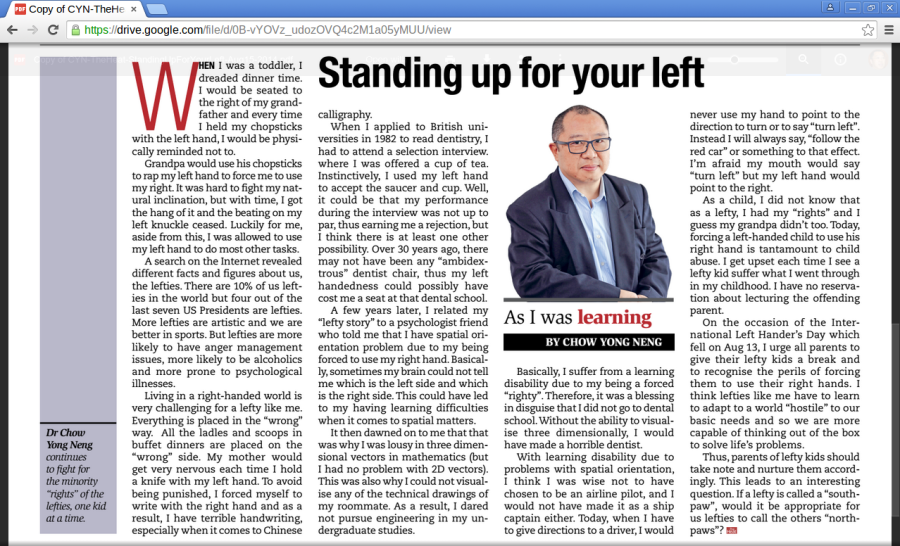
Do you know that forcing a left-handed child to use her/his right hand is tantamount to child abuse? I wrote this article 3 years back when I was a columnist of the now defunct, The Heat. I hope to spread this message to help fellow lefties so that they do not have to suffer the irreparable damage like me. So by now many of my university mates should know why I did not take up engineering at Queen’s University of Belfast (though the admission officer, Mr. Sterling Weisner did offer me to read all engineering degree programmes in 1982, except for Electrical & Electronic Engineering)!

When I was studying for my GCE “A” levels in South Shields, Tyne & Wear, England, for the life of me,  I could never figure out my roommate, TS Lau’s technical drawing, no matter how hard I tried. Later a fellow Malaysian student, Andrew Chew’s girlfriend who studied psychology explained to me that people like me suffer from spatial orientation problem and in severe cases, sufferers can go mad!

I understand there are cultural requirements for one to use the right hand to perform certain rituals etc. but that do not mean that a left handed person is supposed to use her/his right hand to do everything. Lefties are very adaptable. My daughter who is left handed learned to use the chopsticks using her right hand as it was the way her mother taught her. It did not do her any harm as she was free to use her left hand to do other crucial learning tasks such as writing and drawing. So there is one less excuse for forcing a lefty to be totally “righty” in whatever he/she does.

Hopefully, we lefties will have our birthrights respected and I hope more like me, will stand up for our LEFT!

Please click on the photograph of the article above to view a bigger sized image.

MRT: a good start, more attention to details needed

Sungai Buloh – Kajang MRT line is not perfect but it connects people from far flung areas of the Klang Valley together. Despite the teething problems it provides a great comfortable ride. All it takes to make it more attractive to car drivers is a more comprehensive “last-mile” connections of feeder buses that cover many more areas and run on more frequent scheduled services.

The launch of the MRT first complete line from Sungai Buloh to Kajang was done with much funfair on and prior to D-day of July 17, 2017.

As an avid public transport user and advocate, I too went on to test out the MRT line. My wife, daughter and I fancied having our favourite satay at Restaurant Malaysia, Kajang. So we took the LRT from Taipan station to KL Sentral to change to the MRT at Museum Negara.

Instead of writing a long story, I shall let the pictures speak a thousand words each! [but with my captions!]

Where is the link way?

tiny signage
So which way is Museum Negara MRT station?

Coming from Nu Sentral mall’s direction, the link way to Museum Negara MRT station is just beside McDonald on the right. But you will need to walk right near the entrance to spot the MRT logo.

Spot the MRT logo & you will know where to go!

Once inside, you will need to have very good eyesight to spot the tiny MRT logo on the signage inside the huge hallway (which was partly the waiting area for the ERL previously). Then it is a matter of “follow the crowd”. You will reach the “very deep” underground Museum Negara MRT station.

Where’s the contingency plan when technology fouls up?

Where the heck are we?

The MRT train that we boarded at Museum Negara had problems with its “station indicator” LED screen. This was made worse by the fact that the audio announcement of impending station was linked fully with this. So if one kaput, all kaput!. The MRT coach was well lit. So when we stopped at an underground station, one would have to literally step out of the coach quickly, and look for the signs that tell us which station we were at. There was also not a single Sungai Buloh – Kajang MRT line map inside the coach (there would be many places to stick this), so we could not even use the age-old system of counting station to know where we were!

When it is working, this thing is great!


A tried and tested, simple map to show the MRT line like this on the old LRT coach will be great!

We should not place so much faith in technology working every time. A simple map of the MRT line like that found in the older LRT coaches would “insure” against the electronic announcement system (both audio and visual) failing.

Plenty of space in MRT coach to stick more useful information like stations along the line!

Instead of these self-congratulatory stick-on posters, why don’t we have useful information like a line map, bigger sized full RapidKL rail system map etc. put up?

One of the side benefits of the MRT line –  Kajang satay vendors could not cope with demand!

Kajang satay, it’s worth the trip!

We reached Kajang and went straight to Restaurant Malaysia for our favourite satay. We were lucky to have arrived 5 minutes earlier than the crowd. Many were eyeing our table! The MRT line really shortens the distances between towns within the Klang Valley and the first economic benefits felt in Kajang is the sale of satay! Many more economic benefits shall follow!

Seamless transfer between MRT and LRT, a great feature

We went home from Kajang Stadium to USJ by changing form the MRT to LRT (Kelana Jaya line) at Pasar Seni. The sight was great but I was more attracted to the seamless transfer between the two lines. This is the most crucial factor to ease the congestion (of people getting out of one line and joining into another). You will also be fully protected from the elements getting from the MRT line to the LRT. I feel that if more seamless transfer can be made available, it will make life a lot easier. One candidate up for seamless transfer will be the Monorail and LRT at KL Sentral.

My take on the MRT

Despite what the critics have said, I think the MRT system is a great addition to the Klang Valley public transport system. It will surely bring up the economic value of properties around the stations. Kajang folks have already seen more visitors than before!

If the teething issues highlighted by yours truly can be looked into, I think the MRT system, which has broader coaches (thus steadier to ride) will help to convince more people to follow yours truly, to take public transport as the first option. The only thing that is stopping this is the last-mile linkages which is still very rudimentary. Feeder bus service (more lines and more frequent services) need to be extended in coverage and hours of operation. It is often the last-mile issue that forces people to have to drive.

RapidKL needs simple lesson in maths!

RapidKL could have avoided this botched up if those in charge have done some simple mathematics like what I had done. It does not need a Ph.D. in Operational Management for one to figure this out and plan accordingly. It is clear from my calculation that RapidKL will not be able to complete the issuance of all 68,000 new MyRapid concessionary cards before the deadline of mid July 2017. I think the sooner that RapidKL owns up to this fact and makes an contingency plan, the better it is to salvage its tarnished reputation.

The much anticipated changing of MyRapid cards to the new version to coincide with the launch of the full first MRT line in the country started in earnest from mid June 2017.

No issue with changing of non-concessionary MyRapid cards

As one of the first holders of the original version of the MyRapid card, I went to USJ 7 LRT station and changed this to the new version on June 16, 2017 without any difficulty. The entire process, inclusive of waiting time (with 2 persons ahead of me) was around eight minutes.

Chaos reign in changing of concessionary MyRapid cards

But no sooner that this exercise was announced, the press had been receiving and reporting a severe botch up by RapidKL in the changing of concessionary MyRapid cards. This author’s daughter who holds an original version of the college student’s concessionary MyRapid card, which she just obtained less than two months ago, on hearing the chaos at Pasar Seni LRT station had decided to wait.

The social media was rife with horror stories of people, especially senior citizens having to wait for hours, often without any seats and still could not get their old MyRapid cards replaced. There were also announcements that only 200 concession cards would be issued at Pasar Seni LRT station each day and after the queue numbers are taken up, commuters would have to make another trip and try their luck the next day. Someone announced that there are only three new card processing machines at Pasar Seni. My wife who had been monitoring the social media on this issue also spotted a student whose old MyRapid concessionary card was due to expire soon being told that he must change to the new card, which will carry the same impending expiry date and when this card expires, he will be required to apply for another card.

My wife was fast in spotting the announcement on June 21, 2017 about the setting up of two additional card processing centres, one at Subang Jaya and the other at Awan Besar and alerted my daughter who got her MyRapid student concessionary cards done within 30 minutes. So did a couple of her friends but others were not so fortunate. By then, my daughter spotted chairs being decked out for applicants and RapidKL’s staff even provided free biscuits to her while she was waiting. While these acts of providing convenience to commuters waiting for their new cards to be processed are commendable, they came a little too late, the reputational damage to RapidKL had already been done.

A little maths would have spotted the impending chaos

I wonder if those who are responsible for this entire concessionay cards replacement exercise at RapidKL really employ any simple operation management practices to estimate the size of the job and thus the time needed to complete the exercise.

I had used a simple spreadsheet to estimate the number of days needed to replace all 68,000 concessionary MyRapid cards in Tables 1, 2 and 3 below. It was reported that each MyRapid card processing machine takes around three minutes to process and issue  a new card. However, if we take into account the time needed to key in the command (assuming the data migration from the old to the new card would be seamless) and physically handling of the card during the process, this could easily add two minutes to the process, making it a five minutes job. This does not include the actual time taken for the applicants to present the old card, checking of credentials etc. On social media, a figure of 15 minutes was quoted as the “actual” time for a new card to be produced, from the time the applicant hands in the old card. Given that it takes 3 , 5, or  15 minutes to process a new card, I ask a few simple questions:

  1. How many cards can be issued a day if the machine is made to work 8, 10, 12, 14, 16, 20, 24 hours?
  2. How many cards can be issued if RapidKL has 1, 3, 6, 9 or more machines on seven different total working hours per day?
  3. How many days will it take to issue all 68,000 concessionary MyRapid cards in each of the different scenarios as given in (1) and (2)?

myrapid-table1

myrapid-table2

myrapid-table3

Note: I have published a Google Sheet containing the data for Table 3. Readers can play around with two of the key parameters, no. of cards to process and how long to process each card to see how these affect the outcome.

Why the rush?
It is clear from my calculation that RapidKL will not be able to complete the issuance of all 68,000 new MyRapid concessionary cards before the deadline of mid July 2017. I think the sooner that RapidKL owns up to this fact and makes an contingency plan, the better it is to salvage its tarnished reputation. I wonder why was the rush to complete all concession cards replacement within 30 days from June 16, 2017 given the estimation in the tables above that even if it takes only 3 minutes (which is just how fast the machine works) to complete the processing of one new MyRapid concessionary card, it would take 9 machines working fourteen-hours-day a good 27 days to complete the job. If we put in extra couple of minutes, the 9 machines would have to work 24 hours a day to churn out 68,000 new cards within one month. If it takes 15 minutes of total processing time (including physical handling of the cards, sorting etc.) as has been reported recently, the 9 machines working 24 hours a day would not be able to complete the job in 30 days. In fact, with a 15 minutes turnaround time, it would take 24 card processing machines and the whole replacement card exercise to run 24 hours per day (assuming applicants and staff will be willing to get this done 24 hours a day) to churn out 68,000 new cards within 30 days! And if RapidKL just stick to 9 machines working non-stop with a processing time of 15 minutes, it will take 79 days to process all 68,000 new cards!

What should RapidKL do?

Here are some of the suggestions I can make to tackle this issue:

  1. Own up that someone at RapidKL did not do his/her homework and bungled the whole thing.
  2. Set up an online application system for replacement of MyRapid concessionary cards for students ONLY and drive them to use the online application, thus taking them (I would assume that this group is the largest of all concessionary cards holders) off the queue.
  3. Continue to process MyRapid concessionary card replacement exercise at the three centres for senior citizens and the disabled. Open up the online application system to these two groups of people so that those who are tech-savvy will be removed from the queues.
  4. Let all holders of MyRapid concessionary card use their old cards for another two month and continue the “token” system at the MRT system for these commuters. This will also remove the rush for all other concessionary card users to get their cards replaced by mid July 2017, thus removing the long queues at the three designated card processing centres of Pasar Seni, Subang Jaya and Awan Besar LRT stations.
  5. Let the students nominate the most convenient LRT or MRT station to collect their new cards, thereby further reducing the crowd at the three replacement card processing centres.

With the students all applying online (this group should be the most tech savvy and will not have any issue), the overall processing time of the cards for this group will not be 15 minutes, as there is no need for the applicants to wait and the initial processing/ data crunching and verifications etc. are all done online and upfront. Thus if all the 9 machines (plus staff on shifts) working 24 hours a day, it will take an additional 45 – 60 days (i.e. total of about 75 – 90 days) to complete the exercise.

Why we need to round up the value to multiples of RM5?

In fact one odd thing that I noticed when I changed my old MyRapid card to the new one was the strange request from the nice RapidKL staff at USJ 7 LRT station for me to top up my card to RM45 (from something like RM37). She told me that the system would work better if the migration of data was done with stored value in multiples of RM5! This, I think added to the waiting and processing time, especially if the card holders (of both types of MyRapid cards) are not informed of this. Why we need the tail to wag the dog is one mystery that RapidKL needs to explain.

Have “organizational memory” and not repeat this botch up!

RapidKL could have avoided this botched up if those in charge have done some simple mathematics like what I had done. It does not need a Ph.D. in Operational Management for one to figure this out and plan accordingly.

Having more card processing machines than the 9 at present may help to speed things up, but it may break the budget and may be wasteful when there is another change in the technology that mandated another round of upgrades. Thus planning and using logical thinking is the key!

Why was the MRT ticketing system being allowed to be incompatible with the first version of MyRapid card shall remain a mystery. More intriguing was, why the first version of MyRapid cards were allowed to be issued in the first place since these were clearly not fully compatible with the Touch N Go system which caused the replacement exercise? I think that RapidKL owes the taxpayer an explanation on both counts.

Of course if the intention was to reduce the 68,000 concessionary cards holders substantially, then the chaotic way the whole exercise is carried out and the short processing period are the “right” things to do!