Can you learn to be innovative & creative?

The management guru, Peter Druker (1909 -2005) said, “Innovation is the specific instrument of entrepreneurship. The act that endows resources with a new capacity to create wealth”.

I wonder how many entrepreneurs practice what Drucker’s had preached. Many think that innovation and creativity are confined to the “creative people”, like those who design your logo. Wrong! You can actually learn to be innovative and creative. I am in fact learning from a Massive Open Online Course (MOOC) from the Pennsylvania State University entitled, “Creativity, Innovation and Change” (CIC) at present*. There are a great deal that even an “old dog” and trained scientist like me can pick up. This 8-weeks course is near its completion for this session, but do check it out on Coursera (www.coursera.org) to put this course on your watch-list for the next session**.

I particularly like the idea of the “idea journal”, a physical notebook, or the electronic version from your smartphone or tablet that you use to jot down any idea that come to mind. Doing this regularly will help you to build up a good collection. Review and act on some of these ideas periodically and you are on the first step of being innovative and creative.

But having ideas, recording them and executing your ideas are not the surefire way to be successful in your innovative quest. You need to have two further actions: being observant and having the habit of collecting and analysing data from your innovative and creative projects.

My PhD work over two decades ago was on how to multiply narcissus using a non-conventional method (narcissus are bulbs that produce trumpet-like yellow flowers that signify the imminent arrival of Spring). In the era of 1980s plant tissue culture or commonly know as cloning of plants was beginning to be used extensively to clone high potential and high value plants.  After working on the problem for over a year, I was not getting my plants that I cloned  to multiply fast enough. I was stuck.

On one cold Friday night in late 1988, I was working for over 12 hours in the laboratory, doing more work to fine tune my technique to multiply my plants. Fatigue and frustration overcame my mind (later I attributed this to my having inhaled too much 99% alcohol used as antiseptic spray over the long working day). I was very brutal in the way I used the scalpel to cut my plants. I was even more brutal in the way I stuffed the cut plant materials in my test tube with growth medium. Despite feeling tired, my training dictated that I would need to label and keep record of my experiment with full eagerness, even though I had done about 500 test-tubes of plants by then, at about 10 pm.

10 weeks later, while doing my daily routine of inspecting and recording data on my hundreds of test-tubes, something odd caught my eyes. 12 test-tubes were showing 12 to 15 shoots each while the rest were “normal”, pathetically with 2 or 3 shoots. Checking back my records, I found out that the plants in these particular batch of test-tubes were in fact those that received the severe cutting and brutal stuffing in that fateful night. This was in fact the turning point of my research.  I had cracked the the tough nut of low multiplication rate of my plants in tissue culture.  Without the keen and trained eyes, I would not have figured out what caused the substantially higher rate of multiplication of my plants inside these 12 test-tubes. Without a habit of recording data and events, I would not have traced the unexpected results back to my brutal treatment of the plants, which in fact removed the effect of what plant scientists called apical dominance that allowed the severely cut plants to multiply in much larger number. I had a system then to produce massive number of narcissus shoots in test-tubes. However, the end product that was required of my PhD work was a system to produce a massive number of narcisus bulbs which will in turn produce flowers. I was not out of the woods yet.

Being innovative also means that one should look at other people’s idea and see if you can borrow any concept or ideas from them. That is why academics always tell their research students to read around the subject and think out of the box.  In 1989, my supervisors, the late Dr. Barbara M. Harvey, Dr. Christopher Selby and I were having a casual discussion with another scientist who was studying the physiology of potato. We learned that in potato, if you provide high concentration of sugar in your growth medium, you could trick the plants to form potato tubers. By adapting and innovating on this technique, I reached another turning point of my PhD work. I could make my narcissus shoots form bulbs in test-tubes. In fact I had created the protocol not only to produce bulbs from shoots but these bulbs were physiologically matured by my system. I had sliced two to three years off the time of 5 years that normally took young bulbs to flower.

By early 1990, I had enough data to commence write up for my PhD thesis. To ensure that I used my creative and innovative flair only on my thesis, my supervisors “banished” me from my lab. Six months later, I completed my writing.  Subsequently three papers were produced from my thesis and accepted for publication in international journals, two of these are still being cited by other researchers working on bulbs today, 20 years after publication.

Innovation is not magic, it will not bring you success in a puff of smoke. You need to work on it, and there is no short cut. It requires what I learned from CIC, “intelligent fast failure”: getting to experiment with your idea fast, doing the work intelligently and learn from the failure so that you can rework at the problem with a refined execution plan. I had about 15 months of constantly having failures in my PhD studies, killing lots of narcissus plants in the process, but each time, I learned new facts and gathered  new observations. As well opined by Professor Darrell Velegol one of the brilliant professors of CIC, “You want to make failures that are early-small-fast-cheap, as opposed to late-large-slow-expensive”. I built on this knowledge and with a trained but keen sense of observation, recording my data judiciously, I had my “Eureka” moment  twice. Unlike the legend of Archimedes, I was wrapped up in my labcoat each time!

Plantcloner was trained at Queen’s University of Belfast.  He  believes that innovative and creative skills can be learned and there is creative and innovative flair in everyone of us waiting to be unleashed.

Footnote:

This article was initially published in October 26, 2013 edition of Focus Malaysia by Dr. Chow YN under the moniker of “Plantcloner”.

*The author took and completed this course successfully in September 2013.

**CIC has just started again on July 14, 2014. Interested learners may still have time to join in the fun.

Discrimination against the small guy on the Internet?

The first time I heard of the term, “Internet Neutrality” I did not understand its  true meaning. After all the Internet is supposed to be the disruptive technology that have brought equality to users. Anyone now can publish without the need of being tied to a newspaper, magazine or a publisher. Freedom of expression is still very much in place (well, most of the places in the world anyway). Is this not an Utopian realm that we are in?

However Professor Stephen Wicker’s Massive Open Online Course, “Wiretaps to Bigdata” which I successfully completed in May 2014 had opened my eyes to the issue of “Internet Neutrality” (IN) . Why the tech savvy internet users, especially those of Professor Wicker’s intellect are up in arms against what is happening to IN? What does IN entail? Why having IN is essential to all Internet users, rich or poor, power or just men-on-the-street? An article in the UK’s The Observer (July 26, 2014) attempted to answer some of these questions. It mentioned the report on Youtube (HBO) about Internet Neutrality by John Oliver. Watch this hilarious video (warning: adult language is used but censored!) to find out more about the issue of IN.

[youtube http://www.youtube.com/watch?v=fpbOEoRrHyU]

IN means that the Internet Service Provider (ISP) is expected to treat all its subscribers as equals. Any packets of data sent and received by any subscriber will be done on an orderly queue or in practice many, many such order queues. No one is to be treated preferentially and the speed of data transmission is a factor of just how big is the “pipe” (capacity) divided by how many users are concurrently sending and receiving data. You can subscribe for a bigger “pipe” to have more data traffic to/from your site but each bit of the data that you send and receive are treated on the same way as the others. It is like travelling on a tolled highway, every car pays the same toll rate and travel at the maximum prevailing speed of the traffic at the particular stretch of the road.

Now IN is under threat! The court in the USA has just allowed a media company to be given a special treatment by its ISP so that data flow to and from this company’s websites are preferentially treated and given “queue jumping” right. Of course the ISP justifies this special treatment and negating the principle of IN by showing that this media company is paying extra for the service. At first, it seems there is nothing wrong. A passenger who is able to pay for a first class seat on an airplane is entitled to better service, flat-bed seat, caviar,  champagne and the works compare to fellow passengers travelling on economic class seats. But internet traffic is not like travelling on an airplane where all the passengers, regardless of the class of seats that they have traveled will depart and arrive together. First class passengers on the same flight do not get to fly faster and arrive earlier. However in the IN’s case, now those companies who pay extra to the ISP are in fact given a different plane so that they could fly faster than the rest of the crowd. Thus discrimination of the type of users of the Internet has been created and allowed by the USA legal system with the Federal Communications Commission very likely to side with the ISPs.

Now it seems that if you have more traffic and willing to pay more, you can have a “special lane” on the information highway that the others are not allowed to enter. This discrimination against the common internet users is a bad precedent. It allows another form of censorship of the Internet at the hands of the ISPs. If people accessing your portal is experiencing congestion all the time, they will move on. Big businesses can virtually smother out the small guys by buying up the data flow available.  That is the danger that the tech savvy people have identified.

If you have more vehicles and bigger vehicles on the highway, does that give you the right to take up all the space on the fast lane and forbid the other users from enjoying the high speed travel?

The way things are going in the US, it seems size is might and might is right and the ISPs and Big Businesses can have their cake and eat it.

Footnote: This article is contributed by Dr. YN Chow who thinks that the rights of internet users all over the world is in danger of being stepped on if Internet Neutrality is being dismantled.

How much of our lives revolve around the internet?

Two days ago when I woke up in the morning, after all the chores and usual morning exercises, I dutifully switched on the laptop. The internet speed was snail pace at first, then it drop to a crawl and virtually “died” within 5 minutes.

At first I thought it must have been my broadband router playing. After switching off and on, reset, reboot etc. access to the internet was still sporadic, all these while we could get our phone and IPTV services (which are tied to the broadband fibre optic from the ISP).

Then my son announced that he accessed his twitter account on his smartphone and found out that the main ISP in Malaysia which we subscribe to has suffered some issues on its DNS servers. Apparently the whole of Malaysia where this ISP is the main player was experiencing interruption in internet access.

For 4 hours I was only relying on my mobile internet to access my usual diet of information, emails etc. But I was not able to write much, which I usually do. Worse, I wanted to accessCoursera to take my MOOC class on “Genes and human condition” where some work/quizes were due. Although I have 5 Gb data plan from my mobile telephony service provider, tried as I had, taking a MOOC class using the Android apps from Coursera was not an enjoyable experience. I realised that I was suffering from withdrawal syndrome of “internet access denial”, albeit partially as I still had my mobile data to do at least some “minor” work.

A few things that I can conclude from this:

  1. Our lives today is inextricably tied to the internet. A lot of work and business transactions cannot be carried out adequately without internet access.

  2. There is still a place for the PC/laptop for work despite the advances in mobile internet and tablet/smartphone technology. You just can’t type or interact well on a tablet, especially if you want to take your MOOC classes. Try doing all those image editing on your smart phone and then export it to your blog, you will know what I mean.

  3. It pays to have a back up in the form of mobile data access. But if these mobile ISP are tied somehow (the last mile syndrome?) to the country’s main ISP and if this ISP is suffering an outage, you are done. However, at least in Malaysia there are a few mobile ISP to choose from and access is usually not excessively costly.

This brings me to another point, since I rely so much on the broadband to do my work, why am I subscribing to a 5Gb mobile data package and using less than 1 Gb of it each month? It is about time I review this and when the contract ends, I should switch to a cheaper data plan!

Footnote: This article is contributed by Dr. YN Chow. It is also published on Linkedin.

Scholarships to study in US ivy league for China’s poor: why this is great?

US $100 million education fund to send China’s poor high achievers to Ivy League schools in the USA.

A recent Wall Street Journal’s report about the US$100 million education fund set up by one of China’s growing band of billionaires to send China higher achievers from poor families to US ivy league universities generated a lot of unexpected reactions.

Billionaires Zhang Xin and her husband, Pan Shiyi of SOHO China who made their fortune in properties in China had donated US$100 million to set up this education fund. The fund’s main aim is to finance high achieving students from poor families in China to elite schools in the USA for their undergraduate education.

One would have expected positive reactions from across the country to this philanthropic deed. However a look at the comments left by readers of this article would indicate the responses were diverse. Though most commentaries stated that the philanthropic act of Zhang and Pan was good, many differed in their opinion on why the money has to be spent on institutions in the USA. The argument most cited was that China has world-class universities, why not spread the fund more widely by financing poor students to study in China? Similar sort of arguments have been given by Malaysians as to the value of the Malaysian Government spending millions of ringgit sending students to study overseas.

In fact the cost of higher education in China is relatively low compared to the USA and even Malaysia. Thus many from poor families in China, if they have good Gaokao (university entrance examination) scores it would not be difficult for them to get into high ranking Chinese universities and by the same account some sort of funding. But if one select from among this group of high achievers and fund their studies overseas, there are many benefits that the country will gain.

There are 3 most obvious reasons why the education fund from Zhang and Pan is aiming to send high achievers from poor families to ivy league schools in the USA:

1. Great exposure to Western ideas, innovation and approaches to solve problems:
Zhang Xin herself is a recipient of a scholarship that enable her to gain a Western education. But she had to work in a sweatshop in Hong Kong for five years before saving enough to go to London to enroll in a language school, working to pay her way before securing a scholarship for her undergraduate studies. Zhang must have appreciated the differences in approach to tackle problems in the West compared to what is practiced in China. I think without integrating and “cross fertilizing” of Western innovative approaches with the pragmatism of the Chinese “way”, Zhang might not have made it to the major league. Thinking out of the box is not something in the culture and traditions of the Chinese. By sending high achievers from China to top universities in the USA, Zhang and Pan will help to create an elite group of highly intelligent young people who will have the benefit of this “blended” approach to help solve many problems that China will face.

2. Great networking potential:
Only by learning and working with elite scholars from all over the world will a high achievers from China be able to learn to be expand his/her horizon. This sort of networking and friendships forged with fellow elite high achievers from all over the world can only be found at elite universities and US ivy league schools perhaps have the best mix of high achievers from all over the world. Although China’s elite universities have been admitting increasing number of foreign students, the number and “mix” of nationalities is still minute compared to their peers in the West, especially USA ivy league. This sort of network that is built when one is at undergraduate levels will bring tremendous payouts when these high achieving China students complete their studies and move on to industry or academia. This sort of networking will not only do the scholarship holders a great deal of good but will benefit  China immensely in many different dimensions in the long run.

3.  Character building:
The most crucial lesson that every student who is fortunate enough (including this author) to receive an opportunity to study in a Western country is indeed the need to “grow up” fast, to be independent and to be accountable for one’s own actions, i.e. character building. This sort of character building is most pronounced if one is living and learning in an environment and culture that are totally alien to what one is accustomed to. To survive, study and thrive in elite ivy league schools in the USA, Chinese students will have to be able to communicate well and be independent in their thinking, both may not be easily attainable if they were to study in their home country.

The same three reasons above are what drive many parents in Asia to send their children to study in the West even when faced with escalating cost every year.

Now, I only hope that we have our own version of Zhang Zin and Pan Shiyi in Malaysia!

Footnote: This article is contributed by Dr. YN Chow who spent about 12 years studying in the UK.

Contagion effects of for-profit colleges woes?

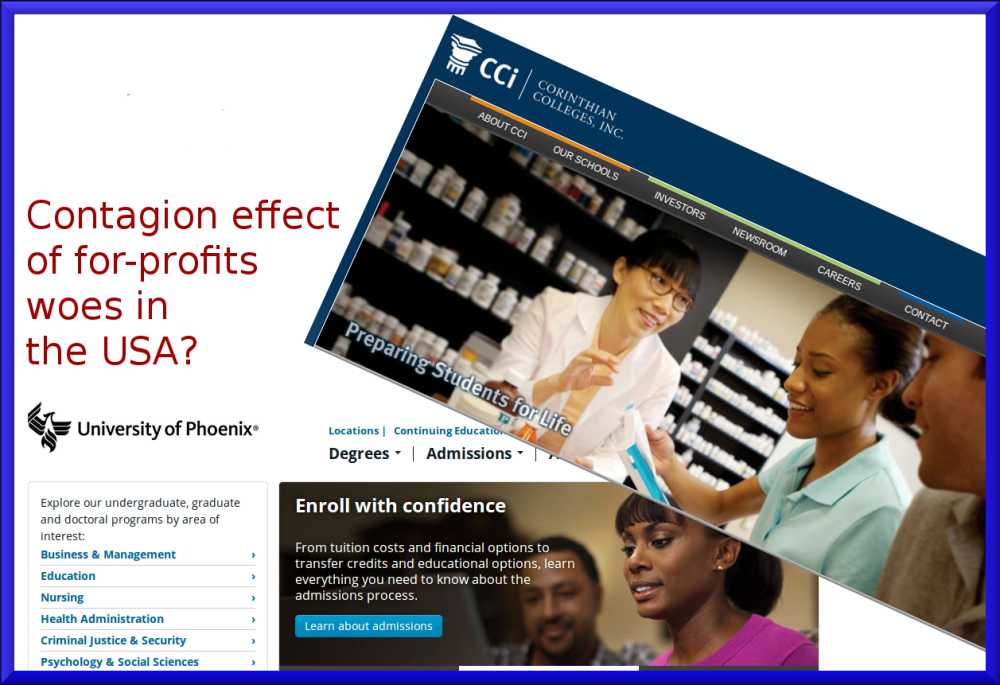
On the day that Americans celebrated the country’s independence day, The Huffington Post reported that one of the largest for-profit college groups in the USA, Corinthian Colleges was heading for disaster. The crux of the matter was due to Corinthian’s over reliant on federal government-backed study loans to the bulk of its 72,000 student loan which was effectively pulled back by the authority. For 2013 Corinthian had a revenue of US$1.6 billion, US$1.4 billion of which was attributed to federal government-backed study loans. 85 out of over 100 of Corinthian’s campuses over 25 states are now up for sale with another 12 slated for full closure.

Although Corinthian gave reassurance to affected students that their studies would not be disrupted, the damage to the confidence of the market is irreparably done.  Corinthian’s case has not been helped by a judge ruling that it does not need to disclose its financial woes in any of its advertising materials. This fuels speculations that there must be more that meet the eyes as far as Corinthian’s predicament is concerned.  It was disclosed that Corinthian’s case may just be the tip of the iceberg, another for-profit group, ITT Education Services Inc. is set to lose some of its federal government funding.

Just 10 days later, a routine audit and review by the U.S. Department of Education (DOE) on the largest for-profit education group, Apollo Education Group which, according to Apollo was a routine procedural matters was read by the market, in light of the Corinthian case with “controlled alarm“.

Are we seeing a contagion effect on the for-profit higher education sector in the USA? Will this contagion effect due to the pulling back and tightening scrutiny of for-profit players in the USA have a “mirror” image if PTPTN (Malaysia’s National Higher Education Funding Corporation) copies some of the measures taken by the USA’s DOE?

So far PTPTN has been concentrating on its efforts in the recovery of study loans and it has not been paying too much attention on the education providers. It is surely highly beneficial if PTPTN performs periodic auditing and review of all the education providers, both public and private to ensure that the study loans provided are spent prudently and achieving their intended purposes.

PTPTN can also collaborate with other agencies such as the Malaysian Qualifications Agency which oversees the quality of teaching and learning of higher education providers to ensure that their respective databases can be cross-referenced.

The yearly amount of RM5.0 billion injected to the entire Malaysian higher education industry as student loans. This is the fuel that sustains the bulk of the for-profit institutions of higher learning in Malaysia. More stringent reporting and auditing procedures should be levied on all institutions of higher learning whose students are receiving PTPTN loans. Institutions, whether public or private with high percentage of PTPTN loan defaulters should be made accountable and if needed, PTPTN should do like the DOE of USA, pull funding from these institutions accordingly.

If we let the status quo persists, the student loan contagion effect of the USA will reach our shores sooner than you expect!

Footnote: Dr. Chow has an opinion piece on his column in the weekly, The Heat dealing with his experience in repayment of study loan and why he sleeps soundly each night as his conscience is clear, he paid back all he had owed! 


Updates:

July 20, 2014: It seems that the contagion effect has started in the USA. Another for-profit education group is under the spotlight. This time, DeVry University is being investigated by New York Attorney General.

Article: Germany’s Beautifully Communal World Cup Win Over Argentina

I always thought that football/soccer is a team game. Germany’s win shows that only those who played as a team would win. Individualism gets you nowhere!

This article depicts this elegantly.

Germany’s Beautifully Communal World Cup Win Over Argentina

http://www.theatlantic.com/entertainment/archive/2014/07/germanys-victory-was-an-argument-against-the-uss-me-first-sports-culture/374353/

What are on-demand MOOCs?

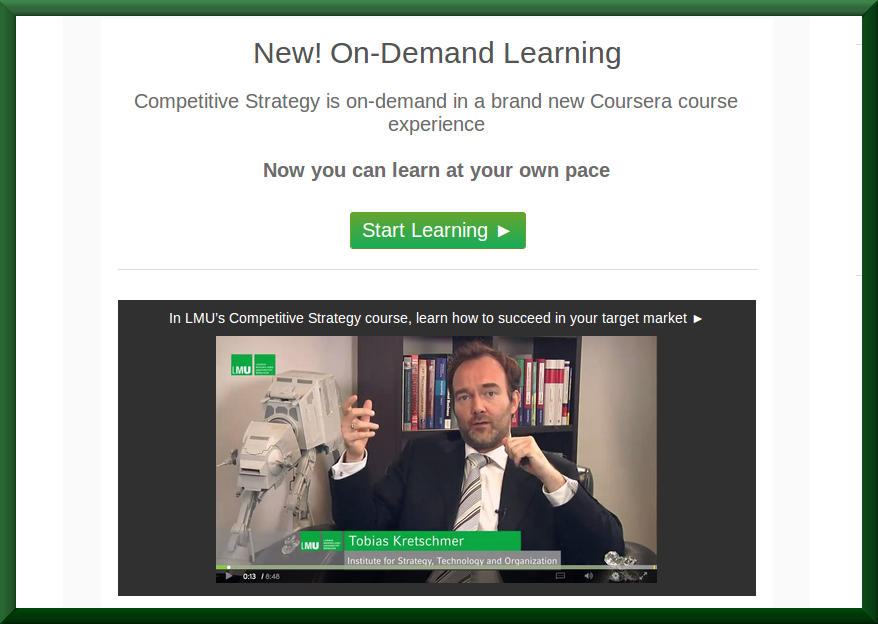
I think Coursera has been listening to its 8.44 million MOOCians (learners) lately. It has joined Udacity in offering On-Demand MOOCs. So far only 3 MOOcs are available in on-demand mode from Coursera, I think there will be more to come.

What are on-demand MOOCs? You may want to ask.

Well there is one aspect of Massive Open Online Courses that has been limiting its acceptance. Due to the familiarity of content / course providers who are almost entirely from academia (with notable exceptions being many course lecturers of Udacity who hails from industry). This means that the MOOCs from the main players like Coursera and edX work on the college-semester system and design the delivery of their MOOCs along fixed time frame, deadlines for assignments/ exams etc. Learners need to follow the schedule and the particular MOOC is only available at fixed time of the year (usually not more than once per year).

To an adult learner, which the bulk of MOOCians belong, the lack of flexibility in most of the MOOCs in terms of the need to enroll and take classes in accordance to a schedule dent lots of the enthusiasm, especially your work life is hectic and you may need to travel frequently.

Someone, especially Udacity came out with a brilliant solution early on. Why don’t we follow the Video-on-demand mode of the movie industry to let users decide when and how they would like to take a MOOC? For the learner, on-demand MOOCs means that they can pick and choose to take which of these MOOCs as their needs arises and decide how long they want to devote to the course each week and the time line for them to complete the course.

However there is one disadvantage to learning in on-demand mode that I can see. Without the tight deadlines and the urging from the professors (albeit via the video lecture) and teaching assistants/ coursemates encouragements and engagements in the asynchronous course discussion forum there is just no pressure for one to progress. The dropout rate for on-demand MOOCs may be far higher than the “conventional” fixed schedule mode. This may be partially mitigated by the MOOC players and content providers if they create (and have teaching assistants in place) to service the learning discussion forum. But I can tell from experience that the feeling of loneliness in learning is the most difficult hurdle for a MOOCian to overcome.

For the MOOC players and content partners, there will have to be many re-defining of the way a MOOC is designed and delivered. Hence re-designing of existing MOOCs may be needed if these are to be “converted” to on-demand mode.  Even in on-demand mode, both the MOOC players and content partners will not be able to let these courses be delivered on “auto-pilot” without inputs. The level of engagement between a course provider (aka a learning institution) and the MOOCians can be very much reduced (thus reducing the cost of delivery). However, someone (a skeleton crew of teaching assistants / technical staff) will need to be monitoring and responding to queries from MOOCians, especially dealing with technical problems. As mentioned above, there is still a need of a course discussion forum for MOOCians to learn from each other and for teaching assistants to help out occasionally.

The design of the assessment for on-demand MOOCs will need to be adjusted. There may not be possible to include “group discussion and peer assessments” in on-demand MOOCs as someone needs to organize the MOOCians and the level of engagement and monitoring is  far too demanding if the on-demand MOOC is available all the time. Thus the kind of assessment that can be used in on-demand MOOCs may be limited to the multiple choice questions only. Thus the likes of Stanford University’s Technology Entrepreneurship MOOCs which requires learners to form their own project groups with high reliant on peer assessment review and scoring will not fit well into the on-demand mode per se.

I think if the MOOC players and content partners can find a way to decouple some of the crucial assessment and engagement elements from on-demand MOOCs and some how offer these as an extra which may require greater inputs from the content providers and hence the market may be opened to the charging of a fee for the added service, this “hybrid” of on-demand delivery with scheduled / supervised assessment may be a possible solution.

I have taken Professor Tobias Kretschmer’s “Competitive Strategy” before and I think Coursera has pick the right MOOC to roll out the on-demand mode. “Competitve Strategy” has all the features that makes it very easily adapted to the on-demand mode.

The on-demand feature will be the first step towards MOOC players and their content/course providers in homing in on the corporate learning market. The next step may is to reduce each course into manageable chunks of modules that a corporate learning provider can mix and match (like Lego bricks) to create a customized learning solution for its clients. I have mentioned before, this may be the pot of gold for the MOOC players (and content partners). Instead of offering an MOOC that cost a lot of resources to create once a year, with on-demand mode, these courses can be rolled out (and thus pick up revenue) as and when there are learners, whether these are MOOCians or from the corporate learning circle, it does not matter!

The MOOC realm is getting more interesting!

Footnote:  Dr. YN Chow is a keen MOOC learner and has taken over 20 MOOCs since the start of the MOOC phenomenon.

Negative comments on social media ain’t that bad

A recent posting by a social media marketer, Praveen Inbarajan on Linkedin describeed a scenario where a Indian cab company’s Facebook promo advertisement was bringing more than the cab company, TaxiForSure (TFS) bargained for: a deluge of negative comments.

Inbarajan went on to give a commentary on some of the more vocal feedback provided by Facebook users whom  the promo advertisement had targeted with good precision. While I agree with Inbarajan’s interpretation of the grouses of the respondents to TFS’s post, I feel that Inbarajan, as a social media marketer, missed the point of such feedback.

Negative feedback is not necessarily equals to bad public relation. No one, least of all a cab company with many drivers, can please every body all the time. The billion dollar question is, how TFS deals with these negative responses.

TFS could have deleted all the negative comments to “protect” its public image and we are none the wiser which fortunate for TFS that it did not. What has turned the tide in TFS’s favour is indeed it readiness to admit the errors as pointed out by the respondents and apologized. In my book, if I am not happy with a company’s services and complained there are three things I will be receptive to which will turn me from an irate respondent to a sympathetic listener:

(a) They apologize for the errors:

This will calm down most people with a grouse with the company’s services or products. It is the first step to resolve a customer relation issue.

(b) They (presumably after looking at the compliant) admit fault:

This will have the effect of defusing any explosive situation. However in some litigious business environment, admitting fault may have implications on compensation etc.  however, a company should always treat this as the first step to stop litigation. In most cases, the complainer just want to get heard. If you hear them out and ascertain the fact that they are right, you can, in most cases win them over.

(c) They offer some token redress to the complainer:

Most people who feel that they have been wronged by a company’s staff, services or products, will be very prepared to accept even token redress such as a Starbucks voucher, or discount coupons. This is because most people do not expect to receive any response from the company, let alone an apology (best from someone with seniority) and a token of appreciation. The good will generated from this gesture is worth many times the face value of the vouchers.

I think what is worst will be a situation where having put up a promo advertisement like TFS did, a company’s staff are not monitoring the Facebook post and respond to feedback in a timely manner. Timely means at most 3 – 4 hours after the comment is made, not three to four days! Wasting the promo ad cost is the least of the problems, giving negative impression to all those who have responded is worst.

I have a situation whereby my team put up a promo on a posting of a new property development project for a company and obtained over 90 responses, some asking to be contacted as these were clearly  prospective customers wanted more information. The RM90.00 (less than US$30) budget spent had created the kind of reach and engagement that we designed. I thought this posting and promo advertisement would have generated some good sales for the properties company. However, the lynch pin of the whole work was of course the timely and accurate engagement by the project owner, the marketing staff of this development project. No one from the marketing team bothered to take the effort to engage with the prospective customers despite desperate pleas from me. In short, no one took ownership for the campaign (except the poor social media guys). We had a situation that not only created negative vibes among the respondents but anyone else looking at the Facebook posting will have a negative impression of the company as a whole. This is the worst kind of social media nightmare compared to the one that TFS has to deal with!

After the above episode, I changed my operational principle: before I set up a campaign on Facebook for anyone, I would get the sign off from the senior manager to confirm that she/he would ensure that her/his staff would not only monitor the posting regularly, but put effort to respond to comments in a timely manner. I needed the buy-in for the whole campaign from the project owner, otherwise it would be no deal from me! This evidently has turned out to be a beneficial move. A social media marketing campaign is as effective as the campaign owner’s preparedness to engage directly, timely and effectively with the intended target audience. This is no rocket science!

Footnote: This article is contributed by Dr. Chow Yong Neng who for a period of close to 10 months was engaged fully with using social media to drive engagement and traffic to his employer’s news portal.

Multitasking, smartphone and easy distractibility

As supervisors, managers or bosses if we expect our staff to multitask, we should be prepared for our staff’s inability to perform with 100% efficiency and effectiveness. Instead fast-switching between tasks should be encouraged.

[show_post_categories show=”category” hyperlink=”yes”]

[show_post_categories show=”category” tag=”yes”]

Commentary (Apr 20.2018)

I contributed this article entitled, “Multitasking bad for work efficiency” to Focus Malaysia when I was working for HCK Capital Group Bhd. . The article was published under my moniker of  “Plantcloner”. At that time my son was a student of SEGi University  and we shared a ride in my car on each working day.


Observing multitasking by a “pretty young thing”

My son passed his driving test a few months back, but he lacks confidence in handling Klang Valley’s road and whenever I have the chance, I would be his “driving instructor” and let him drive. A few days back when I was being “chauffeured” home I noticed a pretty young thing (PYT) driving beside my car (but slightly behind) but she did not seem to pay any attention when my son indicated to join her lane on the highway. As it was the rush hour on New Klang Valley Expressway, the traffic was bumper to bumper. It gave me a chance to observe (and tried to find out) why the PYT was not paying attention to my son’s signal: she was talking on the mobile phone! As my car and PYT’s car were side by side for over 5 km, it gave me more opportunities to observe the PYT further. After finishing her mobile phone conversation, the PYT went on to send some text messages or instant messages on her mobile phone, then a few minutes later, she whipped out a makeup box with a mirror and went on to apply something on her face. All the while we were travelling at about 25 km/h in parallel! I guess the PYT was just multitasking. Luckily for my son and I (and for the PYT), she was a better driver than my son and no untoward incident occurred.

You’re dumber when multitasking!

I have read Joe Kraus’s blog posting on multitasking and watched his TED Talk video entitled, “Slow Tech” . This was what Kraus said about multitasking: “It’s shown not only that we’re dumber when we do this (an average of 10 IQ points dumber……), but that we’re also 40% less efficient at whatever it is we’re doing.” This probably sums up why multitasking is bad for your work efficiency or whatever you intend to do.

A few weeks ago I  completed the Massive Open Online Course entitled “Understanding media by understanding Google” by veteran journalist and Knight Chair in Digital Media Strategy of Northwestern University, Professor Owen Youngman. One of the written assignments asked, “If someone instinctively and repeatedly picks up a mobile device to consume media while engaged in another activity, which of the following do you believe is more likely to be true of that person: (1) he/she is engaged & seeking to enhance and deepen the first activity or (2) he/she is bored & is seeking to be distracted from the first activity?”  How often have you encountered colleagues (or even yourself) in a formal meeting doing just that: whipping out the smartphone and checking for emails, SMS, BBM, Twitter etc. every now and again? Is this multitasking or it this easy distraction? Is the person bored? In most cases, I think the person was forced to multitask. Sound familiar?

Demand of modern days for multitasking?

With the current “24 by 7” business operating environment, clients and colleagues across continents and many time zones have the expectation of having their needs taken care of & queries answered instantly. Thus it is inevitable that disruption and distractions from these sources via the smartphone happen during all hours of the day and nights. It seems that the 8-hours working day has now been, with the “always-on-always-connected” mobile internet, replaced by the 18-hours working day (with 6 hours left for sleep). I really enjoyed my stint working with Pearson plc where my British boss would not dared to call me after work and during public holidays. It could have been the Britishness in him but I guess the man was worried that if he were to call me, I would reciprocate when he would be on his holidays sunning himself in some beach with his family!

I think as a superior you should not demand that regardless of the hour of the day/night or the staff’s current situation, he/she must answer your text messages, emails etc. within 30 minutes or some tight timeframe. Despite the disruptions and distractions involved, your staff will have no choice but to check up on his/her smartphone periodically watching out for text messages, instant messages, Blackberry Messages, Tweets etc. from you and multitask. [Note: this piece was written long before the “Right to disconnect” issue made it to the fore!]

Fast switching vs multitasking

The best thing to do, it seems, is not engage in multitasking at all, which is just fast switching between tasks. You are spreading your mental capacity and attention too thinly. If you look at a juggler, he/she can juggle 3, 4 or even 5 items at most. But in today’s work environment, most staff are expected to juggle many more tasks than 5, with some staff ended up not “catching” any single item. I think bosses should recognise the peril of multitasking. Like the PYT, if she were to multitask more strenuously while driving, she might end up causing a car accident!

I think we cannot change the current work and business environment in light of the advance in technology. The best for one to do is to prioritise and perhaps do what I call “semi-multitasking”. You should have all the tasks in a prioritized list, instead of working your way down the list,  you should go on to commence work on every task in the list but paying more attention in accordance to the priority and importance of the task. In this way, you will have made at least a start in each task assigned and have a better chance of completing each with maybe not 100% but at least close to 80 or 90% efficiency . I think your IQ dip for each task will be much less than 10 points! It is also good to separate routine multitasks from ad hoc tasks because routine tasks usually have tighter deadlines. If possible enlist the help of and encourage ownership of tasks by your staff and you may find that your collective efficiency and IQ go up significantly.

Hilarious consequences of multitasking too much

There is a current TV advertisement about a secretary having to multitask, she needed to arrange for a parcel to be sent and to book a flight for her boss both at the same time. She ended up sending the parcel by business-class flight and the boss on a tin-pot airline flying with chicken in the plane. That sums up the peril of multitasking! I think as supervisors, managers or bosses if we expect our staff to multitask, we should be prepared for our staff’s inability to perform with 100% efficiency and effectiveness.

Footnote:

This is the unedited version of my original piece. I usually have to juggle more than 5 tasks in any working day. With “semi-multitasking” I managed to minimise “accidents” and still achieve a reasonable efficiency & effectiveness in the tasks I accomplished.


A great way to learn about genetics & how it affects you

I was one of the “guinea pigs” of Queen’s University of Belfast in 1985 when along with 5 others from the Class of 1985, I was awarded a scholarship to be the pioneer batch of Master of Science students in the newly minted Biotechnology programme.

A lot the then state-of-the-art knowledge that I was imparted with have indeed been superseded over the last 20 odd years of intense research in this domain. However, the basics in genetics, I hope do not change much.

When I first review this course, Genes and the Human Condition from The University of Maryland under Coursera, I thought to myself, since this course does not have any requirements in advanced biology, it may be too easy for me. I guess I did not know how much I have forgotten about genetics that I picked up about 30 years ago. After taking Week 1 classes, I have decided to stick to this course till its completion. I guess I have a lot of unlearning and re-learning to do. 

Although the course information states that there is no requirement for advanced biology. I think one will have to have at least some knowledge of high school level biology to appreciate the course fully. Professor Tammantha O’Brien (who gives Week 1 classes) is very animated in the way she teaches and the lectures can be a bit too fast at times, her enthusiasm to teach is infectious on the learners’ mood to learn. In short, you will learn a lot if you make the effort to keep up with her. Professor. O’Brien’s co-instructor, Professor Raymond J. St. Legar’s classes has yet to start.

There is still a couple of days to the end of Week 1 and I urge those who want to know about how genes work and how genetics affects you should give this MOOC a go.

Already this “revision” course for me has kept me updated on the subject of genetics. I will be a better teacher if I get to teach my plant tissue culture class again! It took me less than 3 hours to complete Week 1, but I expect that I will need to put in more in later weeks because Week 1 is a sort of revision for me!

(This article is contributed by Dr. Chow Yong Neng)