Creating tangible value from MOOCs?

Since the pioneers of the MOOC movement have been the US universities, it is understandable for the World to expect some sort of leadership in this field from these pioneers. One thing that have been missing from most of these players is indeed a credible business model, without which MOOCs may not be sustainable.

[show_post_categories show=”category” hyperlink=”yes”]

[show_post_categories show=”tag” hyperlink=”yes”]

Since the pioneers of the Massive Open Online Courses (MOOC) movement have been the US universities, it is understandable for the World to expect some sort of leadership in this field from these pioneers.

One thing that have been missing from most of these players is indeed a credible business model. Along the way, both Coursera and Udacity have introduced “premium” assessment model whereby the identity of the MOOC learner is verified (in Udacity’s case, it even have an online proctored examination system) and hence the academic credit earned will be acceptable to some institutions. My son took an introductory statistics course from Udacity and under “ProctorU”  (an online proctored examination service company) his credit, granted by St. Jose State University should be acceptable to his US university. The fees for this was US$150.  However all these add-on services are not paying the bills for these players. For the massiveness of its enrollment, MOOCs only have completion rates of about 7%, and even lower percentage of these learners would be “buying” the premium services.

I have mentioned in my previous article on MOOC that there are several ways that the MOOC players can generate income streams. In fact a recent report stated that one of the income streams (as I have mentioned) is indeed the recruitment of students to the universities associated with one of the MOOC players. 2 years ago I mooted the idea of MOOC to some for-profit higher education providers in Malaysia, but none managed to see beyond the trees to the positive branding effects of MOOC. Perhaps now with this article they should say, “We should have listened to that fellow”!!

I do not think that this revenue stream will be large, but I think the branding effect of successful MOOCs are great for the providing institutions. Whether this will end up in positive foreign student recruitment (which is a very complicated and complex affair) and how the MOOC players are paid for the recruitment is a different matter (will it be cost-per-click through or full fledged recruitment services?).

I think there is one element that none of the big MOOC player:s have explored: the corporate training domain. Although Udacity’s “nanodegree” is a good initiative that plots a MOOC course-learning path for learners. If they complete the suite of Udacity’s MOOCs successfully, this will put them in a position of advantage with skill-sets that employers (who have collaborated with Udacity)  want. This model is still sticking to mainly academic learning mixed with professional-skills courses. In fact many of the existing MOOCs have elements of learning that can be easily re-purposed for corporate learning and training usage. These learning courseware and delivery system are the key to creating a recurring revenue stream for the MOOC players. If the learning outcomes of these can be pegged with college credits or “star employers” acceptance as in the case of nanodegree of Udacity, I think the corporate learning providers out there will be able to sell these to their clients and learners easily.

With more and more smaller MOOC players with varying degree of quality coming on stream these days, I feel that some sort of consolidation will have to take place soon, especially with the current lack of any profitable business models.

(This article is contributed by Dr. YN Chow)

HRDF Funding of training – the Malaysian employees’ perspective

[show_post_categories show=”category” hyperlink=”yes”]

[show_post_categories show=”tag” hyperlink=”yes”]

This is the unedited version of an article published as “Fairer disbursement of HRDF grant sorely needed” in Focus Malaysia on July 06, 2013, written by Dr. YN Chow under his moniker of Plantcloner. He  thinks that a boss who says, “our people is our greatest asset” or words to that effect must be prepared to put his/her  money where his/her mouths is and invest accordingly and do so on a regular basis.

__________________________________________________

Up-skilling, re-skilling, cross-skilling are the buzzwords these days in the corporate learning and training circle.

To ensure that Malaysia’s goal of attaining developed nation status is achieved by 2020, the Perbadanan Sumber Manusia Berhad Act (PSMB Act) was enacted in 1993 and revised in 2001. Thus PSMB, a corporatized government agency was formed.

PSMB Act enactment was followed by the formation of Human Resource Development Fund (HRDF) where manufacturing and service industries in Malaysia were mandated to contribute 1% of their payroll per month into the HRDF.  The idea was for HRDF to provide training grants from the levy for the purpose to training of employees of contributors.

The collection of levy by HRDF has been very successful, it has been reported in December 2012 that RM3.96 billions had been collected with RM3.21 billions disbursed since HRDF’s inception where utilization of the fund was at 80%.

One should ask how effective has the distribution of HRDF grant in improving the human capital of Malaysia been? Who actually calls the shots when it comes to the spending of the grant: the employer or the employees?

In fact there are more to those statistics published by PSMB in its annual reports that meet the eyes.

For starters, if the objective of HRDF is to ensure that Malaysians are continuously up-skilling, cross-skilling and re-skilling themselves, why would there be no provision for employees having any say in the utilization of HRDF grant?

A case in point, in 2009 when I was serving in a corporatized-state-owned entity, a conference on entrepreneurship in institutions of higher learning attracted my attention. The conference fees was only RM900 for this 2 days event. It was an event that would be attended by the “Who’s Who” of industries, higher learning institutions and regulatory bodies. The networking and learning potential of this event were great, especially for a practitioner in the higher education sector. My superior, instead of attending this event with me, went on to disallow the use of HRDF grant to pay for my conference fees. By then, the HRDF levy paid by my company and attributable to me was more than RM1,500. Later from the grapevine I heard that my superior went for a RM19,000-per-person, one week “senior management residential course” by an Ivy League university’s professors paid for by the company. Of course not privy to the company’s HRDF account I was in no position to say if any HRDF grant was given for this event.  A quick calculation would reveal that for an employee to have RM19,000 attributed to his/her payroll contribution to HRDF’s levy, he/she would have to be paid RM1.9 million in annual salary. In my case, I had the last laugh as I was invited by the organizers of the conference to deliver a paper and was given a complimentary ticket. However, not many employees had means and ways like me to find “alternative funding” to attend training or conferences to improve on our knowledge and skills, as was intended by the HRDF grant.

There were many cases of abnormal use of HRDF grant that have been uncovered, but it is beyond the scope of this article.

The crux of the matter is, both the administrator and the employers seem to view the HRDF levy and grant as “belonging” to the employers. It seems that the objective of the PSMB Act for employees to get their training (and hence up-skill, re-skill and cross-skill themselves) is incidental in this context. In fact, the “spending” of HRDF grant is fully decided by the employers. Employers also have the sole discretion on who among their staff is to benefit from the HRDF grant.

Thus for the benefits of the employees, in whose names that annual RM360 million or so contributions to HRDF is made, some changes to the status quo must be seriously considered by the power-that-be.

I have two suggestions that are complementary in their effects in fulfilling the objective of HRDF.

Firstly, it would be easy for PSMB to implement an audit whereby all Malaysian employees of HRDF levy contributing employers shall get at least 1 training spent on them every 24 months. This will mandate employers to plan the spending of the grant to fulfil this obligation. Thus posh retreats and Ivy League universities’ “senior executive programmes” will not be easily charged to the grant. PSMB should also put an upper limit to what employers could claim for an individual employee and take away all those luxurious programmes from their approved list. Implementation of this suggestion will require only minor tweaks to the existing PSMB system.

My second and most equitable suggestion, as far as the employees are concerned, is in splitting the disbursement of HRDF grant into two equal portions. The “Employer’s Portion” should be used for training and related programmes at the sole discretion of the employer. PSMB can also make it compulsory for employers to use this portion for mandatory certification and licensing programmes for their employees. The “Employee’s Portion” should be used for training at the sole discretion of the employee. This means that, like the Employee Provident Fund (EPF), all Malaysian employees should have individual “PSMB Accounts”. Levy/grant contributed to the employee’s account shall stay with the person if he/she  changes job. PSMB has already a good selection of approved programmes which could easily be made more “affordable” to employees. With the larger number of learners, PSMB can even organise these training programmes or seek volume discount from providers to reduce the course fees to further benefit employees. One of the main disadvantages of this suggestion is the extra administrative work involved, but since the current HRDF system already entailed having the individual employee’s name in the accompanied document when HRDF grant is disbursed, apportioning this levy to the respective “PSMB Accounts” is just a matter of a few extra clicks at the computer keyboard. A quick calculation tells me that if this system were to be in place for employees earning RM5,000 per month, in 10 years, their “PSMB Accounts” will each have a balance of RM3,000.

PSMB reported having over 13,300 contributing employers in 2012, and out of about RM360 million levy collected, RM288 million was disbursed as grants to employers. Each year about 20% of the levy collected, or about RM72 million remained “unspent”. I suggest that the “unspent” levy should be disbursed to all the employees’ “PSMB Accounts”.

To realize our nation’s quest for developed nationhood, we need more than just 13,300 business establishments to contribute to the HRDF. SME Corp’s 2011 economic census showed that there were 645,000 SMEs, 94% of which were in the manufacturing and service sector, and SME accounted for 97.3% of all business establishments in Malaysia. By a simple calculation, we can see that out of about 663,000 business establishments in Malaysia PSMB has only recruited just about 2% of them to contribute to HRDF. This  is not an achievement to brag about!

PSMB Act defines an employee as, any citizen of Malaysia who is employed for wages under a contract of service with an employer, irrespective of whether they are permanent, part-time or on contract, but does not include any domestic servant“. This definition  means that if you have less than 10 Malaysians supervising 100 foreign workers in your factory or your service business, you are not obliged to contribute to HRDF. Could this be the reason for the low registration of business establishments with PSMB? If each of these 650,000 “escapees” of the HRDF levy has only 2 Malaysian employees, we are seeing over  1.3  million workers not receiving the benefits of the PSMB Act.  I think PSMB needs to do something to reconcile this and do so fast.

What’s going on in MOOC world?

This is the original article (unedited) on MOOC that was published in Focus Malaysia on June 08, 2013. It was written under the name of Plantcloner, the moniker used by Dr. YN Chow who had a column with Focus Malaysia for a stint. The published article’s title was, “What is going on in the revolutionary MOOC world”.

A new learning phenomenon was born in early 2012. It is called Massive Open Online Course (MOOC). MOOC has revolutionized the learning world with class enrolments in the range of thousands with some going to over 160,000. The era of democratization of learning was created, so was the idea of separating learning from credentialization & certification.

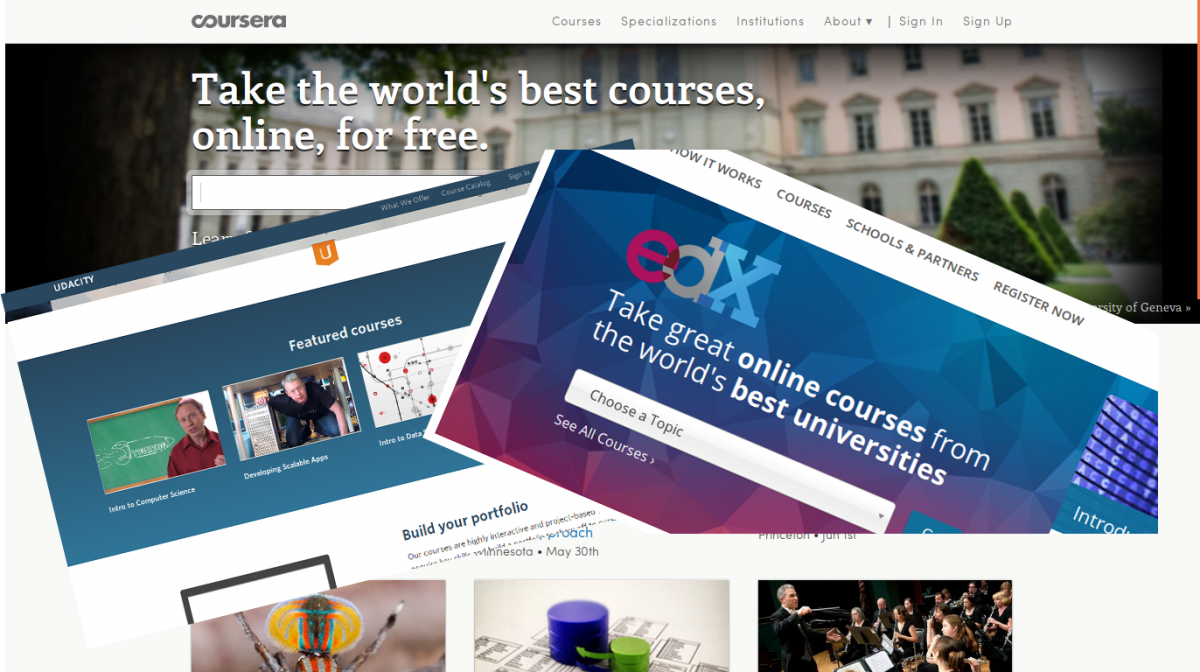
Almost all the big names in Western academia have joined the MOOC movement. This has been followed by notable universities from Asia. In the USA alone, there are three prominent players in the MOOC world. The most popular in the number of learners signing up is Coursera which has over 3.7 million learners, 377 courses 80 partner universities. Udacity which provides a smaller number of courses, but with a much more “standard” format of quality learning content is perhaps best known as the pioneer of the MOOC world. The most elite club of all is perhaps EdX which was formed by MIT and Harvard but joined later by the likes of Stanford, UC Berkeley, & University of Texas System. EdX also has the elite members from Asia such as Peking University, Kyoto University, Hong Kong University of Science & Technology, and Seoul National University to name a few. However, Yale has decided to join Coursera in addition to National University of Singapore and a host of European and South American universities, making Coursera perhaps the most comprehensive in terms of member institutions, with the capability of 5 languages. Not to be outdone, 21 “redbrick” British universities, led by Open University (UK) formed Futurelearn in early 2013. However, to-date, there has been no offering from Futurelearn as yet.

Despite the revolutionary nature of MOOC, not everyone in the academic world supports it. Some academicians feel that MOOC does not provide sufficient learning experience such as student-to-student and faculty-to-students interactions. Others question the wisdom of spending scarce resources on a project that does not have a clear returns on investment. There are also questions raised on the lack of proctored examination for the various certification to safeguard academic standards and integrity. Some question the relatively low completion rate of learners of MOOC. Data from Coursera indicated that out of 100% of learners who sign up, about 70% will “turn up” for the start of the MOOC. Only about 30% would attempt the first assignment and 7 to 9% will stay and complete the course successfully. If we put this in the proper context, MOOC allows an institution to reach at least 1,000 times its classroom capacity in terms of learners. For a typical MOOC of 30,000 learners, 9% completion rate translates into a staggering 2,700 learners!

This author thinks that the detractors of MOOC have missed a very important point. That is, learning can now be easily segregated from certification & credentialization, an idea that was promoted by Salman Khan of Khan Academy (KA) fame (KA is one of the pioneered of MOOC but focus mainly on learning at primary & secondary levels). Thus democratization and massification of learning by MOOC has to be separated from credentialization and academic certification. Those who want to take up certification of their learning & knowledge attained via MOOC should have access to and be willing to pay for such certification. In fact this is precisely what both Coursera and Udacity have provided independently.

In Coursera’s case, it provides what it termed “Signature Track” where for a fees of US$49.00, a learner can have his/her identity digitally verified (using the latest webcam and other online imaging technology). Thus a “Signature Tracked” learner will have his/her identity authenticated thereby his/her certification by Coursera’s partner institution verified. How acceptable “Signature Track” is to the academic and industry worlds remains to be seen at this early days.

Udacity has gone perhaps in a more traditional direction. It has teamed up with San Jose State University (SJSU) to offer “College Credit” for US$150.00 per course. Thus anyone signing up for one of Udacity’s MOOC with “College Credit” will essentially, if he/she passes the online proctored examination, be given relevant college credit for that course. This opens up possibilities for any learners who may need the “College Credit” such as university students who may not have such a course offered at their college to take Udacity’s MOOC and earn the relevant credit. At US$150.00 for a course, it is a reasonably affordable fee. In fact the author’s son is taking Udacity’s “Elementary Statistics” to earn “College Credits” that he hopes to transfer to his degree program later. Of course, the key question is, how acceptable is SJSU’s credit by the university that finally award the author’s son a degree. As SJSU belongs to the California State University System and accredited by Western Association of Schools and Colleges this may not be a great issue. Initial feedback from this author’s 17-year-old son indicates that Udacity’s format of interesting and aesthetically pleasing video is gaining the confidence of this young learner.

Not every institution is geared to offer MOOC. If one has not planned the whole project well, the negative impact to the institution’s reputation is immense. This was  exactly what happened to Georgia Institute of Technology in February 2013. The course lecturer did not understand the scale of MOOC and used a free Google Spreadsheet to handle learners’ groupings. Google Spreadsheet has a capacity of 50 simultaneous “sign-ins”. With tens of thousands learners being told to confirm their grouping at the start of this MOOC the system just collapsed. The author was one of the learners and after struggling for 3 days to get on the course grouping, and before Coursera’s shutting the course down, he un-enrolled himself, fully disgusted with Geogia Tech for wasting his time and expectation on “Fundamentals of Online Learning: Planning and Application”. Needless to say, he will not touch any MOOCs from Georgia Tech with a barge pole.

Closer to home, Taylor’s University seems to be the first in Malaysia to jump on the MOOC bandwagon. The author has signed up and evaluated Taylor’s offering, “Entrepreneurship”. This maiden MOOC of Taylor’s attracted about 900 learners. However, the heavy reliance on recordings of “live” lectures has dampened the impact of this MOOC. It is very difficult to follow a lecture when you cannot see the slide presentation and having to follow the professor’s every movement in front of the cameras. Nevertheless it is a good start for Malaysia.

Mind where and how you use your smartphones

I am learning Edx.org’s Wiretap to Big Data as an MOOC at present. One of the lessons is on how exposed you are if you are not careful in the way you use your smartphones. This infographic tells the story well!

After reading this, you should modify the way you use your smart phones!

More details about the article that comes with this infographic is available.

Completing ChinaX’s Module 2: The creation and end of a unified empire

To understand the future, one must learn from the past. To understand China of today, one must learn about China of the past. If you are a Chinese Malaysian (or ethnic Chinese of other nationalities), you could do no wrong in learning a lot more about your roots.

It is not easy to follow a highly demanding course on the history of China delivered by 2 of the current authorities in Chinese history and culture in Harvard University, Professors Peter Bol and William Kirby.

I got to learn from these scholars free of charge via MOOC from edx.org.

The course demanded lots of reading (but all provided free) and most importantly, you need to post your comments and participate in discussions. The course materials composed mainly of video lectures and reading plus assessments in the form of multiple choice questions and some short answer questions. These by themselves are not as demanding as the need for the learner to have a good command of English. There were many words and phrases that I had to consult Google to figure out. But the learning and understand you will achieve is all worth the effort.

I spent about 10 -12 hours each week on the course and picked up lots and lots of knowledge that I wish I was given as a school student studying Chinese and history.

To understand the future, one must learn from the past. To understand China of today, one must learn about China of the past. If you are a Chinese Malaysian (or ethnic Chinese of other nationalities), you could do no wrong in learning a lot more about your roots.

The 2nd module is about the Han Dynasty (206 BCE – 220 CE). It began with the fall of Qin Dynasty  (221 – 206 BCE) and compared the systems of government of the two. The story telling nature of the delivery was great in helping me to follow the course. The course then cover the rise of the Western Han then the Eastern Han. It also touches on how Buddhism was established in China and the influence the new “foreign” religion has on the people and the rulers. But I like the Salt and Iron debate most where the Lord Chancellor of Han was debating with the Literati about the relative merits of the Han system of governance and the scholars wish to revert to Confucianism and antiquity (used in the Zhou Dynasty, 800 years before).

The concluding video for the module is presented below:

Despicable act of an educator – inflating marks for bribes

Professor-Creation-3

It is disgraceful for an academic to inflate the marks of students in exchange for bribes so that they can pass their examinations. This is despicable.

It seems that the institution concerned, Curtin University, Australia, does not have a foolproof system to detect and check on possible abuse by academics.

I think all institutions should have an examination board rather than one person to decide on grades etc. When I was managing the academic operation of a college, all examination decisions were made by the examination board and no individual, including the head of academics had the right to make decisions on grades. The check and balance system worked very well. Also proper and judicious record keeping is crucial. In my case, for the lack of a functional examination operation system, I invented the use of Google Docs and the many features to provide a full paper-trails (or electronic trail, to be more precise) of all decisions and operational work. This allowed me to deal with all the malicious accusations made by people with ulterior motives and exposed their ill intend.

I feel that the institution is just as responsible as the disgraced academic on this issue.

___________________________________________________________________________

Malaysian lecturer escapes jail over bribery charges in Perth

DECEMBER 6, 2013


MELBOURNE, Dec 6 — A former Malaysian-born Perth university lecturer has escaped imprisonment after admitting he took thousands of dollars in bribes to increase exam marks for students who would otherwise have failed.

The Australian Associated Press said Foong Tuck Cheong, 54, pleaded guilty in the Perth Magistrates Court in June to three charges of corruption and two counts of bribery following a Corruption and Crime Commission investigation into offences committed at Curtin University in 2012.

Foong increased the marks of two students who should have failed units for their Bachelor of Applied Science (Construction Management and Economics) degree.

One student paid him A$3,000 (RM8,776) and the other paid A$1,500.

For a third student — whose father in Malaysia had known Foong for many years — he increased the marks on one assignment and gave him a pass mark on another project even though the assignment had not even been submitted.

Judge Philip McCann on Friday sentenced Foong to 16 months’ jail, suspended or two years.

He said the offences were very serious and had the potential to cause serious damage to Curtin University’s reputation.

While it was important to send a message to others that jail would follow such offending, and that academic integrity was taken seriously, McCann acknowledged Foong’s behaviour was “irrational and out character”, and accordingly suspended the sentence.

It followed Foong being told he was about to be made redundant after 24 years with the university, which left him “emotionally devastated” and affected his judgment.

Foong was also fined A$6,000 for his actions relating to the Malaysian student. — Bernama

From: http://www.themalaymailonline.com/malaysia/article/malaysian-lecturer-escapes-jail-over-bribery-charges-in-perth#sthash.np6kd2JG.dpuf

Dismal showing by Malaysian students in PISA 2012

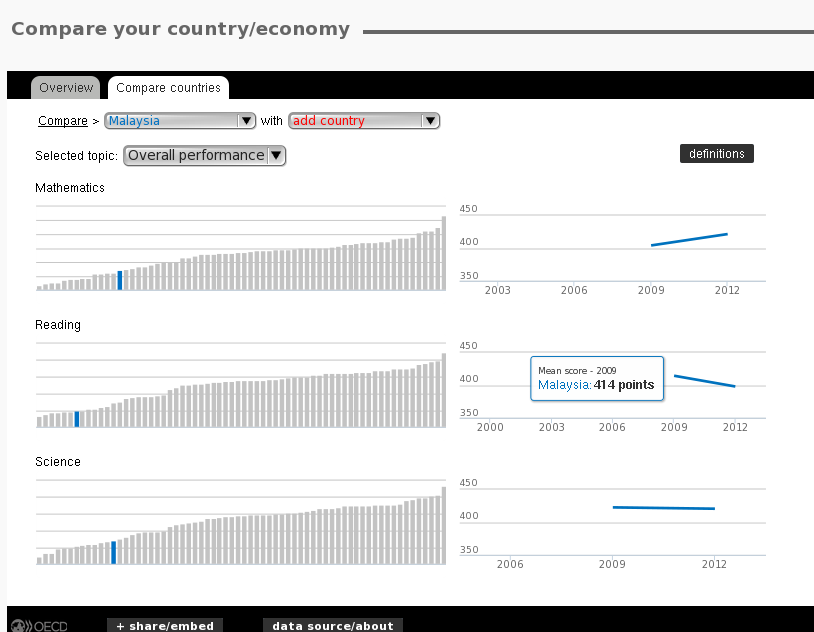
The latest Programme for International Student Assessment (PISA) ranking showed that Malaysian students’ collective performance was way below par and had in fact retreated from previous PISA ranking in 2009.

PISA was carried out in 2012 over 510,000 plus students, aged between 15 and 16 years across 65 nations.

PISA-Malaysia-2012

On the whole, Asian nations did better than most other countries. Singapore took the number two spot. Thailand was 2 places above Malaysia at 53rd. Key findings of PISA 2012 can be downloaded from OECD’s site.

The funny thing was, compared to Singapore and Thailand, which spent 3.5% and 3.8% of their respective GDP on education, Malaysia’s 5.1% GDP spending (all were 2010 data from the World Bank) seemed to have very low Returns on Investment! Budget 2014 will see Malaysia spending 21% of her expenditure on education. With all these spending, we should expect better performances unless the expenditure has not been targeted at what that matters most: the learning outcomes of students.

Already there have been calls for urgent review by the media and politicians. But regardless of all the debates, unless the power that be accepts that there is an urgent need to review education policies and implementations that have been overly politicized, all the huff and puff will just be steam and nothing will stop the rot. It was not long ago that the government insisted that Malaysia has one of the best education system in the world. If we are playing the ostrich, we are forever not seeing the light with our rear end lay bare. Unless we take PISA 2012 ranking seriously like the Finns and Swedes do and face reality with courage, we will be blamed by future generations of Malaysians for our inaction.

Learning about Bitcoin

There has been lots of interest in this virtual currency or more appropriately described as cryptographic transaction medium called Bitcoin. One Bitcoin at the end of Nov 2013 is worth over US$1,000 making it coming close to the price of one ounce of gold (about US$1,250 on Nov 29, 2013).

I have done a lot of digging of information about Bitcoin to learn about this concept and am sharing my learning in this post.


The Economist has a series of good articles on Bitcoin:

1.  This article is a brief summary about how Bitcoin works.

2. Despite Bitcoin system claims of anonymity for the users, there is a trail that is really relatively easy to be picked up. This has been demonstrated by researchers in the University of California, San Diego. The Economist also gave a good coverage in this article. This trail was how the drug dealing site, Silk Road was nailed by authorities eventually.

3. Keeping the Bitcoin ecosystem going requires lots of computing power that is ever increasing. Bitcoin is a cyptographically generated virtual currency that has no backing by any government or precious metal. It is generated when “miners” using huge amount of computing power solve complicated mathematical problems (that are getting increasingly difficult). The miner who solve the latest problem will be given a reward of 25 Bitcoin (currently). The next problem will be harder and progressively so. The entire ecosystem is too taxing and there is not fixed rule for the game, making the system very flexible but also fragile. The Economist has a great article covering the technological challenge for the Bitcoin ecosystem.

4. Because of the fact that Bitcoin has risen in value from US$15 a year ago to US$1,070 at one point in late November 2013, many experts have cautioned about the Bitcoin bubble. I think this is very akin to the 17th century’s tulip mania that was also a big bubble. This article gives a very good explanation of the bubbly Bitcoin.

I have also dug around for other sources of information about Bitcoin and compiled this into a document that is shared here.

My take on Bitcoin:

It is good and cheap a system for moving lots of money across international boarders and do so in minutes. But I will not speculate on it. If I own any (which I don’t), I will sell them fast before the bubble busts.

Updated (Dec 18, 2013):  The China government has decided to curb the speculative trading and impending bubble of bitcoin. It s central bank has ordered financial institutions in China not to provide Bitcoin-related services and products and cautioned against its potential use in money-laundering. The value of bitcoin tumbled 60% from its highest level.

Free college education: what about the private providers?

The Malaymailonline has a report on an exchange between Deputy Minister of Education, Mary Yap and Ipoh Barat MP, Thomas Su on the issue of PTPTN loan defaulters. The matter of free higher education was mentioned.

The whole debate was flawed. No considerations on both sides were given to the fact that higher education in Malaysia is not provided by the public institutions of higher learning (IPTA) alone. Over half of Malaysian students in tertiary institutions are studying in private colleges and universities (IPTS). Many of those students studying in IPTSs rely on PTPTN to fund their studies, at least for their tuition fees (PTPTN loan often is insufficient to cover the cost of living). 

It does not need a genius to figure out that you cannot leave out over 50% of the tertiary students when considering a shift in policy. Those debating on higher education issues must have their facts on hand. The IPTSs will not be able to continue providing education if the bulk of their students are unable to pay their fees. Will the opposition be willing to grant scholarships (or convert PTPTN loans to scholarships) for the IPTS students? Can we leave a strategically important sector of the economy, the private higher education industry high and dry with a stroke of the pen?

Until the issue is holistically reviewed, any debate is a waste of time.

___________________________________________________________________________

Free education will create subsidy addicts, claims Putrajaya
BY SYED JAYMAL ZAHIIDNOVEMBER 26, 2013

A student sleeps inside a classroom during the first day of school at an islamic local school in Kuala Lumpur on January 4, 2012. — AFP pic
KUALA LUMPUR, Nov 26 — Putrajaya continued today to defend its decision to keep the contentious National Higher Education Fund (PTPTN) running, arguing that abolishing the corporation would have severe impact, including creating a generation of students addicted to subsidies.

Dismantling PTPTN would also see spending on other key sectors affected as the government would be forced to provide free tertiary education which is costly, Deputy Education Minister Mary Yap Kain Ching told the Dewan Rakyat here.

“Among the reasons..is that this would incure higher cost for education and this would affect spending in other key sectors,” she said in a reply to DAP Ipoh Timur lawmaker Su Keong Siong during Question Time.

“This would also make students more dependent on subsidies and this could make them..uncritical,” she added.

The deputy minister also suggested that giving out free education would spoil students.

“If education is free they will take it for granted”.

Su at this point rebutted and argued otherwise, citing as example those studying abroad and their refusal to return due to the lack of education opportunities back home.

Yap’s reply was: “That is only your opinion”.

Over more than 45,000 PTPTN out 132,801 borrowers have been blacklisted recently for failing to make repayments amounting to RM239.44 million, up to October 31, Parliament revealed yesterday.

Yap had said the move to blacklist the borrowers was not carried out indiscriminately but it was a last resort after the borrowers failed to make repayments and came for negotiations.

The staggering amount of loans owned by borrowers and concerns of repayment evasion have prompted the government to revive its plan to list defaulters on Bank Negara Malaysia’s bad credit list, although the proposal was purportedly shelved following opposition pressure.

But the opposition have called on Putrajaya to reconsider, arguing that the government should conduct research instead and determine the root cause behind the failure instead.

Among the suggestions was that the federal government do a breakdown of PTPTN borrowers’ backgrounds and factors affecting them, including their monthly incomes, success rate in obtaining jobs related to their qualifications and the quality of the public universities, in order to determine the possible issues they face.

The plan to list borrowers on the CCRIS, or Central Credit Reference Information System, was announced recently by Minister in the Prime Minister Department in charge of education, Datuk Seri Idris Jusoh, as a measure to help the PTPTN recover loans.

It immediately earned criticism from politicians across the divide, including Youth and Sports Minister Khairy Jamaluddin.

Khairy confirmed the shelving of the proposal via his Facebook and Twitter accounts, saying the Cabinet rejected the idea at its weekly meeting.

The federal opposition bloc Pakatan Rakyat had proposed to do away with PTPTN and argued that free education was a viable idea.

It became one of its major election pledges in the last national polls and helped gain traction among the country’s youth voters.

See more at: http://www.themalaymailonline.com/malaysia/article/free-education-will-create-subsidy-addicts-claims-putrajaya#sthash.WLhmYrJx.dpuf 

It is not a contest when everyone wins an award

CYN-USM-medals


One of us has written a piece for The Heat (Friday, 08 Nov 2013) on the self-congratulatory acts by local public universities which cannot produce good research to “score” points. They sent students and staff to attend inventors show where more than 60% of entries win a prize (and team will have more than one entry…making it a sure win).

Read more: http://www.theheat.my/Article.aspx?ArticleId=1675