
Examleaks and public examinations in Malaysia

The primary school standard six’s Ujian Pencapian Sekolah Rendah (Primary School Achievements Examination or UPSR) science paper has suffered Examleak, and it was confirmed as this article was written that the UPSR English paper was also compromised. Now12 years old students at primary schools in Malaysia have to pay for the consequences of Examleaks this year.

It seems that nothing in Malaysian public examination system can be kept secret any more. The students and their teachers are the ones having to face the psychological and mental stress due either to the incompetence of those involved or to a system that needs major revamping.

I recalled that back in the 1970s, out of curiosity, my late father, a primary school principal who had never formally learned Malay decided that he should take the Malaysian Certificate of Education’s Malay paper. That year was the first I heard of the leaking of public examination paper. My father was not happy to have to take the MCE Malay paper twice. Nevertheless, he passed with a “credit” grade, much to his joy and unexpectation.

There were many Examleaks cases since then, but each time the lesson learned was quickly forgotten as if the various organizations charged with the duty to ensure fair conduct of public examinations have collective amnesia or have what I call a lack of “organizational memory”.

One of the most famous Examleaks cases was the 2001 leaking of the Certificate of Legal Practice examination papers. At least in this case the culprit was caught, prosecuted and punished. I do not recall anyone else from the many other Examleaks cases being caught least of all being punished.

In the late August 1980, I was just waiting to enter GEC “A” levels studies in the UK when I was asked by my former classmates to obtain University of Cambridge’s “O” level examination papers for Summer 1980 for them. I dutifully carried out this task and happily my friends received their papers. According to one of my friends (who related this story to me much later on) coincidentally, a few questions in their Sijil Pelajaran Malaysia (SPM) examinations bore close resemblance to the questions of the Cambridge’s examination papers that I sent back to Malaysia. I was told that two students from another school that somehow got hold of the Cambridge’s paper that I sent gave near identical answers and Examleaks was suspected. I think that case was a “false positive” but it did show up the kind of sensitivities that Malaysians held to the integrity of public examinations. One would have thought, with this sort of sensitivities about Examleaks, very few cases would be seen after the 1980s. Well we have been proven wrong.

Normally in all strategic public examinations (and even for college examinations that I ran as a deputy principal) there will always be two sets of examination papers for each subject. In my case, I would, as the head of academic of my former college, be the one who would choose which of the two sets to use. I am sure in the latest cases, there must be “2nd sets” for all subjects. Thus one way to thaw the effort of those “Examleakers” is to print both sets and sent these to the relevant centres in advance. The decision on which of the two sets to use for each subject can be made on the day by the relevant Director General or his/her designated senior officers. This way, unless both sets of papers are leaked, the Examleakers have only at most 50% chance of getting the correct paper! We can then spare the suffering of the poor UPSR students of the class of 2014.

As the leaked UPSR science paper was posted on social media, it should not be long for those with the power and tools to identify those involved. Hopefully, someone will be caught and face the consequences of this misdeed.

To all the unfortunate UPSR students and their teachers, May The Force Be With You

How to pass every exam that you take

In the previous article, I covered the importance for learners to know the syllabus of each subject that they are taking in what I termed “knowing your enemy” to achieve “smart learning”. This article digs deeper into knowing your other enemy, the dreaded examination. I have passed every single academic examination in my long study career at university of eight and a half year and hence have the “formula” to share.

In the academic settings, even if you know your “enemy” well and have all the facts and figures of the subject, you are still not there yet – the “last mile” is how you translate this knowledge into marks. Examination is perhaps better associated as the “enemy” by most learners. The key to conquering your examination blues lies in how you can maximise your mark scoring potential with the knowledge that you have attained.

There is not much in terms of examination taking technique to multiple choice questions. You have to be sure of the marking format, whether marks are taken off for wrong answers. Aside from this, you just have to be careful that you shade the correct answers for each question and put a mark on the question paper to tell you that you have answered the question. All multiple choice paper will be very time constrained, so your “thinking time” per question is very limited. You just have to answer as many questions as possible. Move on to the next question if you are stuck (making a notation on the question paper so that you can come back to this later if time permits). If there is “no penalty” for wrong answers, then if you are unsure of the correct answer, just “guess” and move on. If there is a “penalty” for wrong answers, you will be best to leave any questions that you have doubt unanswered and concentrate on those that you are confident of answering correctly. You need to read and understand all the choices offered in each question and do your best to spot any “trick” questions. I must admit, multiple choice question is not my favourite form of assessment whether as a student or an examiner. For Massive Open Online Courses (MOOC), multiple choice question is the format used extensively. In the case of MOOC, a great many variations of the classic “one correct answer” multiple choice question have evolved. These include having learners choose more than one answers (and scoring both the chosen and unchosen answers), thus making the choice by learners a lot more complicated.

For essay type of questions, you will likely be given ample time to write your answers. There will usually be some choices, such as you need to answer 4 out of 6 questions etc. You should act like an investor of stock and shares: evaluate each and every question and figure out how many marks you will likely to score for each question before making your choice. But before that, try to read and understand in detail what each of the questions are asking. Jot down in point form the relevant answers. If you have done your studying well, you probably would have constructed some mind maps or concept maps while revising. Try to draw these for your answers. Label each concept map with the question number. Always ask for an extra examination answer booklet and use this to jot down the answers in point form together with your mind maps and concept maps, this will be your answer plan. Do not forget to fill in the candidate details as required on this answer booklet. When you have completed the answer plan for all the questions that you can answer, you should then proceed to evaluate how well you are likely to score mark for each question and decide on your choices. Only then should you begin to write according to the answer plan. If you are running out of time and you have one or two questions to complete, you can make use of the relevant section of your answer plan and submit these as your answers (crossing out those that you have already completed). This way you are extending your chances to score marks. Examiners are trained to look out for ways to understand if a candidate has provided relevant answers to a question. Even if your answer is in point form and with a mind map, it will still be acceptable and you can salvage a good portion of the marks. You are in fact “maximising” your marks by doing so rather than having no answers for these questions.

The choice of questions is also a key consideration. Given equal potential to score, I always choose questions that are long and avoid one-liner questions if possible. The logic is simple. If a question is a one-liner, it will usually be very broad-based. There is little in the form of clues for you to pinpoint what the examiner needs to see for you to score. For multi-paragraph questions, you will have a clear indication of what the question entails and it is very unlikely that your answer will go off in a tangent. I will also choose to answer questions on topics that I know are not so popular (a knowledge of this gained during lectures and during discussions with fellow coursemates). This is a strategy that will work if you can answer questions in the “unpopular” topics well. The rationale is simple, the examiner will be reading a great many answers on “popular” topics and thus has a lot more cases to compare. If you are offering answers to “unpopular” questions, it will be something different, a “breath of fresh air” and you stand a better chance of impressing the examiner.

Another examination technique that has been used but with varying results is the spotting of questions. This involves studying the trend in the topics examined in past year questions and using the statistics along with the syllabus to home in on topics that are likely to be featured in the examination. This is a very dangerous strategy. Unless you are like my applied mathematics lecturer in GCE “A” levels who has years of experience teaching and “spotting” questions, your payoff may not be good. I faced the exact dilemma during my first year at university. In the early 1980s, my university did not practice the provision of a syllabus for each subject. A topic might warrant only a two minutes mention in class and yet when it came to the examination, we would be expected to write a long essay on the very topic. Hence we have one crucial “enemy” that we would have trouble defeating. Animal physiology was a subject taught by a team of 8 veterinary researchers who were very generous in giving us printed notes. The trouble was, every one of these lecturers gave us copious amount of notes and extra reading with the effect that students did not know what was crucial. I teamed up with my college mate and analysed 5 years’ worth of past year questions to limit the notes that we had to study (about 2 rims of paper in thickness) to something more manageable. On the day of the examination both of us were stunned – of the eight essay questions (in which we were to choose five), we spotted only two and a half questions. We did not take into consideration that my university’s system dictated that every three years there should be a change of external examiner for every subject. We had a new external examiner that year who changed the way examination questions were to be composed and the topics that were to be examined. I scraped through but sadly my study buddy did not.

Open book examination seems to be an “easy” option at first glance but in fact is the most difficult for learners to score well. The questions that come with open book examination sometimes give you no clue as to what are the appropriate points to be included in your answer. These questions also tend to be more complicated and include a lot of application of the knowledge of the examinees. The hardest part for some learner in this type of assessment is knowing what to include and what to exclude from the answer. The chances of mis-reading the questions are very high. Even the best student could be floored by an open book examination as it did one of my top performing engineering students in a project management subject some years back.

I hope the sharing of my “formula” for “smart examination taking” would help adult learners in conquering their examination blues and help to ease the burden for those who are resuming their studies. The same “formula” will also work for young learners. So far I have not covered any tips on doing desk research and writing good assignments, this is a topic for another article.

This is a revision of the original article submitted to Focus Malaysia that was published in August 2013 under Dr. Chow’s moniker of “Plantcloner”. Dr. Chow provides education management consultancy and technology commercialization advisory as a principal consultant of MyGreenCircle.

If your business ain’t online, you don’t exist

If you run a brick-and-mortar business, you will do well to have a presence online. A small business delivering flyers and related business promotional materials in Ipoh, Malaysia, Flyersam solved its difficulties in gaining new clients as by being online with Google Suite.

[show_post_categories show=”tag” hyperlink=”yes”]

If you run a brick-and-mortar business, you will do well to have a presence online. Just over 5 years ago my younger brother who has a small business delivering flyers and related business promotional materials in Ipoh, Malaysia related about his difficulties in gaining new clients as his business, Flyersam was relatively new in town. As I was already very familiar with Google Sites and Google Apps (having used these extensively in my previous appointment as the deputy principal of a college), we decided to make use of what I know to put Flyersam online.  The free version of Google Apps was still available in 2010.

With an investment of just US$9.90 which was the cost of registering the flyersam.com domain name via Google, we set to work. Sam’s job was to get me the relevant content and photographs to be included into flysam.com. I constructed a simple website using Google Sites. By March 2010, flyersam.com was bringing in about 2 – 3 enquiries per month from clients, many of whom found flyersam via online search and most were not even located in Ipoh.

The flyer distribution business requires the distributor to show proof that they have completed the job as assigned to clients by taking and sending relevant photographs to the clients. Thus it was easy for me to suggest to Sam that he should upload some of these “proofs of delivery” photographs to his website as updates. However, Sam was still not confident enough to post updates to his website regularly. But like most Malaysians, he and his sons were great users of Facebook.

My next project for Flyersam was to set up a Flyersam Facebook Page where Sam or one of my nephews could easily post “proofs of delivery” as updates. Sam himself having learned to use Wechat with his smartphone recently is now also posting similar updates regularly.

As flyersam.com is registered under my name, I routinely get at least a couple of calls a month from prospective clients. Thus for the yearly expenditure of only about US$10.00, Sam has been getting at least 5 additional enquiries per month, most of which are usually translated into sales. Sam buys the beer these days whenever I visit him in Ipoh.

Flyersam is a typical example of how a small business can leverage on a simple website and social media to generate sales. The Google sponsored Get Malaysian Business Online (GMBO) campaign of 2011 was a huge success with 12,000 businesses having benefited from it and having a web presence. Building on the success of GMBO, in 2012 the Malaysian Government set aside a budget of RM50.00 million (US$15.63 million) to provide small and medium businesses (SME) with RM1,000 (US$312.00) grant (GMBO Grant) to build their websites. The grant had been fully utilized before the end of 2013.

[Note on Apr 13, 2018: this campaign ended, I think after the grant was exhausted]

The entire domain name registration, web hosting and website creating business is so competitive these days, both locally and internationally, that someone with a rudimentary website creating knowledge can easily put together a simple business website for about RM100.00 (US$32.00) per year. Google Apps for Business which costs US$50 (RM160) per year for 1 user is another alternative that is very simple to use, if one is willing to do some trial and errors. Thus even if there is no more grant available, the cost of having your business website online is still very affordable.

However, I do not think everyone of the beneficiaries of the GMBO campaign or the GMBO grant would have the kind of success as did Flyersam.com which was created without GMBO privileges or GMBO grant. Many of these business websites do not receive regular or any updates after their creation and there lies the problem.

Having a business website without regular updates gives visitors very little confidence on the dependability of that business. The visitors have no way of telling if the business concerned is still active. Hence my insistence on having Flyersam.com linked to its Facebook Page and having regular updates at least on Flyersam’s FB Page is the crucial success factor for Flyersam. In today’s connected business environment, customers will not look up the telephone directory if they want their flyers distributed. They will most likely do a search online to find out who can provide this service to them.

For a brick-and-mortar business to have an online presence is just as important as for those running online businesses. In today’s internet age, if your business is not online, to most of your prospective clients, you do not exist! But having a business website but not bothering to update it is as bad as not having a website at all. People checking out vendors for services will look closely to see if your business is still active before they will be confident enough to try your services or products out.,

Selling your idea in one page

During the 1990s I used to listen to BBC World Service on shortwave radio, using a headphone while working in my laboratory. I was serving as the Research Scientist for a major freshwater aquatic plants exporter in Singapore. There was a programme on films review, “On Screen” that I particularly looked forward to. I took part in some of the show’s contests and won two T-shirts from the BBC. On hindsight, I realized that there must have been hundreds of correct entries to each contest but I wondered why mine was chosen as the winner. Then I got my answer. My employer produced very nice photographs of his products and printed some of these as postcards which I used for the contests (to help in marketing our products). I think it was the attractive waterlily flowers on the postcards that I sent in that got my entry noticed and chosen.

In the era where there are many “equals” fighting for attention of decision makers, it will often be the one with the best communication strategy who will be chosen as the winner. The producer of BBC’s On Screen had chosen my entries as winners twice, I think the subliminal advantage I had in using very attractive postcards of waterlily gave me the edge.

When I was a young graduate student working on my Master’s degree, I was fortunate to have met a kind visiting professor from the USA. Professor Gerald Jung of Pennsylvania State University taught me that I must create a one-page resume as recruiters would not have the time and patience to read anything longer. I went on to write my one-pager which was repeatedly tore to pieces by the good professor. He explained kindly to me (after shredding my draft resume) that I had only at most one shot at catching the eye of the recruiter, and having an attractively produced one-pager is therefore a no-brainer. That was in 1986 and I learned a great lesson from a very kind gentleman who bothered to give me the time and advice and is forever grateful for the wisdom he conferred me.

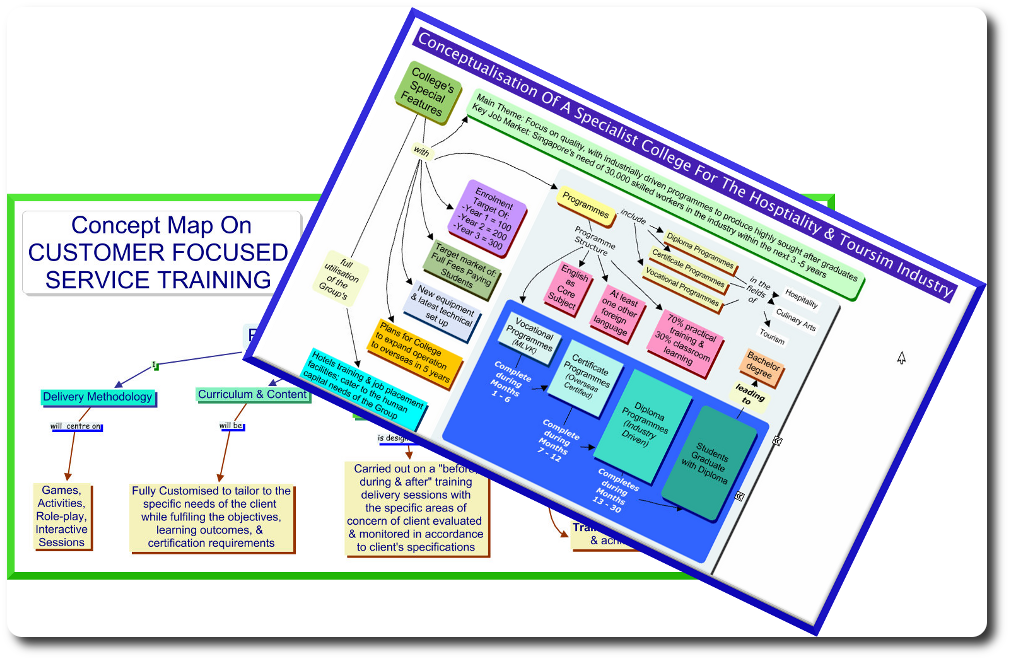
It was unfortunate for me to discover the magic of concept map much later in life, for it has many practical applications, especially when you want to put an idea on paper among others. When I was working as the Director of Special Projects for an established education group, I would have to translate my boss’s ideas (which he would be generating at least 2 or 3 a month) into a working proposal complete with financials, bells and whistles. These ideas would often begin life as a three-lines memo to me! But often the boss would have additional inputs or a change in the features of his ideas. To capture all these in words and to handle the constant changes in directions would be rather difficult and messy.

By chance I discovered concept map and a great piece of software (cross platforms and free) by the name of CmapTools. I would always translate the boss’s command into a concept map using CmapTools and discuss with him about the business idea, modifying the concept map (as CmapTools made this a relatively painless task) as we went along. At the same time, I would commence my desk research so that I could add on to the boss’s business idea. I would only commence writing after the boss has agreed on the main points of the idea as presented in my one-page concept map. Essentially I had to sell the “executable” form of the boss’s business idea in the form of a one-page concept map back to him!

From formulating of business ideas I extended concept map usage to organising ideas to write speeches. In fact all speeches I wrote for my bosses including those presented by the company’s chairman and later the CEO at their respective honorary doctorate conferment ceremonies in Australia and England began “life” as a one-page concept map. Again, I sold the idea for the speech back to the bosses effectively using one-page concept maps.

With today’s demanding business environment, most people do not have the luxury of time to read through the many documents that they will encounter each day. Thus the “short-sharp-shock” strategy is needed to fight for your target audience’s attention. While I cannot say that my one-page concept map idea can create the “shock” effect, it is certainly concise and right to the point in its approach. Nowadays, when I am asked to send in my resume for any purposes, I will always send in my one-page resume done in the form of a concept map to set myself apart from the rest. My concept map resume may not be pretty or shockingly attractive, but it is different and convey much more information than I could write in an A4 page. In addition, concept maps are designed to make it easier for the reader to pick up details and to have a much better recall on what was presented. If you are looking for a job, this brings you added advantage.

This brings me to my principle on presenting and selling an idea: If an idea cannot be presented in an A4 page, it is still not yet a good idea.

And you can quote me on that!

Smart learning to conquer exam blues

I studied over eight years at university which is much longer  than most people. As a result I am often being introduced by former schoolmates and college mates as “he who likes to study” to their friends, offsprings and spouses.  Naturally, I do get lots of requests from every corner for advice on “how to study”.   Aside from having the credential of having been a “veteran university student”, I asked myself what do I have to offer about learning and conquering examination blues. It then dawn on to me that I had passed every major academic examinations so far at first sittings. I even passed my motorcycle riding test and my driving test at first attempts. There  must be some sort of a “formula” that I can share. And there is.

For working adults who have already hung up their schoolbags yonks ago, taking on any academic learning is a daunting task that can cause a great deal of anxiety and stress. Work demand and family commitments are just two of the more obvious hurdles. Balancing these and finding the time and a quiet place to study can be quite a chore.

Let us start with Steven Covey’s famous quote, “Begin with the end in mind”. In an academic setting, examinations of one form or another are inevitable. “The end” in your mind will depend on your aspiration, to pass or to ace the final examination. However the “formula” for both are the same, the difference is in the amount of effort that you would need to commit.

Sun Tzu said, “If you know yourself and know your enemy, in a hundred battles, you will never fear the result.”, so your first task is to know yourself, then your “enemy” –  the examination.

“Knowing yourself” means you must be truthful to yourself and devise a good time management habit to juggle work, family and learning. Talk to your family and agree on some form of “me time” during your rest days (Saturday and Sunday) or during the evening after work. You must have a good idea how you spend your non-working hours and “steal” some of the leisure or idle time for studying. You also need to find a place to have the peace and quiet for you to concentrate on your learning. Personally, I find early in the morning at the office a good time to learn. Although the duration is rather  short  (45 minutes or less), it is the distraction free and unwinding after a stressful rush hour traffic to the office that make this a quality learning slot for me. You will need to find your own slots and set aside sufficient time to take on your learning effectively. You need to plan your learning schedule so that you have sufficient time to complete the requirements of the learning programme that you have signed up. Do not be over ambitious and sign up more subjects that you can handle. As a rule of thumb, full-time, 18 -23 year-old undergraduates can cope with 4 or 5 subjects during a full semester. Working adults probably can cope with 2 or at most 3 subjects concurrently. In fact most part-time postgraduate programmes rarely push learners to take more than 2 subjects per semester.

The other aspect of “knowing yourself” is the learning technique that you can adopt. For many working adults resuming learning after years of working, adopting a good learning technique is important for them to regain the learning prowess of their school days. One of the first re-learning that needs to be tackled is in note taking. The Cornell Note Taking System (http://coe.jmu.edu/learningtoolbox/cornellnotes.html) is a good system to adopt . Briefly, a page for notes is divided into three sections; two columns and one row (about 5 cm) below the columns. The right column which is 75% of the page is used to record notes. The left column is for key points for the topic covered by the notes to be extracted. The bottom row is to be used to summarise the topic. Thus when revising, the learner will concentrate on the key points and the summary.

Another learning technique is to construct mind maps and concept maps to assist learners to “picturise” a topic and how key points are linked. The act of constructing these maps will itself cause the learners to ponder and think about the facts and figures of a topic and how these can be linked. The key difference between concept maps and mind maps is in the fact that mind maps have one central theme or topic while concept maps caters to the linkages of several concepts, showing the relationships between them. It was too bad for me to discover the magic of concept map a bit late in life. The technique would have helped me a great deal since I am a “pictorial” type of learner. No matter what type of learners you are, the very act of constructing a concept or mind map will involve your thinking through the topic and making sense of the facts and figures while summarising them in a map. All these count towards strengthening your knowledge and factual recall ability on that topic.

The “enemy” in the context of “knowing your enemy”refers not only to the final examination but the entire inputs that you must make and the learning outcomes that you should attain in your academic quest. Many people make the big mistake of not associating the biggest “enemy” as the syllabus of the subject that you are studying and paid dearly for it. I studied for my GCE “A” levels in the early 1980s in a technical college in England. The college was catering to vocational and technical students and academic programmes were offered as “resit” options for those who did not do well in their first attempts. The teaching staff was accustomed to preparing their “A” level students to pass their examinations but the few foreign students like my peers from Malaysia and Hong Kong wanted (and needed) to score our grades in  A or B to read engineering, medicine etc. at universities. I learnt two things very fast. Firstly the lecturers were only doing enough to ensure that we could pass the examinations, and they were not going to cover the full syllabus. Secondly, to score grade B or better, I needed to get hold of the syllabus of each subject to know the content inside-out.  I managed to beg and persuade most of my lecturers to help me to cover topics that were not included in their lectures. Due to the clash of time-table those of us who took three sciences (biology, chemistry and physics) were only allowed to take pure and applied mathematics if we were to attend the applied mathematics classes held in the evening which was a revision class and was therefore shorter in duration for each session and the number of sessions. Our lecturer was brilliant. He studied the syllabus well. He only had time to cover about 60% of the syllabus but he focussed on essential topics that would be sufficient to secure a pass for his students. With this focussed approach, we were able to not only pass but score very well in the final examination.

One of my colleagues during my GCE “A” level days was considerably more  hardworking than me. He read broadly and deeply into biology, physics and chemistry, devouring lots of magazines and books covering these subjects. He knew these subjects a lot better than me. But when the results of the final examination were announced, he was stunned that he only passed 2 of the three subjects while I did a lot better than expected. He did not know his “enemy” like I did because he ignored studying the requirements of the syllabus for each subject.

Nowadays providing detailed syllabus is the obligation of all colleges. The document spells out clearly what the students need to study and how the knowledge gained is to be applied. Teaching plans and learning outcomes  should be provided. You should, like I did, know your syllabus inside-out. Knowing what is required and what is not is key to your success in examinations. This is what I call, “smart learning”.

In the next article, I shall cover “smart examination taking”.

This article first appeared in August 31, 2013 edition of Focus Malaysia, under Dr. YN Chow’s moniker as Plantcloner.

Reading deep into university ranking

This is the original unedited text of an article that was published in Focus Malaysia on Sept 28, 2013 under my moniker of Plantcloner.


Each year when the “season” for various world rankings of universities descend upon us, there would be knee-jerk reactions if Malaysia’s “top” universities do not perform well. Institutions that“performed” better in the latest ranking will have lots of explanation for their “successes” and if they do not do well in one ranking but “so-so” in the next, we will also be given plenty of coverage in the media too.

However, I wonder if anyone bother to ask this simplest of question: are we comparing apples with oranges when we compare across different rankings? Did the Times Higher Education’s World University Rankings look at similar criteria as Quacquarelli Symonds’s QS World University Rankings? How about U.S. News’s Best College Rankings (of U.S. institutions) compared with Forbes America Top Colleges List? How come some universities “did” reasonably well under one ranking system but not another?

Unless we know the methodology of each of the ranking systems and “adjust” the data accordingly, we are always comparing apples with oranges as no two ranking systems adopt the same methodology. Even if they look at the same criterion, the weighting given and the manner in which the data has been compiled and analysed vary greatly between ranking systems. However, one thing is clear, the same top 10 to 40 institutions usually appear in the same range in most of the ranking systems. But this does not tell us if a particular ranking system captures data relevant to the key stakeholders: the students and parents. Ranking systems that award similar rankings to these top 40 institutions could just be looking at the same criteria or these 40 institutions have the same sort of features that result in favourable scores that resulted in the high rankings.

I have evaluated four ranking systems mentioned earlier and unsurprisingly, Times Higher Education and QS World (and to a lesser extent, U.S. News) have many similar criteria in their respective ranking systems. This could be the key reasons for many institutions appearing in similar ranking positions across these two systems.

Only Forbes places any relevance in asking students to score their learning experience and satisfaction. Forbes also is the only one that uses several evaluation channels to provide some measure on “returns on investments”such as the salary of alumni and alumni who have made a name for themselves and appear in Forbes lists (Power Women, 30 Under 30, CEOs on the Global 2000), plus Nobel and Pulitzer winners, Guggenheim and MacArthur Fellows, those elected to the National Academy of Sciences and winners of an Academy, Emmy, Tony or Grammy award etc. Hence Forbes puts some weight in how “powerful” and influential the alumni of an institution are/were in society as a measure of their successes. Forbes also gives significant weighting on the ability of student to service their debt as key criteria and hence covers the employability and salary commanded by the graduates via such a measure.

I think a good ranking system will answer four basic questions that a student (or parent) needs to consider:

(a) How easy for me to get accepted to this institution? The relevant entrance requirements for a range of fields of studies need to be evaluated. Perhaps SAT or CAT scores for the North American college systems, GCE “A” levels and other pre-university qualifications need to be provided and evaluated.

(b) What percentage of applicants are accepted each year? This gives a good indication on how popular an institution is and how stringent is its selection process.

(c) How much will it cost? Are financial assistance provided for high achieving students? This give a measure of how much it will cost to finance a student through his/her studies. The provision of financial assistance to high achieving students is a measure of how well an institution is endowed .

(d) How fast does the average graduate gets a job after graduation and what is the average starting salary for fresh graduates of this institution? What percentage of graduates get jobs in their areas of studies?

Most of the ranking systems cover (a) to (c) in some measure of detail but only Forbes covers (d) which is one of the most important reasons for a student to go to university: to be able to secure a good job and build a career in his/her chosen field .

Another measure of academic quality is the percentage of fresh graduates that progressed to postgraduate studies. However a more precise measure is the percentage of PhD graduates that secured postings to carry out postdoctoral studies within 6 months of graduation. This shows how “popular” an institution’s PhD holders are and how the other institutions rate the quality of the research training of that institution. None of the ranking systems evaluated cover this which is a very good direct peer-review of an institution.

A good ranking system, aside from measuring the outputs (i.e. the quality of the graduates) also needs to provide a measure of students’ happiness with their lives while at college. Only Forbes provides a good measure of this aspect to rate the facilities, the teaching and the overall experience of the students.

Apart from the various criteria used by a ranking system, the manner in which the data are collected requires detailed evaluation. Some like Times Higher Education and QS World rely heavily on scoring of the academic reputation of institutions by their peers or professional students recruiters / counsellors. In addition, heavy weighting is often given to this criterion. To me this serve no purpose at all as it is highly subjective without any concrete data that can be used by the scorers to objectively assign a score to an institution. Measuring the research output of institutions (such as the number of papers published per PhD thesis approved; the average number of citations received by each teaching staff per year, the percentage of PhD holders getting postdoctoral research jobs etc. ) serves as a better yardstick.

Some ranking systems like QS World use “employer reputation” (how employers rank the institutions in terms of the quality of their graduates) which covers the employability aspect well. This is rather a very subjective way of measuring reputation. A more objective measure would be to rank or score an institutions on what percentage of their fresh graduates are hired each year by multinationals, Fortune 500 companies, 100 largest companies etc. in the country. The proof of the pudding is in the eating. We need to know if getting a degree from an institution will allow the graduate to a) get a job readily, b) join a network of powerful and influential alumni (to enhance his/her career development prospect); c) get a job that pays her/him sufficiently to allow the servicing of any debt incurred in the process of studying for the degree. In fact way back in 1999 when I first visited New Delhi on business, I was amazed to read advertisements placed by private higher education institutions in major newspaper that read something like this: “90% of our graduates found placements in multinational and major Indian corporate giants such as XYZ. with starting pay of ZZZ rupees per month”. There was (and still is) intense competition in the market and these private institutions of higher learning were trying to distinguish themselves by getting job placements for their graduates with major employers that paid well. I feel that any university ranking systems that ignore this crucial criterion is not giving the readers an accurate picture of the “value” generated by each institutions for its graduates.

Another measure of an institution’s reputation is in its industrial linkages (and hence the ability to place its graduates in industry). This could simply be the amount of research funding per faculty member that it receives from industry. Related to this, how well an institution is perceived to serve industry can be measured by the value that research and development activities of this institution bring to industry. This can be measured indirectly by the value of commercialization per faculty member per year that an institution has carried out. This also measures the innovative capability and entrepreneurship of an institution.

This is not a comprehensive evaluation of the different university ranking systems. I merely demonstrated that with a bit of drilling down of the methodology we can discover a lot more about these ranking systems and their relative shortcomings. One should therefore, when reading reports of these ranking systems take a heavy pinch of salt. We can use them as rough yardsticks to gauge the “reputation” of an institution at best but one should not read further beyond this. We should be reminded that, no matter how high an institution is ranked by a system, if its graduates are not able to secure jobs in the relevant fields, then there is a disservice being performed by that institution to its stakeholders.

Footnote:
Plantcloner has evaluated many institutions in Asia Pacific when he served as the regional quality manager of a UK-based publishing-education company. He believes that an institution’s reputation is only as good as the graduates that it has produced.

Plagiarize and risk getting stigmatized

No body wants to be labelled as a cheat. That is something given for granted. In the academic world, the worst sin is none other than being caught as a plagiarist. Getting stigmatized by your peers and society at large is the consequences of being caught.

In the days before the internet era and before the rise of the mighty search engines like Yahoo and later Google, the risk of getting caught if you lift sections of work from others assignment or even published work was remote. This is especially so if you are just writing a term paper or an essay that get filed (and later thrashed). But today, with the rise of the internet and more and more literature, thesis, even essays are published or made available online by authors, the life of the plagiarist is getting riskier by the minute.

I have submitted an article for my column in The Heat which deals with a few examples from my own experience as a research scientist and a college lecturer which I hope the editor will accept for publication.

The availability of many plagiarism detection services with access to huge databases, fast and effective search engines means that to cheat on one’s academic work now is a very risky affairs. Even those who had plagiarized and it seems that their bad deeds were not detected when the work was submitted and accepted, the freedom of information principle and the eventual inclusion of the plagiarists’ work in one or more databases will lay bare the fraud committed sooner or later.

On August 7, 2014, it was reported that prominent US senator John Welsh was forced to quit his re-election campaign due to the exposure of his being a plagiarist. Welsh’s 2007 act of plagiarism for his master’s degree assignment was only exposed recently. The plagiarism committed and uncovered was clearly detected and published in fine details in which the detection software not only picked up “blow-by-blow”  the act of plagiarism committed by Welsh, it even pointed to which paragraphs, sections and entire page that were copied and from whom the relevant content was lifted. It was reported that Welsh’s alma mater may be rescinding his master’s degree. Hence being stigmatized by the academic community is just the beginning of Welsh’s woes, now losing his political career is far more damaging.

Once you are labelled as a cheat, in today’s digital world it means that you are forever digitally branded as a cheat. That is the peril of plagiarism. So those who have cheated in order to gain their academic degrees should rightly be worried sick now. This is because someone, somewhere and some time in the future will uncover your bad deeds. It is just a matter of time that you will be caught. There is no escape!

The M in MOOC stands for Massive!

Inside Higher Ed reported that the University of Wisconsin – Madison is revamping its Massive Open Online Courses (MOOC) offering. It will put emphasis on MOOCs that have local interests. This was done at the back of 3.2% average completion rate for Wisconsin – Madison’s MOOCs. Although this is low, it still falls within the 3 to 7 % range that is the average for MOOCs in terms of completion rate.

As a “veteran” MOOCer, I think Wisconsin-Madison has missed the whole point about MOOC by going local. MOOC is the means by which academic and other learning institutions can extend their reach to learners at all corners of the world whose only criteria of participation (aside from prior knowledge specific to some courses) is access to the Internet. Local learners can well afford the time (and resources?) to take up on-campus courses. By “going local” there may be many consequences such as:

  1. Lower sign up figures:

With an averagely popular MOOC, you can expect at least 30,000 enrollment. With local-focused MOOCs, you will bound to have a much lower enrollment figure as your subject will not have broad enough interest to the “Massive” part of MOOC. Hence a figure of 3,000 enrollment is already very generous, I think it will be more in the range of 800 – 1500. You will not have the kind of geographical reach that MOOC is designed to bring. Will you still be able to “qualify” your courses as MOOCs?

2. Lower total number of people completing the MOOCs: (Is completion rate more important than the number of learner benefiting from your MOOCs?)

The cost of putting up Wisconsin-Madison’s revamped MOOCs, IMHO will not be that much different from the previous version. With 4% completion rate of the “old” MOOCs and with say 30,000 enrollment, you would stand to educate and benefit 1,200 people. With an enrollment figure of 1,000 and a completion rate of say triple of the conventional 4%, you will only educate more or less 80 people. Hence your return on invested effort (the MOOC industry has still not figured out a business model, thus it is best to measure return on invested effort rather than investment at this point) will be very low.

To benefit 80 – 100 local learners, you might as well provide free on-campus delivery of the course rather than using the more expensive MOOC system.

I think what Wisconsin-Madison needs to do is to look into the delivery system of their “old” MOOCs and find out from learners or if possible engage a sample of learners (with incentives) to give them answers to what work for the learners and what elements are the “turnoffs”. By improving the completion rate by just 2 to 3 percent, a significant increase in the number of people benefiting from the institution’s MOOCs can be attained.

What elements of an MOOC that worked for me may not work for everyone. However in my case I think these are, for me at least the success factors in an MOOC:

(a) Clear and concise learning objectives and learning outcomes. The kind of pre-requisite knowledge and skills must be well specified as well. The syllabus must be well written and available BEFORE the course commences to allow learners to judge whether they want to or have the pre-requisites to benefit from enrolling and learning.

(b) Tie to (a) a series of short video lectures, “purpose-shot” (i.e. shot purely in MOOC fashion and not a class recording). Each video lecture should be around 8 to 10 minutes long, covering a learning point each. Long video covering many points will lose learners and it is not easy to resume learning if you have to take a break while watching a 1 hour lecture.

(c) Tie to (b) a good summary of the learning points to be achieved for the chapter, summarizing the key learning outcomes attained with glossary of new terms / concepts.

(d) A clear and easy to follow assessment regime. I for one is a kind “loner” when it comes to studying. I like discussion forum and will take part even if not required by the assessment regime if the conversation is interesting. I never like to work in a group in which the bulk of the assessment for knowledge attainment is based. In Stanford University’s pioneer “Technology Entrepreneurship” MOOC, I was let down by some of my fellow group members (we were from Malaysia, Singapore, and Pakistan) to the extent that we could not develop our project fully (luckily the assessment system made allowance for such scenario). I think group work should still be used but assessment of which should not occupy a significant chunk of the final grade. I also do not like peer-based-assessment for written work. This is because the system will not have the ability to distinguish the serious peer assessors from those who just want to complete the task and simply assign a grade. In fact, I have an idea: why not engage some of these serious peer reviewers as course monitors (a sort of class representatives) give them some Teaching Assistant’s privileges to “double mark” a group of learners’ work. In return these serious peer assessors can be given some incentives such as free enrollment into verified assessment (i.e Coursera’s Signature Track or edX’s Verified Certificate) which usually cost a fair bit of money especially if you are not earning US dollars like me.

In short, learners’ expectations and what an MOOC promised to deliver must tally. Some MOOCs look good on the introduction page but the content was either not suitable or too demanding of the learner. Some will have unrealistic assessment regime that drives away those who already enrolled.

The “we build it and they will come” expectation of some of the MOOC providers has to be erased from their vocabulary! What happens will likely be this, veteran MOOCers like me will come, even sign up and look around, feeling disappointed and dropout from the course!

Reading deeper into dates

Today is the “official” birth anniversary of my father who passed away on December 01, 2013. Officially, if he was alive today, the late Mr. Chow Kong Yong would have been 85 years old.

It was not until we were arranging for my father’s funeral in December 2013 that we discovered a new fact about my dad. One that we suspected even my dad, a retired school master did not know about.

My father’s birth certificate showed that he was born on the 5th of August, 1929 in the town of Pusing near Ipoh. All along we learned to remember his birthday on the Gregorian Calendar as such and that his birthday on the lunar calender was the 23rd Day of the Sixth month. You can imagine the shock we, the children and grandchildren of the late Mr. Chow showed when the administrator for the columbarium in Sam Poh Tong Cave Temple (a famous Chinese temple built into a series of caves in Ipoh) calmly informed us that the 23rd Day of the Sixth month in 1929 did not fall on 5th of August but 29th of July!

It seemed that for 84 years my dad (and the rest of us) did not know his actual date of birth! I then recalled one of the stories that my late grandfather used to tell me when I was a kid. During the good old days (in the 1930s – 40s), many babies were born in the home. The “standard operating procedure”  (SOP) back then was to report the birth at the nearest police station to get a birth certificate for the child. With high infant mortality, especially during the Great Depression years, the SOP was to wait till the baby survived for 7 days before the father would register the birth. It is my educated guess that my grandfather followed this SOP as far as the birth of my dad was concern!

Of course during those early years it was very difficult to convert the date from Lunar Calendar to the Gregorian Calendar system, so the “mistake” in my dad’s birth date would go on undiscovered. But today, we have plenty of apps on our smartphones that have lunar calendars which can do a conversion of dates in 2 to 3 swipes. If one wants to get the conversion from an authoritative source, the Hong Kong Observatory provides great conversion tables.

So if you are given a date, especially a distant date in the lunar calendar by anyone, do not take their word for the conversion of this date to Gregorian Calendar. Always double check with your lunar calendar apps or to be on the safe side, consult the Hong Kong Observatory’s conversion tables! For conversion of Muslim Calendar to Gregorian Calendar (and vice versa),  this site provides a good conversion apps on their website.

I guess the wrong conversion of my late father’s birth date shall remain a Chow family joke for generations to come!

The late Mr. Chow Kong Yong, taken on Feb 11, 2011 in his house in Ipoh, Perak, Malaysia.

Killing your ad with poor music

Some movies have great soundtracks which help to them to sell well, especially the snippets of video and soundtracks used in the trailers.

Great soundtrack can save a “so-so” movie

Some movies on the other hand are very “forgettable” if not for their soundtracks. The classic example is 2001 – A Space Odyssey. The soundtrack, “Also sprach Zarathustra” is highly memorable and those who have watched the movie will, upon listening to this piece music quickly recall scenes of the movie. But aside from the theme song and a few scenes such as the “spinning wheels” space station scenes, I did not remember much of the storyline. But I can always associate Also sprach Zarathustra with the movie. This is the strong influence that a good soundtrack can have on a movie.

2001-space-oddesy

(Picture from : http://www.imdb.com/media/rm261462016/tt0062622?ref_=ttmi_mi_all_sf_48#)

Catchy jingles rule the day

The creative people making videos as TV commercials had discovered the power of a good jingle or key pieces of a soundtrack very early on. Those of us who were around since the 1970s would have been exposed to the theme song of Coca Cola, “I’d Like to Teach the World to Sing (In Perfect Harmony)”. Through the years Coca Cola’s advertising people have been producing these “jingle hit” songs. More than both the TV and cinema commercials, these Coke songs were the driving force of the message that Coca Cola wanted to convey to its consumers and conveyed they did.

How to spoil a good TV commercial with crappy soundtrack

There is a TV commercial by a health drink company which has been running for over a year or so in Malaysia which tries to promote the company’s chicken essence. The message that this company wants to put forward to the viewers is that this product brings vitality and energy to the users which work to increase their brain power so that the whole world will be at his/her hands. A very good idea with reasonably good video that tells the intended story. But the let down is the sound track.

Towards the middle of the commercial the tempo of the song was changed. I remember that the soundtrack for earlier versions of this commercial (both the English and Mandarin versions) was reasonably catchy and not out of tune. But somehow the commercial’s was altered. Now the soundtrack has deteriorated to the extent that from the middle part of the clip, the song is out of tune. To someone like me who has a good hearing, it is a torture listening to this commercial now. This is compounded by the fact that the same out-of-tune soundtrack is also used in the company’s radio commercials. The singer now sounds as if he is so lethargic after consuming this brand of chicken essence that viewers will get an unintended message: drink it and you will feel tired!  I will usually switch station when I hear this commercial while driving to avoid further irritation to my hearing.

I wonder why the people putting the commercial on air is not listening to their own advertisement! If they do, my guess is they are all tune deaf! I guess the people at the company that hires this particular advertising agency are all tone-deaf too!

This is a classic example of a good commercial being killed by a poor choice or poor quality of a soundtrack. Perhaps advertising agencies may want to consider hiring someone like me, with good hearing to evaluate their TV and radio commercials before these hit the airwaves?