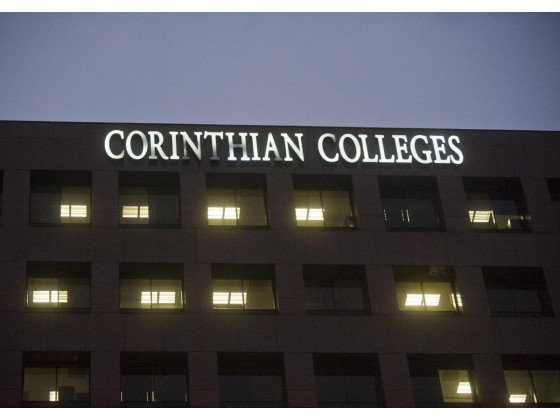
Will Corinthian Colleges’s kind of education meltdown happen in Malaysia?

nnu2yb-corinthian
Photograph source: http://images.onset.freedom.com/ocregister/nnu2yb-corinthian.jpg

The final nails are being hammered into the coffin of Corinthian Colleges, once one of the largest for-profit education groups in the USA. The impact of this private higher education meltdown is far and wide. Many of its remaining 16,000 students are left out in the cold, most are shouldering huge personal / education debts with bleak future. Many of Corinthian’s problems that led to its downfall are related to inappropriate management of state-funded education loans to students and over promise of job prospects and pay levels. Can we find similarities in cases of education institutions’ collapse in Malaysia?

If PTPTN can finally get it’s act together (it looks as if it has began the clean-up which it should have been doing in terms of defaulting borrowers management long time ago), will we witness similar higher education meltdowns in Malaysia too?

There are just too many colleges (private, community, public etc.) chasing a Malaysian youth population that is not growing in tandem with their collective capacities. The growth in international students population can help to redress this only a little. Not all the smaller players have what it takes to attract foreign students!

Should PTPTN now also start honing on errand colleges and universities which have been over promising its students with job prospects? Let’s be fair on this, PTPTN should include every institution, both private and public where the most loan defaulters have come from. It also owes the citizens of Malaysia an explanation on why it had decided in November 2014 to whack 15% from the private college students’ PTPTN loan amount while taking only 5% from those in the public institutions of higher learning. This reduction has already showing its impact on the enrollment figures of many private institutions relying heavily on PTPTN loan to fund their students (does this ring a bell?….think Corinthian!).

Consolidation of the higher education industry of Malaysia was called for by some politicians recently. But these people may not have a full understanding on how the higher education industry works and they have no idea of the complexities that the act of consolidation (along the idea of banks mergers) would entail. Colleges and universities are not like banks, the “products” are all very different, the pricing systems and delivery schedules are all unique to individual institutions. It would be easier to let “sick” colleges die than to “cross infect” the healthier ones! No sane edupreneur will be willing to buy into someone else’s huge debt!

With more stringent entry requirements for private colleges and universities set to come into effect in 2016, and the possibilities of PTPTN getting tougher on institutions which produced the largest number of bad debtors, there is a huge storm that the higher education industry as a whole and the private sector in particular are riding into. The “Corinthian Meltdown” may yet to be witnessed in Malaysia!

I for one will not be buying any education stocks for now!

(Declaration: I do not hold any direct shares in any of the 4 public listed education groups in Bursa Malaysia!)

Learning and commenting about Duke-Kunshan University

I have been a loyal student of Harvard University’s highly successful massive open online course (MOOC) on the history of China, ChinaX for the last 14 months. I have successfully completed 9 out of the 10 mini-courses and am now more than half way through the last mini-course.

In week 46 of ChinaX, we were introduced to the remarkable success of Kunshan, a formal agricultural region between Shanghai and Nanjing. We learned that present day Kunshan has a per capita income of over US$19,000 and if we exclude the internal migrants’ income, the per capita income of the population with household resident right (hu kou) is US$52,000. The local government, in the era of the late 1970s (after Mao’s passing) took an unilateral decision to develop the economy of this agricultural region and this gamble (which did not receive any endorsement from the central government) paid off.

This particular module focussed on education, in particular how Kunshan’s local government made the decision to work with one of the elite universities from the USA, Duke University which roped in Wuhan University to form the Duke-Kunshan University. It showed the farsighted leadership of Kunshan in investing in human capital development and innovation as the twin pillars for their residents to stay competitive amidst greater & greater competition from other Chinese cities & regions. But the key phrase IMHO is ” Location, location & location “. No other cities have the great location of Kunshan for being nested between China’s two great cities of Shanghai & Nanjing and having two high speed rail systems having stops at Kunshan!

We were asked the following question as a part of the discussion/ assessment for our course:

What are some challenges Duke University and Kunshan face moving forward? What advice would you give Chancellor Liu and Vice-chancellor Bullock?

I am honoured that my answer was one of the few (among thousands of MOOC learners) picked up for discussion in the weekly “Office Hour” where either Professor Bill Kirby or Professor Peter Bol will review last week’s module, further the discussion and answer questions post by the learners. This is the second time that my contributions get picked up and I am really thrilled to share this with you. I am impressed with Duku Kunshan University’s Vice Provost, Dr. Nora Bynum for her “deciphering” of my online moniker of “everboleh”!

The following is my answer to the question above which ‘earned” me a mention by Professor Kirby. My moniker as an MOOC learner is “everboleh”. The segment of Office Hour Week 46 which touched on my contribution is between 11:30 to 13:00 minutes of this video.

ChinaXOfficehour46

 everboleh

I think Kunshan will have to figure out why it did not involve the Taiwanese whose support was the cornerstone for its eventual success. Both Duke, Kunshan and Wuhan will need to ensure that there are significant landmark successes that DKU can score. Nothing of the prior successes that each of these three partners can guarantee the success of DKU. Being the two largest economies in the world China and the US need not only to engage with each other but the rest of the world, especially India. The challenge for DKU is to fulfill its mission to create human capital not only for Kunshan but which can bring in the kind of human interactions with the rest of the world.

For Duke, the challenge as related by Kunshan Party Secretary, Guan Aigo that the city needs more than just DKU to be successful. How Duke can secure the biggest part of this interaction before other big universities from the US and UK make a move on Kunshan is a relationship game that it must succeed in to ensure Duke’s investment in time and effort (and reputational risks) will pay off.

The departmental-less approach of DKU is new even to Duke, how the cross disciplinary approach in the face of fierce guarding of their respective turf by academics (which is a tradition that cut across all culture and national boundaries) is something Professors Liu and Bullock have to iron out fully. However as a practitioner in education management, I think the idea of a Masters in Management Science that cater to the needs of liberal arts and humanity graduates to take on business administration is a concept that may take hold in not only China but other regions. It is a concept that I will surely adopt for the new university that I am currently helping to establish in Malaysia. I shall watch the progress of DKU with great interest and hoping to learn and emulate its success.

(Source of feature photograph:  http://dku.edu.cn/sites/all/themes/kunshan/images/overview.jpg )

Life’s lessons learned from Harry Potter

What life’s lessons can you get from Harry Potter books? Read what a young fan, Potterhead got to say about this.

[show_post_categories show=”category” hyperlink=”yes”]

[show_post_categories show=”tag” hyperlink=”yes”]

Commentary about this article (revised –  Apr 19, 2018)

The author, Leland Chow was a junior reading Finance, minor in communication studies and economics at the University of Nebraska-Lincoln when he wrote this piece. This article originated as an assignment for one of the author’s classes and is presented here for our readers’ enjoyment.

In late 2012 Leland Chow took the Malaysian Sijil Pelajaran Malaysia (SPM) which is a national high school diploma equivalent examination that most Malaysian school leavers will take. My wife and I were very worried for Leland. Instead of burying himself with SPM study guides, textbooks etc., he was reading Harry Potter books during most of this month-long examination. We joked that if Harry Potter books are included in his examination, he would score grade A+ hands down. Leland simply smiled and told us that it (reading J.K, Rowling’s books) was his way of relaxing. He claimed that reading Harry Potter calmed his nerves as well. Well, Leland might have a point there. He did extremely well in his SPM to win a full scholarship at SEGi University. But after reading what he wrote, I think Leland gets more than just a calming of his nerves! I also learned two things from this piece, (i) Leland was a victim of bullying at high school (& wish I knew earlier to help him to tackle this),  and (ii) the meaning of a new term, “Potterheads”! ————–> Chow Yong Neng, PhD.

~~~~~~~~~~~~~~~~~~~~~~~~~~~~~~~~~~~~~~~~~~~~~~~~~~~~~~~~~~~~~~~~

This was the third and final essay of my English: Rhetoric as Inquiry. My instructor, Ms. Maria Nazos has asked me to write an essay regarding a person or a group of people who I admire. Instead of choosing a real-life person or a group of real-life people, I decided to choose my favorite characters from my favorite childhood series, Harry Potter, Ron Weasley and Hermione Granger from the Harry Potter series. I utilized textual evidences from the book to support the characteristics of the three unlikely best friends. —————–> Leland Chow

Introduction

He was an orphan as his parents were brutally murdered by a horrendous man. He lived with his maternal aunt and uncle since he was born. His aunt and uncle treated him as if he was their servant. He did not feel loved, happy, cared for. His cousin also did not help to the fact that he was literally neglected and bullied by his aunt and uncle, as his cousin was spoiled by his aunt and uncle, giving his cousin new gifts and toys, while he could only get hand-me-down, second-handed gifts and toys. His room was worse, as he literally lived in a small storage closet, barely enough to fit his small body. His life was basically miserable for the past 11 years, until a letter was written to him, telling him that he was accepted into a prestigious school, a magical school, Hogwarts School of Witchcraft and Wizardry.

It was not until 2005 when I started noticing the world of Harry Potter. People usually read the books before watching the film. I, on the other hand, took notice of the first film, Harry Potter and the Sorcerer’s Stone. I really liked how magical it was, and immediately bought the second film, Harry Potter and the Chamber of Secrets and watched it. I felt that Harry Potter was in a way, sad, but very inspiring to me. Then, I persuaded my parents to buy the three books that came after the first two films. I loved reading books as well, and hence I read the three books quite quickly. Suddenly, I realized that I was actually really enjoying all of the Harry Potter books and films, I was a Potterhead.

Background

Harry Potter was created by a British author named J. K. Rowling, in a delayed train from Manchester to London in 1990. She used that name as she had no middle name, borrowing Kathleen as K. from her grandmother, and this made J. K. Rowling’s initial identity to be more anonymous. She wrote the first few ideas of Harry Potter on a napkin, and in later times, used a typewriter to type the first book, Harry Potter and the Philosopher’s Stone. When she was writing, she usually wrote in cafes in Edinburgh, and her then baby daughter would be around with her (Farr). I found it to be quite ironic that J. K. Rowling got her ideas of Harry Potter in a train, as in her books, a platform in King’s Cross Station, Platform Nine and Three Quarters, is used as the platform for the official school train, Hogwarts Express, which is used to transport students to Hogwarts (Rowling, “Sorcerer’s Stone”, 87). This coincided her writing with her true experience in the train. Her way of writing this type of transportation used in all books of Harry Potter resembled a relation between the land of magic and the land without magic. It served as a bridge between the wizards and witches, and the normal non-magical people, the Muggles (Rowling, “Sorcerer’s Stone”, 53). A bridge whereby there were quite a few similarities between the magical world and the non-magical world, which was quite fascinating because to me, I would not have expected wizards and witches to use just the same mode of transportation: a train. Even though it may be a magical train, but still, it was the same type of transport, using a similar type of train tracks.

The younger me at that time read books pretty quickly, so in a month or two, I have already finished reading the three books, ranging from a thin Prisoner of Azkaban, to a very thick Order of the Phoenix. But, unlike now, where I take my time to read and understand carefully about the books, I was just reading and not understanding the plot of the books. Somewhat, this old habit of mine reflected on my personality that I did not understand deeply enough about the true nature of things. I was technically bullied at that age, but I did not know that I was bullied, nor did I know why I was being picked on. I was just too immature at that time to understand things from a different perspective.

Harry’s Love

Love was one of the themes in the Harry Potter book series, and it was evident in Harry himself. Unlike his nemesis, Voldemort, Harry Potter had been loved by his parents. He was born into a dangerous world, and was bullied by his aunt and uncle, but when he was in school, he was loved by his friends, Ron Weasley and Hermione Granger, Ron’s parents, the headmaster, Professor Albus Dumbledore, and even the deputy headmistress at that time, Professor Minerva McGonagall. Molly Weasley, Ron’s mother, in fact claimed that Harry can be her son, and even gave Harry her brother’s watch as Harry’s 17th birthday present (Rowling, “Order of Phoenix”, 90; “Deathly Hallows”, 114). Harry’s love for his friends was also evident when he saved them in the Chamber of Secrets, where he successfully slayed the Basilisk, a dangerous monster, faced many Dementors, which were soulless creatures, and as mentioned in the previous paragraphs, sacrificed himself for the safety of his friends (Rowling, “Order of Phoenix, 527; “Deathly Hallows”, 703).

If he did not love any of the people mentioned, I believe that he would not have sacrificed himself because the existence of love in him was one of the key reasons he did not join the evil side. The darkness that was present in the society was growing more than ever, but his love for everyone and vice versa kept him grounded. Voldemort utilized his followers as if they were his tools, and when his followers were useless or dead, he did not shed a single drop of tear, nor did he show any signs of remorse (Rowling, “Deathly Hallows”, 656). Harry, on the other hand, showed his emotions clearly. He was sad and cried for the death of his loved ones, even in the case of a death of a non-human creature, Dobby the elf! He manually dug a grave and engraved “Here lies Dobby, a free elf” on top of the gravestone (Rowling, “Deathly Hallows”, 478-481). Would Harry be less emotional, and worse, less likeable, if he cannot feel love? In my opinion, definitely! This is what sets Harry and Voldemort apart, as Harry understood the ability to love someone, while Voldemort, unfortunately, could not feel love, and did not love anyone, as he was born under a concoction of a love potion made by his mother for his father (“J. K. Rowling Web Chat”).

Hermione’s Logical Intelligence

Of course, the adventures of Harry Potter would not be as great if Harry was not accompanied by his friends, Ron Weasley and Hermione Granger. Hermione Granger possessed a trait that many people would seem to admire and hate, all at the same time: logical intelligence. It was because of her logical intelligence that she solved the Potion Riddle to help Harry to defeat the professor who had Voldemort stuck at the back of his head (Rowling, “Sorcerer’s Stone”, 286). However, it was also because of that intelligence that Harry and Ron were not fond at her at first. She was described as a know-it-all, having read and studied every book in detail even before the semester has started (Rowling, “Sorcerer’s Stone”, 105). Her intelligence came from the fact that she was outspoken, and because of her outspokenness, the two boys did not like her (Jusino). She proved herself worthy though, and through her kindness towards everyone, she has won many people’s hearts, including Harry’s and Ron’s, and they eventually became good friends. To me, she has also won my heart, as she resembles me in some ways. I am considered an outspoken person. Because of this though, many people think that I am intelligent, especially when it comes to getting good grades in my exams. Unlike Hermione, however, I am the one who works hard, pay my fullest attention in classes, and try my best to get the grades I want. Unfortunately, when it comes to house chores and other life skills, I am the worst person to ask. I cannot cook, I cannot assemble a shelf properly, and I definitely cannot fix a car. Hence, Hermione possesses a trait that is somewhat relatable to me and I admire her because of this.

Soon, as I grew older, I started rereading the Harry Potter books. I now had four books, including Half-Blood Prince. I slowly began to understand more about the struggles Harry, Ron and Hermione faced in the books. I understood the pain the trio faced, especially Harry, after rereading those books. I have slowly started to change my habit of reading, preferring to read slowly and understand more about the plot development. At the same time, I started to realize that I was not very happy in life. I realized that I was being bullied, and I did not dare to tell my parents about it. I just kept everything to myself, like what Harry did by hiding his pain from Ron and Hermione.

Ron’s Humor and Maturity

Ron Weasley, Harry’s male best friend, on the other hand, was not as smart as Hermione, nor as skilled as Harry, but he had a trait that the both of them lack: His sense of humor. He was a character that provided some comic relief in the books, making sure that the books were not dark and sad at all times. At the beginning where Hermione was not on Ron’s good shoes, he kept on mocking her, saying that she was scary. When Harry and he were stuck in a plant and Hermione was freaking out, he questioned by shouting at her if she was a witch. He also joked that Harry had to get his Inner Eye tested during a class when Harry tried to read the tea leaves from Ron’s cup but failed miserably. When the fake Professor Moody Transfigured Malfoy into a ferret, Ron told Hermione to not say a word, as he was trying to remember that scene forever (Rowling, “Sorcerer’s Stone”, 172, 278; “Prisoner of Azkaban, 105; “Goblet of Fire”, 207). In the first two cases, although he was mean to Hermione, he was funny and in a way, was a joker to the other two of his friends. Rowling has said that the reason why Ron had a good sense of humor was because he was immature as well (Ferreol). He, however, became more mature where he came back to Harry and Hermione after leaving them. At the end, when he married Hermione and had kids, he said to his children that he’s extremely famous, prompting them to laugh, showing that he still had his sense of humor (Rowling, “Deathly Hallows”, 380, 759). In my opinion, Ron was one of those people that no one could hate, as he was hilarious in many situations. Rowling wrote such a contrasting character to accompany Harry and Hermione, but because of what she wrote, Ron was easily likeable by Harry Potter fans, or commonly known as Potterheads. He was the type of guy that every guy would want to be when dating with a girl, as he knew what to say to make the girls laugh.

When the last book, Harry Potter and the Deathly Hallows was released, I was delighted and requested my parents to buy the book for me. As it was quite expensive, they were initially reluctant to buy the book for me. After several plead from me though, they decided to buy for me as they knew I liked books. A few years after owning the last book, after many times of rereading, I finally realized that I had changed after reading Harry Potter, somewhat quite a lot. I learned to look things at a different perspective. When I realized I was being bullied at first, I kept on wondering why I was picked to be the victim, why other people would not be the victims. Then, I realized that maybe it was because of some misunderstanding with them, or they had a huge issue on me that even I did not realize.

The Trio’s Bravery

Harry, Ron, and Hermione, however, possessed one of the few traits that no one else in this real world could compare: Their immense bravery. Lord Voldemort tried to kill Harry many times after he killed Harry’s parents, including the night where his parents died, the time where he was fighting for his life in the Triwizard Tournament, and the time when he was a legal magical adult, facing Voldemort, and came to accept his apparent death (Rowling, “Sorcerer’s Stone”, 12; “Goblet of Fire”, 663; “Deathly Hallows”, 703). He was not alone, as Ron and Hermione bravely stood beside him in nearly all occasions, trying to help him to defeat Voldemort once and for all. They were not cowards, and they did not bother running away. Even until the end, the trio did not surrender, even though Harry sacrificed himself to his death. In fact, Harry knew that he had to do so because that was the only way to defeat Voldemort. He knew that a part of Voldemort’s soul was attached to him, and as long as he lives, Voldemort cannot be defeated. Ron and Hermione did not know about that, but when they found out about it, they were sad and continued fighting against Voldemort and his followers (Rowling, “Deathly Hallows”, 686, 731).  Harry chose to die, and not live, as if he chose to live, everything that has done for by his parents and everyone else he loved will be betrayed (Deyoung).

The trio’s bravery was the main reason why Potterheads, including me, admire him. In my opinion, bravery was something lost in the whole of Harry Potter book series. There were too many characters who were afraid of losing something, including losing Harry’s life. These characters then decided to stay silent and be passive in the general public, unlike Harry, Ron and Hermione. They were one of the only few who decided to take action against Voldemort. They were the one of the few who sought light against all the darkness. They were the ones who stood up against all evil, never giving up, and bravely assumed their roles that they must defeat Lord Voldemort in order to successfully vanquish the evil, and restoring peace in the world.

2012 was the year when the final film adaptation of Harry Potter was released. It was a bittersweet moment for my life as I realized that this was THE final film of Harry Potter. No more Harry, no more Ron, no more Hermione. Deathly Hallows Part 2 was very heartfelt as I finally got to see the truth, as read in the book. My life took a turn for the better after reading and watching the last book and film adaptation, respectively. I finally understood that people were still immature at that time when I was bullied, as when I was finally leaving high school, I was not bullied, but on the contrary, I had friends who I can count on. I finally got to experience true friendship from these great friends.

Conclusion

It was and still is surprising that a pure-blood, a half-blood and a Muggle-born could be good friends together. Harry, Ron and Hermione, from the Harry Potter series, have inspired many people to be brave, to be themselves, to fight against evil. I dare to admit and say that I am one of those people. I applaud Rowling for writing such a great series of books, timeless stories, and most of all, creating a magical world that many Muggles like me try to realize in the real world. I hope that everyone who reads Harry Potter could take something home after reading the series, because I have.


Works Cited

Deyoung, Rebecca Konyndyk. “Love Bears All Things: Thomas Aquinas, Harry Potter & The Virtue of Courage.” Virtual Library of Christian Philosophy. Calvin College. 12 Sept. Web. 16 Nov. 2014.

Farr, Emma-Victoria. “JK Rowling: 10 Facts about the Writer.” The Telegraph. Telegraph Media Group, 27 Sept. 2012. Web. 16 Nov. 2014.

Ferreol, Yvette. “Rowling Reveals `Marriage’ to Harry Potter at Reading (Correct).” Bloomberg.com. Bloomberg, 22 Oct. 2007. Web. 30 Nov. 2014.

“J.K. Rowling Web Chat Transcript”. Bloomsbury. The-Leaky-Cauldron.org. 30 July 2007. Web. 11 Nov. 2014. Transcript.

Jusino, Teresa. “Hermione Granger: Minority Geek Girl”. Potterpalooza on TOR.com. TOR.com, 14 July. 2011. Web. 13 Nov. 2014.

Rowling, J. K.  Harry Potter and the Deathly Hallows. New York, NY: Arthur A. Levine, 2007. Print.

—. Harry Potter and the Goblet of Fire. New York: Arthur A. Levine, 2000. Print.

—. Harry Potter and the Order of the Phoenix. New York: Arthur A. Levine, 2003. Print.

—. Harry Potter and the Prisoner of Azkaban. New York: Arthur A. Levine, 1999. Print.

—. Harry Potter and the Sorcerer’s Stone. New York: Arthur. A. Levine, 1998. Print.

________________________________

Below is the grading & comments from the author’s instructor at the University of Nebraska-Lincoln

Grade: ___A_____Comments: Leland, well done! Your revisions all went in the right direction. It is great to see (after the Doyle essay) how truly athletic you are as a writer, slipping from one challenging essayistic form to the next. You have been a delight to have in my class. Please keep in touch if you need anything.

[Feature picture of this post was derived from: http://blogs-images.forbes.com/markhughes/files/2014/10/Harry-Potter-1940×1212.jpg]
Who’s going to do their work if I send them to training?

If you want your business to have a chance to soar with the eagles & not run with the turkeys, you need to appreciate & develop the staff that you have.

[show_post_categories show=”category” hyperlink=”yes”]

[show_post_categories show=”tag” hyperlink=”yes”]

I attended a graduation ceremony about two years ago in Subang Jaya by the Trinity College London in which 150 musicians graduated with their Associate, Licentiate or Fellowship awards. Parents, spouses and even children of graduates came from all over Malaysia to celebrate their love ones’ achievements. It dawn on me that despite our relatively small population, Malaysia really has a lot of musical talents. In the same year’s Global Chinese Music Award, Malaysian artists took home 20% of the 35 opened awards. However, almost all of these artists had to leave Malaysia to seek and find their fame & fortune, in Taiwan and China. In the inaugural issue of the now defunct print weekly, The Heat, it was revealed that former Miss Malaysia, Soo Wincci had to spend RM1.0 million to launch her musical career. To nurture talents is indeed a very expensive undertaking and there seems to be no allocation by the state to nurture these talents. But judging from the musical talents I witnessed in the Trinity College London event, Malaysian parents are willing to spend heavily on their children’s music education even if the government is not prepared to do so. However, funding of music education is just one of the many aspects of developing musical talents in the country. When the “ecosystem” for an industry is not able to sustain its healthy growth, talents will need to move overseas. We may lose these talents altogether.

In the workplace, aside from the civil service, government-linked companies and multinationals, many private companies still treat the training and development of their staff as something that the government “forces” upon them. The implementation of the Human Resource Development Fund (HRDF) put paid to some of these lack of training commitments as contributing companies have to pay 1% of their payroll as HRDF contribution and they get back training grants in return. But there is still a lack of training culture in private companies, especially among the Small and Medium Enterprises (SME). SMEs form the bulk of the companies that do not fall into the the HRDF contribution requirements.

When I was operating a federal government funded institution that provides technical and vocational training in 2011, my centre was awarded RM100,000 by the SME Corporation Malaysia (SME Corp) to spend on subsidizing 50% of the training fees of approved short technical and vocational courses for SMEs. The qualifying criteria were very simple: the trainees need to be Malaysians, the companies have to be majority Malaysian owned or in sole-proprietorships or partnerships. I was told by my staff that every year we would have trouble spending the full allocation. I decided to do something different. I packaged soft-skills courses (which were not covered by the grant) into the offering so that the trainees would get 2 courses for 50% of the fee for each SME Corp sponsored course they take (2 for half the price of one course). I was prepared to lower the margin for my centre to benefit these SMEs. Despite the incentives, I was having great trouble spending the RM100,000 grant!

It seemed that in that part of Malaysia, the culture of appreciating and nurturing our talent pool did not exist.  I was wondering why many bosses only paid lip service to my effort. In the end my centre only managed to spend less than half of our allocated grant. Later, after I have made some enquiries and spoken to some of the SMEs and clients, I discovered that there were two reasons for my failure to entice SMEs taking up my offer. Firstly, most do not subscribe to the idea of training their staff. I was getting this question thrown to my face many times,”If I send my guy to your training course, who is going to do his job?” Secondly, many of the SMEs were nearly fully relying on foreign workers with only token Malaysians working in the administrative, marketing and supervisory functions. Foreigners are not eligible for the training grant. Many of these SMEs seemed to be contented with being the fabricators or contract manufacturers, at the bottom of the value-chain. They stand to lose out to other companies, especially those from cheaper cost regions when there is any changes in the business environment. They will always be squeezed by the big customers or main contractors because of their lack of technical ability or design capability.

Some years ago, I read a very interesting article in one of the Chinese dailies. It was describing the 4 types of people that employees can be classified into. “Wealth generating people” (WGP) (“Ren Cai“  - 人财) are talents that you have who will help you to create all the wealth of your company. “People being there” (PBT) (”Ren Zai” – 人在) are those employees who will clock in to work each day waiting to clock out and have the “minimalist” approach to doing work. “Woody people” (WP) (“Ren Cai” –  人 材) are those described as deadwood. “Talented people” (TP) (”Ren  Cai” – 人才) are staff who have all the potential and talent waiting to be developed. Of course you will want to be rid of the WP and PBT as fast as possible. You will need to be very alert when communicating with the WGP. These guys know what they have and can do and they will bring their talents elsewhere as soon as they detect any major issues with you or your company. Your success rely more on the TP. But if you do not take the trouble to develop them, either they will look for better opportunities or they will, when they become more experienced, turn themselves into WGP for other companies.

Although all entrepreneurs aspire to soar with the eagles, but many, like those I had encountered in my vocation and skills development centre, are content to run with the turkeys. But I sincerely hope that they know, only with a bit of commitment in cultivating the “Talented people” among their staff, even though they might not be soaring with the eagles, at least they can be the “roadrunners” to always race ahead of the turkeys and escape from the coyote….Beep! Beep!

##################################

I wrote the draft of this article on November 01, 2013. At that time I had been roped in to contribute articles to help in getting the then brand new English business weekly, Focus Malaysia off the ground. As happened to many new publications, getting credible writers was the main headache for the editors. Hence I became the “accidental” writer to fill in the gap till the publication could engage sufficient full-time and part-time writers. This piece was prepared for my column, “Learning Circle” in which I had been publishing my column under my moniker of “Plantcloner” but it did not get the see the light of day in 2013 as my column was pulled in favour of a “star” columnist. For my stint as a columnist for Focus Malaysia, I did not receive a single cent or any incentive for my effort.

Since then this draft has received several revisions when I was writing for The Heat (the print version) and later Focusweek, but somehow I did not manage to shorten it from the 1,000 words (as specified for Focus Malaysia) to about 800 words for the latter two.

If you are a business owner or managing a business for an employer, may all the staff that you have turn out to be either Talented People or Wealth Generating People!

(The image used was derived from: http://schenec.com/business/wp-content/uploads/2013/07/Corporate-Training.jpg

Difficult to score on moving goalposts

The education concept behind the new lower secondary national assessment system, PT3 in Malaysia is a great idea that was horribly implemented. What can students and parents do? Read more to pick up some advice from a parent & educationist.

I had to be on a day-trip to Penang on December 22, 2014 which was the same day that candidates who have sat for the lower secondary school’s Pentasiran Tingkatan 3 (PT3) (which has replaced the traditional Penilaian Menengah Rendah (PMR) examination by the power that be) would get their results. My daughter was one of the 453,413 candidates. When I reached Penang at around 10:30 am I gave my wife a quick call to check on my daughter’s performance. I wanted to speak to my wife first just in case we have some “unforeseen” results. But my daughter answered the call instead, because her mother was driving.

“How many “B”s did you get?”, that was my opening line. “I am surprised you ask this funny question!”, my daughter answered indignantly.

She did her best and scored 5 “A”s, 3 “B”s and 2 “C”s. Naturally, she along with a few hundred thousands “PT3ers” were disappointed and rightly so. Both my wife (a former teacher) and I feel that our daughter has done her very best and we are proud of her achievements despite being one of the “guinea pigs” for Ministry of Education.

Anyone who plays football can tell you that it is very, very difficult to score a goal if the goalposts keep moving. Those charged with implementing PT3 must be either fickle-minded, lack planning skills or both. Parents, students and even teachers have been left guessing what to expect of PT3 candidates and how assessments were to be taken. This was not helped by the constant adjustments to the entire PT3 system. At one point, we did not even know whether there would be a “final” examination, or if there was one, in what format it was going to be. One thing good about this is that the “advantage” held by those who are “customers” of tuition centres have been mainly nullified. No one, even the teachers had any idea what to expect in the entire PT3 examination system. To me, those deciding on the PT3 were actually making up the “rules’ as they went along. This is grossly unfair to all stakeholders. If the system is not yet fully tested and the plan not fully thought out, it would have been better to have retained the PMR for this cohort and implement PT3 for those who have started Form 1 in 2014. The RM100 million questions include, why was the haste in implementing PT3? What was the rationale? Who stood to benefit from this premature implementation of PT3? (the PT3 candidates, their parents and teachers surely were not the beneficiaries)

As an educationist, I have nothing but praise for the concept of PT3. It has many positive features such as giving greater emphasis on continuous learning and assessment. This makes life a lot more difficult for those lazy students and reward those who put in consistent hard work. However PT3 is a great idea that has been very, very poorly executed. As the saying goes, “the devil is in the details”. The constant yo-yoing of policies and instructions given by those handling the PT3 system had caused the poor candidates (their teachers and parents) to second guessing what would the system churn out next.

You cannot sail a ship that is half built and hope that it will withstand the waves in the high seas. It was just plain luck that this half built “ship” called PT3 was only “partially submerged” in its maiden voyage! One thing great about the PT3 system is that “leaking” of examination question papers so endemic in our examination system seems to be “eliminated”.  Schools have the option to choose which version of the examination paper to use.  I am sure the PT3 system has a built-in mechanism to ensure that questions chosen and compiled for different versions of the same subject would assess the students in the similar manner and there is a moderation process to ensure equality. There should not be any “harder” or “easier” papers. I think the power that be should make sure that this process is transparent and communicated well to all stakeholders.

Because of these moving goalposts (I heard that even the scoring system for grades was changed unannounced), many elite schools that were accustomed to producing 70 – 80 or more students with straight “A”s are seeing this elite lot in single digits in 2014. But as a parent, I would strongly advise that we treat our children’s PT3 results as a form of attainment and a rite of passage.  The schools, teachers and candidates are all victims of a badly executed but highly progressive examination system. Console your children if they did not do as well as expected. Tell them that PT3 is only the second public examination in their learning journey, and it is not the “be all and end all” of their tenure as a student. There are bigger challenges ahead. They must enjoy learning and carrying on learning all their lives.

I do advise students who are unhappy with their PT3 results to file in their appeals (there is still about 1 week left to file an appeal by Jan 21, 2015). They owe it to themselves and their younger colleagues at schools to voice up their discontent. Perhaps the power that be may take notice if there are 100,000 appeals. It should take those charged with implementing the PT3 to task for messing up a great opportunity in making progress in our education system due to their inaptness and some might say, incompetence.

*********************************************************

This article was initially written to be published as the penultimate piece on my column in Focusweek / Focus Malaysia last week (Jan 10, 2015). But as there was a change in arrangements which resulted in an earlier termination of my association with the publication, I am publishing this article on my own blog instead. I hope my readers in Focus Malaysia can find this and like this!

……………………….Chow YN, PhD.

Why measuring only academic inputs causes academic decline in Malaysia

Dr. Chow provides a commentary on this article he wrote about the obsession with inputs that is one of the culprits for academic decline in Malaysia.

With the discontinuation of The Heat as a print version and a more reduced Focusweek taking its place in October 2014, I was given about 10 days of “breathing” space. At that time (around late September / early October 2014), some officials in the Ministry of Education threw a “bomb” into the higher education industry: the use of forecast results from the national high school graduation examination, Sijil Pelajaran Malaysia (SPM) for the purpose of granting conditional acceptance for high school graduates to enter private colleges was disallowed. This practice which can be traced back for over 20 years allows students to commence their college studies without having to wait for months for the SPM results to be announced.

The reason cited in the press was IMHO not really credible, some students whose actual SPM results were not up to par were accepted into college studies based on a more favourable forecast result and hence this 20-year-old practice had to stop. It is like saying that because of some cases of accidental injuries due to the kitchen knives, we now make it illegal to have it in the home! The person making the recommendation to the power that be to ban the use of forecast results perhaps was not familiar with the dire consequences to private colleges for any failure to “weed” out students without the correct SPM credentials. This gave me an idea about this article. 

Is the obsession with inputs one of the key contributor to the lackluster academic performance of Malaysian students? That was the question I asked in the following article.

Our system also has very little flexibility when it comes to tapping into the expertise of renown sons and daughters of Malaysia to impart their wisdom to the new generation of learners. By disregarding the professional and industrial attainment of a person when it comes to measuring the academic credential of a person to teach at college level makes it very restrictive when we want to tap on many very established and renown professionals, designers, creative talents to impart their wisdom to our students.

In early 1980s I was taught mathematics at GCE “A” levels by Mr. Gowland who did not go to university. He was better in teaching us and guiding us to score grade A’s than many of his colleagues with Masters and PhDs. A person with a string of degrees does not necessary make a good lecturer. In the same technical college, tucked in the small town of South Shields, Tyne and Wear, England, our head of department, a nuclear physicist with a PhD was having great difficulties in making us understand topics in nuclear physics at GCE “A” level! I remember this lesson well and when I was hired as a  lecturer in 1996 (without any formal training in teaching) by the now defunct Sepang Institute of Technology. I quickly learned the rope by sitting in on classes delivered by senior colleagues especially those from the collaborating university, University of Adelaide. I also was not shy in asking for pointers from senior colleagues and did a “learn as you go” for the first few months.

It is about time we move to an “outcome-centric” education system. Why should we care how and what kind of inputs a student’s learning journey involved? We should only use SPM grades as an “indicative” measure to accept students into higher education. We should provide a “challenge route” for those whose grades may not be sufficient to follow a course of study of their choice so long as they can take the challenge and prove that they can do just as well as others by passing the relevant subjects (in which they did not attain the necessary grade as SPM). We should worry a lot more about what the student can do after taking a subject (the output or learning outcome) and not about the amount of work he put into studying it. We should care less about the different “learning journey” of individual students and more about their reaching their “learning destination”. Each student’s ‘learning journey” is different from the other but it is their ability to demonstrate the attained skills and knowledge, that is the “learning destination” that counts.

I am glad the re-published article in theantdaily.com (in English, Chinese and Malay), at the time of writing this article  has generated 5 comments (all, I am glad to say being favourable to the author!), 170 Facebook “likes” and 6 tweets on the news portal.

The great 20th century statesman who transformed China from an economic basket case to soon-to-be the World’s largest economy, Deng Xiaoping said in 1961, “it doesn’t matter whether a cat is black or white, if it catches mice it is a good cat”. Perhaps educationists in Malaysia, especially those advising the power that be should ruminate on the wisdom of Deng.

Last updated on 11 Jan 08:29 AM

by Dr Chow Yong Neng

OPINION: Parents, students and owners of private colleges and universities are relieved now that the powers that be have concluded that it serves no purpose to prevent the use of forecast Sijil Pelajaran Malaysia (SPM) re­sults for conditional admission into private institutions of higher learning.

Students admitted using forecast re­sults, whose actual SPM results fell short of the required minimal grades, have always been prevented from enrolling into their desired course of study. Private colleges know too well that if they allow them to remain, sooner or later, approving authorities like the Malaysian Qualifica­tions Agency (MQA) will catch up with them. So long as parents and students are well informed of this fact, there should not be any issue of anyone “slipping” through the net.

But what if a student’s actual result does not “qualify” him for enrolment into his desired course of studies but he did well in the first semester of the foundation programme? For instance, student Tan used his SPM forecast result of five credits to enter a foundation programme. But he only scored four credits in his SPM and failed to get a credit in mathematics.

However, since being admitted to his foundation programme, Tan had worked hard and scored grade A for mathematics in his first semester examination. Under the Ministry of Education (MoE) policy, Tan will be denied his quest to be formally enrolled in his foundation studies prog­amme.

However, a true educationist will be persuaded by the fact that Tan’s SPM grade for Mathematics is immaterial as he has proven himself by scoring in Math­ematics in his foundation studies, which is at a higher academic level than SPM. Tan has “made up” for his lack of credit in SPM mathematics and should be allowed to continue his foundation studies.

But Malaysia over-emphasises inputs. We are obsessed with measuring inputs in academia, from the admission of students to institutions of higher learning, to quality assurance of delivery and learning of aca­demic programmes – the key emphasis is just on inputs and more inputs.

We do not have a concept of learners’ ability to “catch up” as we do not have much faith in evaluating our learners’ outputs. So scoring a credit grade in SPM mathematics in Tan’s case is considered more important than his scoring a grade A in an academically higher level math­ematics. Thus Tan’s desirable foundation studies output for mathematics is ignored.

Tan’s case is a classic example of, “the proof of the pudding is in the eating” but Malaysian education policies are more into “what was done to make the pudding”. It is this kind of input-centric mentality in our education system that has held Malaysians back from excelling academically for decades.

Even on the input-side, Malaysian educational policies are overly input-cen­tric as well. Someone once had an idea that to teach at diploma level, the lecturer must have a minimum of a Bachelor degree. This idea eventually made it to be the “standing policy” to evaluate the suitability of a person to teach. Thus for Bachelor level studies, the teaching staff must have a Master’s level qualification and for Master’s subjects the lecturer must hold a PhD in the same field. Our educa­tion system seems not to have the ability to recognise the importance of experience, exposure and achievements over paper qualifications.

If there is a Master’s level class on modern shoe design, Datuk Jimmy Choo would not be allowed to deliver it. This is because Choo, even though he is the world’s most renown shoe designer, does not hold an earned doctorate in this field. Yet a freshly-minted PhD holder in the same field who has never worked beyond academia would be found suitable to teach the same class. Such is the idiosyncrasy of Malaysia’s higher education system.

This obsession with input is the major cause of the lack of transmission of wisdom, insights and experience by successful professionals, industrialists and master craftsmen to the new generations of learners at Malaysian institutions of higher learning.

If our young learners are denied the opportunities to learn from great masters in their respective fields and are instead constantly fed an academic diet of book-knowledge, it will not take a genius to figure out why our universities have been lacking yearly in the various universi­ty ranking systems compared to our peers.

Unless Malaysians collectively get out of the shackles of our input-centric mental­ity, we will always be chasing the tail wind of our competitors

Dr Chow Yong Neng once argued successfully for MQA to allow a few of his students with inadequate SPM grades to continue with their studies by emphasising the satisfactory output of their diploma studies.

This article was first published in the Oct 18, 2014 issue of Focusweek

How do you debunk myths about Chinese primary schools in Malaysia?

It is not easy to fight lies told about the vernacular schools of Malaysia. A recent availability of a string of revealing facts help to debunk these myths. Read more & comment!

I have always wanted to write something to debunk the myths propagated by people with ulterior motives about Malaysia’s Chinese primary schools (to a lesser extent, Malaysia’s Tamil primary schools as well). I have tried without success in getting data from the Ministry of  Education’s website. Without these data, we cannot do much to nullify these myths.

It took the availability of key statistics by the Chinese press in Malaysia to give me the facts and figures I needed in early November 2014 to write this article.

It is extremely difficult to demystify the lies and untruths told over and over again by successive has-been and dead-wood politicians, but I try my best and hopefully provide at least some good points for supporters of the vernacular school system to keep the struggle going and gain the upper hand. A lie told many times unchallenged will eventually be misconstrued as the truth. There are many, many lies told about Malaysia’s vernacular schools and a great deal more will be concocted by politicians with limited mental capability. It is the duty of all who are concern with the rights of Chinese and Indian Malaysians to learn their mother tongues to fight these lies and liars.

Subsequent to the publication of this article on November 14, 2014 in Focusweek, there have been some startling facts further revealed by a Sabahan UMNO (United Malay National Organisation) member, the dominant partner of the coalition that rules Malaysia since independence in 1957 (from the British). Datuk Taufiq Abu Bakar Titingan revealed on November 29, 2014 that, out of 35,162 students studying in Chinese vernacular schools in Sabah last year (2013), 15,120 were bumiputra (and hence not Chinese Malaysians).  In fact in his constituency, 85% of the bumiputra students study in Chinese primary schools! Datuk Taufiq told the annual assembly of UMNO that, “….so there is no need to close down these schools“.  I would have liked very much to see the political rotten eggs on the faces of those who have been calling for the closure of vernacular schools in that grand meeting in the end of November 2014.

Despite the reiteration of the position of the Malaysian government that the vernacular schools are part and parcel of the national education system and their existence guaranteed under the Federal Constitution of Malaysia by the Prime Minister, the vernacular schools, especially Chinese primary schools are still the favourite punching bags of those with ulterior motives. The Mahathir administration was brilliant in coming out with the Wawasan School concept to provide a solution to tackle this problem. I personally was involved in helping to ensure that the first Chinese primary school established by the Malaysian government (in 2002) in 45 years of administration, SJK(C) Tun Tan Cheng Lock was nothing but a true Chinese vernacular school, except it is housed with and shares​ facilities with one Tamil vernacular school and one national primary school in the same school complex. Although there were many detractors (especially the “right-wingers” of the Chinese school movements) to the Wawasan School Concept, SJK(C) TTCL is today one of the most difficult to get your children registered!

Perhaps the Najib administration should relook at the Wawasan School Concept and relaunch it whenever there is an opportunity to do so?

DEBUNKING MYTHS ABOUT CHINESE SCHOOLS

By Dr Chow Yong Neng

1/1/2015 9:00:00 AM

SJKCs and SJKTs are no different from Sekolah Kebangsaan (SK), the national schools, because all these schools follow the same administrative systems as prescribed by the Ministry of Education


For many has-been politicians and those who are vying for attention, attacking the existence of Chinese primary schools, the Sekolah Jenis Kebangsaan (Cina) (SJKC), seems to be a sure way to get attention.

And why not? Those who run Chinese primary schools are government servants; they are not likely to fight back. Their ultra-rightism may bring these mediocre politicians some press attention and hence signify their political relevance to their target audience. Thus, whenever there is a need to divert the people’s attention, the SJKCs have been the politicians’ bogeyman.

Let us get some facts straight. SJKCs and SJKTs (Tamil primary schools) are, for all intents and purposes, no different from Sekolah Kebangsaan (SK), the national schools, because all these schools follow the same administrative systems as prescribed by the Ministry of Education (MoE).

The schools follow the same curriculum with the exception that the vernacular schools have greater emphasis on the use of the respective mother tongues in the delivery of the lessons and have an additional subject, that is Chinese or Tamil language.

There are 1,294 SJKCs, 523 SJKTs and 5,863 SKs, with student enrolments of 560,788, 89,007 and 2,029,658 respectively. SJKCs and SJKTs account for 20.78% and 3.30% of the entire primary school student population respectively. Collectively, they are educating close to a quarter of Malaysian primary students.

Outside of Greater China (China, Hong Kong, Taiwan and Macau), Malaysia is the only country where the government funds and operates Chinese primary schools

Successive prime ministers have made it clear that vernacular schools are part and parcel of our education system and the Federal Constitution guarantees their continued existence.

There are over 60,000 pupils in Chinese primary schools who are not Chinese Malaysians. This group of mainly bumiputera pupils constitutes about 10.7% of SJKCs’ student population. Has it occurred to these opportunistic politicians to wonder why the parents of these 60,000-plus students send their children to SJKCs rather than SKs?

Some politicians say that SJKCs only have Chinese Malaysians as teachers but they do not back this claim with facts. While I do not have access to proper data, my observation of my children’s school reveals that during my daughter’s time (she completed Year Six in 2011) there were two Malay teachers, one of whom I have known personally since she started in the early days of the school’s establishment. When I was a pupil of a SJKC, I was taught Bahasa Malaysia mainly by Malay teachers. So the statement that SJKCs have only Chinese Malaysians as teachers is untrue, concocted by politicians without substance to gain political advantage.

The recent leak of Ujian Pencapaian Sekolah Rendah (UPSR) examination papers supports my point. All UPSR classes of 2014 had to resit the Science, English and Mathematics papers. The only reason why candidates from SKs, SJKCs and SJKTs have to resit these same papers was because they studied the same curriculum in the same medium of instruction.

This pokes a big hole in the credibility of those who charge that vernacular schools are not part of the Malaysian education system. The philosophy of teaching at SJKCs that dates back over 80 years is the only difference. This philosophy is passed on by senior teachers and headmasters to younger teachers. I believe this philosophy alone accounts for the higher scholastic achievements of SJKC students, something which ill-informed politicians have chosen to dispute.

Outside of Greater China (China, Hong Kong, Taiwan and Macau), Malaysia is the only country where the government funds and operates Chinese primary schools. Malaysians are reputed to have the best command of Mandarin outside Greater China. The standard of Chinese at SJKCs easily outclasses that of our southern neighbour, Singapore.

But with the incessant attacks on Chinese schools and deliberate hurdles placed by some officials at the MoE (the case of not sending Chinese language teachers trained for secondary schools is one example), this advantage is eroding. Already many secondary schools pupils have been either actively discouraged or coerced into dropping Chinese at the Sijil Pelajaran Malaysia (SPM) level. This comes at a time when other countries are encouraging the learning of Chinese.

Incidentally, my friend’s son who is studying at a high school in Australia is required to take Chinese as a subject due to his ethnicity. With so many China nationals having settled in Australia, there is no shortage of good Chinese teachers to guide students in Australia. Perhaps Australians outclassing Malaysian in their command of Chinese within the next 20 years may be a reality that we will face.

 [the feature picture for this post was source from The Heat Online]

Answers to “Back To The Future” Quiz

I posted a piece on the great classic sci-fi movie, “Back To The Future” recently. I hope the fans of BTTF found this to be stimulating and challenged your knowledge of this movie that set the tone for many sci-fi to come. It is not easy to accept that this year, 2015, BTTF is THIRTY years old!

Here are the answers to the quiz I posted:

  1. Marvin and The Starlilghters.
  2. (a) Jerry Lewis; (b) Chuck Berry.
  3. Chocolate milk.
  4. Because the car key was kept inside the trunk with Marty.
  5. “It’s like kissing my brother!”.
  6. The Class of 1984.
  7. (a) Chuck Berry, (b) His cousin.
  8. He set fire to the rug.
  9. October 26, 1985, 01:35 am.
  10. Dave; Linda.
  11. Milton, Sally, Cody, Joey.
  12. Purple.
  13. Speed of 88 mph; precisely at 10:04pm; 1.21 Gigawatt of power.
  14. Western Auto Shop.
  15. “A Match Made in Space”.
  16. Bluebird Motel.
  17. October 26, 1985 at 01:24 am.

Scores:   If you get

  • ALL 25 answers correctly:
    You are The Connoisseur of “Back to the Future”!
  • 20 to 24 correct answers:
    You are A Fan of “Back to the Future”.
  • 15  to 19 correct answers:
    You did not go to sleep during the showing of “Back to the Future”.
  • 8 to 14 correct answers:
    You must be yawning away during “Back to the Future”.
  • Less than 8 correct answers:
    Did you fall asleep during “Back to the Future”!

Let your children chase their own dreams!

I mooted the idea of writing a commentary about Malaysian parents, especially Chinese Malaysians wanting to dictate the fields of studies for their offspring way back in January 2014. This was because I regularly get requests from acquaintances, friends, and families to provide “free advising” to their college-going children.

As a freelancer (on and off since 2011), the idea of providing a fee-based advisory service on higher education opportunities and options was a very attractive one. I even managed to get myself appointed as a recruitment adviser by a few overseas institutions. But to base my bread and butter on this kind of work is not exactly child play. It is a pay-on-success-only kind of arrangement. You will get nothing for the time, effort, parking charges, restaurant tabs etc. that you have spent on a student unless the parents concerned sign up their offspring. I had wasted many hours and lots of expenses giving this sort of free advising.

Then I decided to levy a small charge of RM100.00 (about US$28.60 in Dec 2014) for providing unbiased advising. After all, people have no issue paying for professional advisory from their lawyers, accountants, etc. why not education advisers?

Did I earn any income for the advising I have been providing to my “clients”? You may incline to ask. The answer is absolutely NIL!

Either all the people who have engaged my time, knowledge and services are cheapskates or they just did not know that as a freelancer I need to generate some income for my time. So I hope this article will help in a way to sow the seeds for my friends, relatives, and acquaintances to pay my bills! People should be aware that unbiased advice comes with a price tag and mine is a modest RM100.00 only! Doesn’t your kid’s future worth this small sum?

So have I stopped all these pro bono work? Not exactly.  I just become more incline now to refer requests for free education advising to the many education establishments directly and have become very “economical” with my advising unless the request comes from a close friend or relative.

Whatever the message this article below conveys, I would like all parents to do what I have done. Guide your children in their choice of studies which may or may not lead to a career in the same field, but let them chase their own dreams. Whatever their choices, your job as parents is to support them both in spirit and in Ringgit (or US$). Let the kids realize their own dreams. They need not take up the profession of their choice of studies. If they find out that they have to change direction, don’t get mad. It is part and parcel of learning to find a suitable path.

Just look at me. An agriculture graduate who was trained to be a farm manager or farm adviser. The fact is, after graduating with an Honours degree in General Agriculture from the Queen’s University of Belfast in 1985, I have never worked in the field of agriculture. In fact, for 18 years now, I have not worked in the field of expertise I gained from my postgraduate studies, plant tissue culture! Instead, I become an education management specialist.

Luckily for me, the field of plant tissue culture progresses at a snail pace and an armchair “old dog” lab scientist like me can still find my expertise being valued and fortunately, I can still keep pace with developments. But “old dogs” still need to learn new tricks, that is where Massive Open Online Courses come in handy, but that is another story! The broad-based agriculture degree prepared me well to lead the life of an academic when in the heyday of private college growth in the late 1990s and early 2000s this broad knowledge helped me to be a much better educator. The farm management, especially farm marketing and accounting courses that I studied helped to horn in my entrepreneurial skills. The list of applications for knowledge I had picked up during my university days is very long indeed. There again, I spent almost 3 times longer than the average British-educated person in university!

It may be great to know that (and I am very proud to be associated with this man) one of my buddies, Dr. Michael Leong who was trained as a surgeon became a serial entrepreneurs (who retired a very wealthy man before he was 48 years old) is one of those people who did not follow the typical career path of a medical doctor! I don’t get to meet with Micheal who is based in Singapore often enough, but every time we meet he would insist on buying the drinks and food and I usually could not argue well with a self-made multimillionaire on that!


DO PARENTS KNOW BEST?

By Dr Chow Yong Neng
12/27/2014 5:00:00 PM
Young students must be given the freedom to realise their own dreams

Being an 18-year veteran of the education and training industry has its perks. Every year, especially after the Sijil Pelajaran Malaysia (SPM) examination (a public examination for all Malaysian high school graduates), I get invitations to lunch or dinner from friends and relatives to provide advice to their offspring on the next step after high school.

I would be expected to give my unbiased and learned views. My round of questions would usually not solicit much of a reply from the young student involved. Dad or mum knows best is the theme. Mostly, the kid realistically has no say in his choice of studies.

Many parents, even those who have had the benefit of university education, do not understand the real reason for their children having a university education. The notion, especially among Malaysian parents, is that students must choose and seek their career in their respective fields of undergraduate studies. That is why parents are so concerned and usually take over the decision-making in the fields of studies that their children should undertake.

A former colleague, Dr. CGB, who was a practicing engineer and lecturer in structural engineering, once commented: “Most fresh graduate engineers are half-baked; we need to put them through at least three years of rigorous industrial exposure before they are ready.”

I think Dr. CGB’s view can be applied to almost all fresh graduates. University education is a means to provide students with the opportunity to learn new knowledge, skills and social networking. A person holding an undergraduate degree demonstrates to the world that he has the ability to think, analyse and assimilate factual knowledge to solve problems better than those without such an advantage.

That’s why I had adopted a liberal view in helping my own children choose what they want to do. I exposed them to what different career choices entail and explained what they need to do to be in various different professions.

My son, having learned these quickly, discarded the idea of being a medical doctor right from the age of 15 and decided by the time he was in Form 4 that he would like to study mathematics, finance or actuarial science. He settled on the finance option when he embarked on his tertiary education.

Exposing your children to different professions at an early age lets them gain the knowledge that they need to make the right decision on a course of study when the time comes.

As parents, it is our duty to guide our children on their choices of study. The key phrase here is “their choices”. We should be flexible and should refrain from deciding on the choice of study for them. Young students must be given the freedom to realise their own dreams. They should not be expected to accomplish and live the dreams of their fathers or mothers. Parents force their children to take a study choice that they do not have an aptitude for, there may be damaging consequences.

While you are explaining and exposing different professions and career choices to them, never attempt to look down on non-traditional choices of study. Not everyone is interested to be an engineer, doctor, accountant, lawyer or banker. Many people who did not choose to be in any of these professions in their university studies ended up doing just as well or better.

In 1982, I had chosen general agriculture as my choice of study. My parents, who were paying for my education, supported my choice without hesitation. I met many fellow Malaysian students at the Queen’s University of Belfast who were reading medicine, engineering or accounting. Some of them thought I chose to read agriculture because (a) I must have had poor grades for my GCE ‘A’ levels, (b) I must have some predilection for the smell of cow dung or (c) both.

They were gobsmacked when they learned that with two A’s and two B’s, I was offered to read medicine, engineering or accounting but I had chosen agriculture instead. I like biology and the most practical form of biology was agriculture.

Interestingly, you would think that an education consultant would be able to earn a living from satisfying regular requests for unbiased advice. In reality, no one seems to be willing to pay my consultancy fees of RM100 per hour. My friends and relatives either do not think that my advice is worth RM100 or they think I am too wealthy and therefore will not need this small fee.

[This article was originally published on November 1st, 2014 edition of Focusweek  & is re-published in The Heat Online on December 27, 2014]

How much do you know about “Back to the future”?

Are you into sci-fi? Have you watched “Back to the future”? How much do you remember about the plot? Take the challenge, complete this quiz! Watch this space for the answer in the next posting. Enjoy!

I had to take a day trip to Penang by semi-luxury express bus recently from my home in Subang Jaya near Kuala Lumpur which was five hours each way. The bus was installed with media entertainment akin to what your can find on airliners. After exhausting the current/latest hits of movies on offer, I decided to rewatch the classic 1985 sci-fi, “Back to the future” (BTTF).

The first time I partially watched BTTF was in 1986 when I worked in a summer camp tucked in the Pocono Mountains of Pennsylvania, USA as the baker’s assistant. But, as the film was shown to the campers, naturally workers like me who had to bake some cookies for the campers did not get to watch the entire film.

It was sometimes in the late 1980s when I was working on my doctoral studies in Belfast that I had the chance to fully watch this action-packed, cleverly-plotted sci-fi aired on one of the TV channels. This film was the first of a series of 3 that was produced and I watched them all. The best, as far as I am concern is still the first BTTF.

I found this sci-fi one of the best scripted shows I have ever watched. If you watch all 3 films in the BTTF series, you will be impressed by the way all the plots seem to be seamlessly weaved and intertwined together.

In this festive season, I think I should put up a small quiz for my readers on BTTF. I promise to publish the answers in my next posting! Enjoy the challenge!

(NO CHEATING, Go watch the movie, do not Google these questions!)

Quiz

  1. What is the name of the band engaged to play in the Enchantment Under The Sea dance in Marty’s school in 1955? _________________.
  2. Doc Emmet Brown of the 1950s did not believe that Ronald Regan was the President in 1985. Who did he mention as (a)  the Vice President?  __________________  ? (b) The Secretary of the Treasury _____________?
  3. When Marty bumped into his dad, George McFly of the 1955 at Lou’s Cafe for the first time, what did George order?   _____________________________.
  4. Why band members could not get Marty out of their car boot/trunk after Biff Tannen pushed Marty inside it? _________________________________________.
  5. What did Lorraine Baines (Marty’s “future” mother) say when she kissed Marty for the first time? ___________________________________.
  6. What was written on Marty’s sister T-shirt in the photograph of the three McFly siblings?  ______________________________.
  7. The band leader of called someone after hearing Marty McFly play “”Johnny B. Goode”. Who did he call? What was his relationship to this person? (a) ____________;  (b) ___________.
  8. What mischief did Marty get into when he was eight years old? _____________________.
  9. From 1955, what date and time that Marty originally set in the DeLorean car to travelled back to the future?  ____________________________________________.
  10. What are the names of Marty’s elder siblings?  (a) ______________ &   (b)  ____________.
  11. What are the names of Marty’s uncles and aunts?  (a)_____________; (b) ______________;  (c)___________________;  (d) _____________________________.
  12. What colour was Marty’s underpant when he time travelled back to 1955?  ______________.
  13. What were the parameters that the DeLorean car must meet before Marty could get back to 1985? (a) ____________;  (b) ______________; (c) ____________________.
  14. What was the name of the shop that Marty parked Doc Brown’s car just before he was supposed travel back to the future in the DeLorean car?  __________________________.
  15. When Marty finally managed to travel back to 1985, he found that things had changed. What was the name of the book that his father just published? _________________________.
  16. What was the name of the motel in the main street of Hill Valley?  ____________________.
  17. What was the actual date and time that Marty finally managed to return to the future?
    __________________________.

[The feature image is a combo sourced from:
http://en.wikipedia.org/wiki/Back_to_the_Future#mediaviewer/File:Back_to_the_Future.jpg
http://ecx.images-amazon.com/images/I/91mRbaBaGML._SL1500_.jpg
https://encrypted-tbn2.gstatic.com/images?q=tbn:ANd9GcS1xcMwC7aO66BbFbqi7iNZDqIWnUDsAMN22E5tQbnZ1oc5OIoT]