| When two or more isolated protoplasts
fuse together, there is a coalescence of the cytoplasm. The nuclei of the
fused protoplasts may fuse together, or they may remain separate.
Cells containing nonidentical nuclei are often called heterokaryons.
Fusion of nuclei in a binucleate heterokaryon results in a true hybrid
or synkaryocyte, also called somatic hybrid. Fusion of two
protoplasts from the same culture results in a homokaryon.
Genetic information may be lost from one of the nuclei.
If one nucleus completely disappears, the cytoplasms of the two parental
protoplasts still hybridize the resulting product is known as a cybrid.
The formation of cybrids has application in plant breeding. |
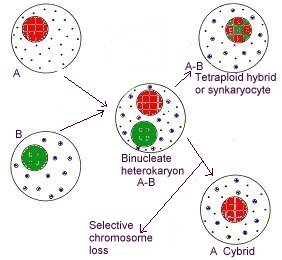 Possible fusion products
|
