-
At a given moment, the integrity of the histogenic layers of the young,
developing leaf meristems was disturbed. This had the largest effect on
the youngest developing leaf meristem, because it only consisted of a
limited number of cells. Probably the cells of the L1-layer divided in
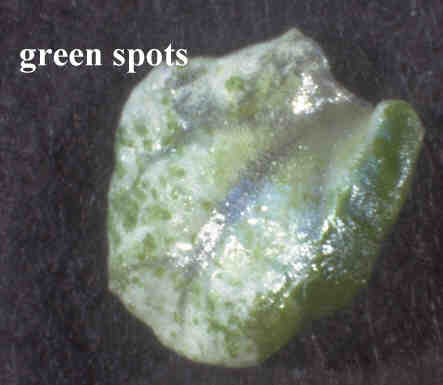
an unusual way and entered the L2-layer. These intruder cells, which
are genetically green, divided further as true L2-cells. Non-epidermal
leaf cells that trace back to these cells, contain green chloroplasts, and
are the origin of the green spots and deformations. In more developed
leaf meristems, the intruder cells only had few descendants, which
explains the more discrete spots on the oldest of the three symptom
bearing leaves.
|
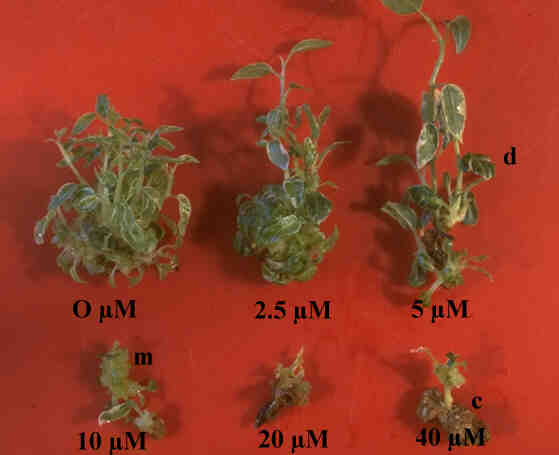
Effect of different concentrations of prochloraz on a micropropagated Ficus benjamina GWW chimera after 8 weeks (d: deformed leaf; m: multi-apexed meristem; c: callus). |
Effect of different concentrations of prochloraz on a micropropagated Ficus benjamina GWW chimera after 8 weeks. |