
|
Initiation of suspension cultures |
Many of the factors which effect callus culture are applicable to the establishment of suspension cultures. Dicot species tend to be easier to establish in suspension than monocot species.
 |
 |
|
Callus induction |
Suspension initiation |
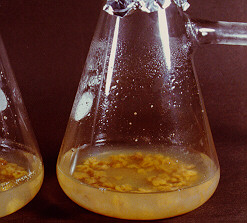
Most methods for the establishment of suspension cultures require that callus first be derived in vitro. There are three main catagories of induction:
| Use of friable callus (most common) Transfer friable callus to liquid medium followed by agitation. The friability of the callus is important as it break apart easily in the liquid medium giving rise to cell aggregates. With repeated subculture and filtering, the suspension can be reduced to very small cell aggregates interspersed with single cells. To get suitable friable callus, alter the ratio of auxin:cytokinin in the medium by raising the concentration of auxin. |
| Use of unfriable callus Tranfer callus to liquid culture. The cultures are shaken and subcultured regularly until the callus reaches the desired degree of friability. |
| Use of enzymes Callus is added to liquid medium containing low concentrations of wall degrading enzymes (cellulase and pectinase) until a suspension is obtained. |
When establishing the suspension, it is necessary to subculture repeatedly in conjunction with filtering to reduce the size of the aggregates.